
What this calculator does
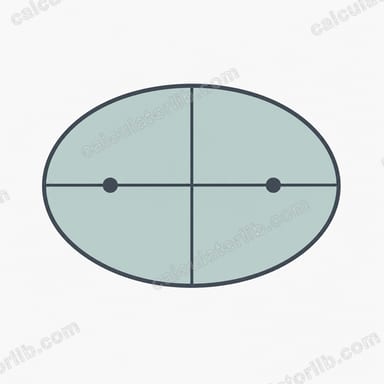
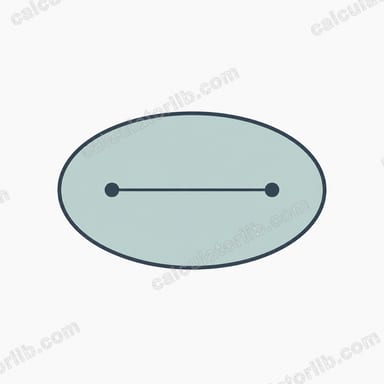
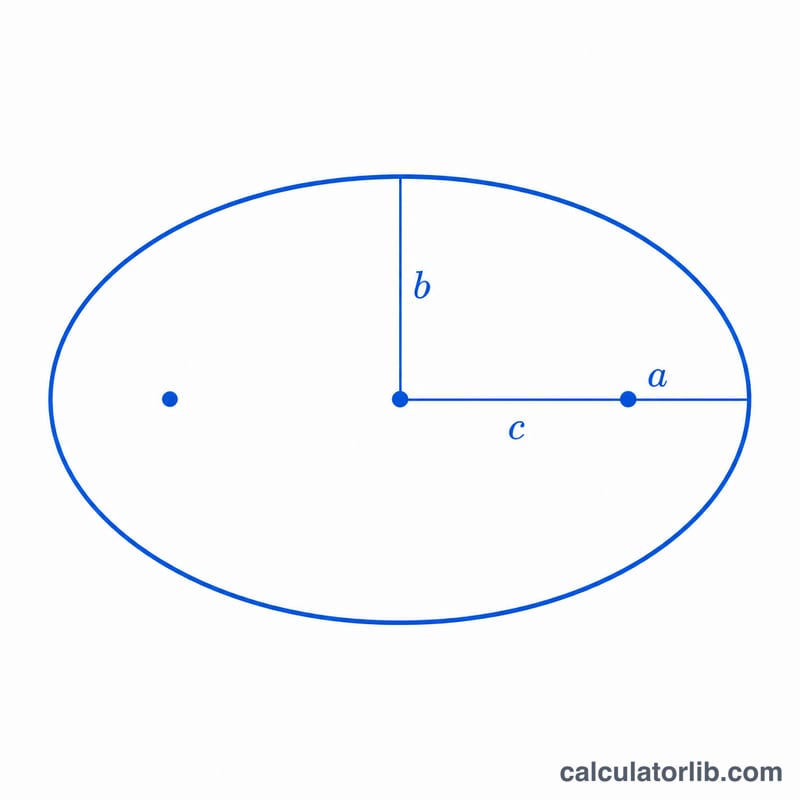
This tool analyzes an ellipse from its two semi-axes, a and b. It returns the linear eccentricity c (the distance from the center to each focus), the eccentricity e, the semi-major and semi-minor axes, the enclosed area, and an accurate approximation of the perimeter. It works whether the longer axis is horizontal or vertical, because it automatically treats the larger value as the semi-major axis.
How to use it
Enter the two semi-axis lengths in any consistent units (the result uses those same units). The semi-axis is half the full width or height of the ellipse. Press calculate to see the focal distance and eccentricity instantly.
The formula explained
The foci of an ellipse sit on the major axis at distance c from the center, where
$$c = \sqrt{\left|\,\text{a}^{2} - \text{b}^{2}\,\right|}$$The eccentricity
$$e = \frac{c}{\text{a}_3}$$(a₃ being the semi-major axis) measures how stretched the ellipse is: \(e = 0\) is a perfect circle, and \(e\) approaches 1 as the ellipse grows long and thin. The area is \(\pi a b\), and the perimeter uses Ramanujan second approximation, which is extremely accurate for all aspect ratios.
Worked example
For \(a = 5\) and \(b = 3\):
$$c = \sqrt{\left|\,25 - 9\,\right|} = \sqrt{16} = 4$$Eccentricity
$$e = \frac{4}{5} = 0.8$$Area
$$A = \pi \times 5 \times 3 \approx 47.124$$The two foci lie 4 units on either side of the center along the major axis.
FAQ
What if a equals b? The ellipse is a circle: \(c = 0\) and \(e = 0\), so there is a single focus at the center.
Does axis order matter? No. The calculator finds the larger axis itself, so you can enter a and b in any order.
Why is the perimeter approximate? An ellipse perimeter has no simple closed form (it requires an elliptic integral). Ramanujan formula matches the true value to within a tiny fraction of a percent.