
What is the Compound Inequality Solver?
A compound inequality joins two inequalities into a single statement, most commonly written as \(a < bx + c < d\). This calculator solves that "AND" (intersection) form for the variable x and returns the resulting interval. It is a universal algebra tool — the same rules apply everywhere, no jurisdiction or units required.
How to use it
Enter the four numbers from your inequality: the lower bound a, the coefficient b in front of x, the constant c, and the upper bound d. Press calculate and the tool returns the solution set for x in both inequality and interval notation. If no value of x works, it reports "No solution"; if every value works, it reports "All real numbers."
The formula explained
To isolate x you perform the same operation on all three parts of the compound inequality. First subtract c: \(a - c < bx < d - c\). Then divide every part by b. The crucial rule: if b is negative, both inequality signs flip, which swaps the lower and upper bounds. The calculator handles this automatically and orders the bounds so the smaller value is always on the left.
$$\text{a} < \text{b}\,x + \text{c} < \text{d} \;\Longrightarrow\; \frac{\text{a} - \text{c}}{\text{b}} < x < \frac{\text{d} - \text{c}}{\text{b}}$$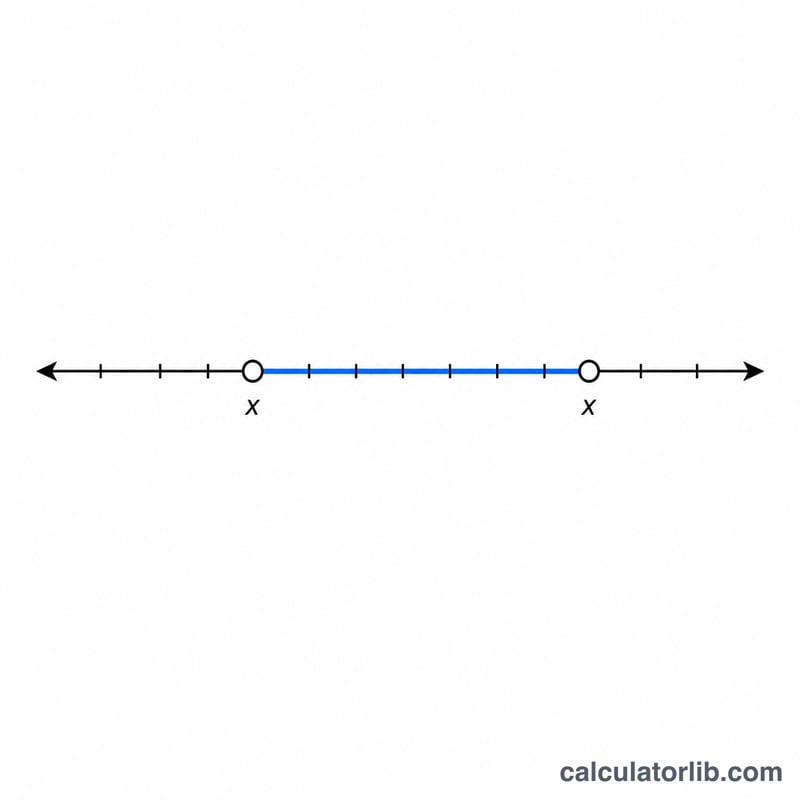
Worked example
Solve \(-3 < 2x + 1 < 7\). Subtract 1 from all parts: \(-4 < 2x < 6\). Divide by 2: \(-2 < x < 3\). The solution interval is \((-2, 3)\).
$$-3 < 2x + 1 < 7 \;\Longrightarrow\; -2 < x < 3$$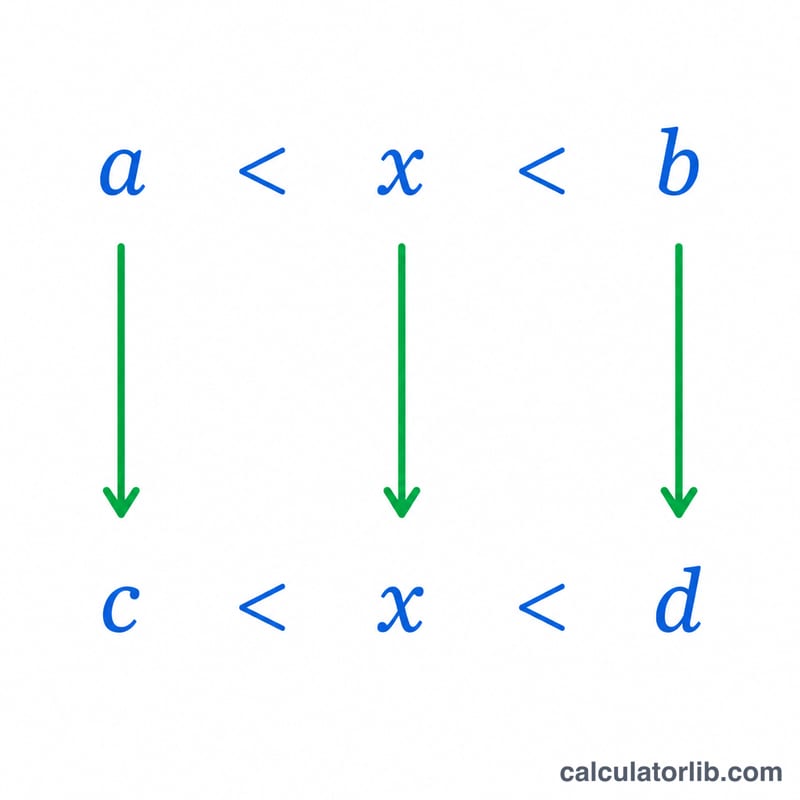
FAQ
What if I divide by a negative b? The inequality directions reverse. For example, \(-3 < -2x + 1 < 7\) becomes \(-2 < x < 2\) after flipping and reordering.
What does "No solution" mean? It means the lower and upper bounds cross, so no x can satisfy both parts at once.
Can it handle b = 0? Yes. With no x term, the statement is either always true (all real numbers) or always false (no solution), depending on whether \(a < c < d\).