
What is a radical equation?
A radical equation contains a variable inside a square root. This solver handles equations of the form \(\sqrt{ax + b} = c\), where a, b, and c are real numbers. It isolates the radical, squares both sides, and solves the resulting linear equation for x, while checking whether a real solution actually exists.
How to use it
Enter the coefficient a (multiplying x inside the root), the constant b (added inside the root), and c (the value on the right of the equals sign). Press calculate to get x along with a step-by-step breakdown. If c is negative or a is zero, the tool reports that no real solution exists.
The formula explained
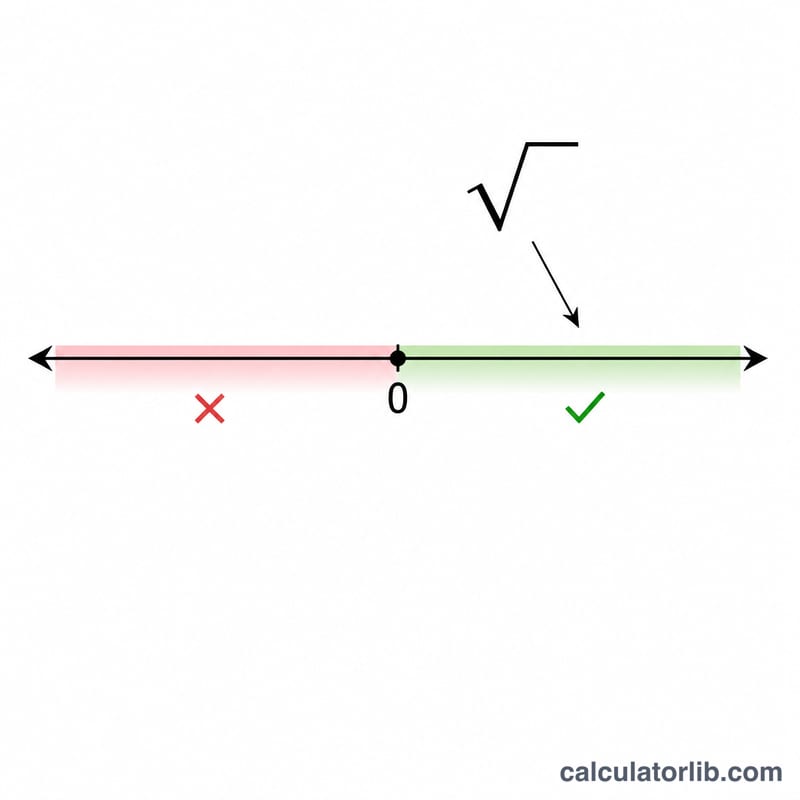
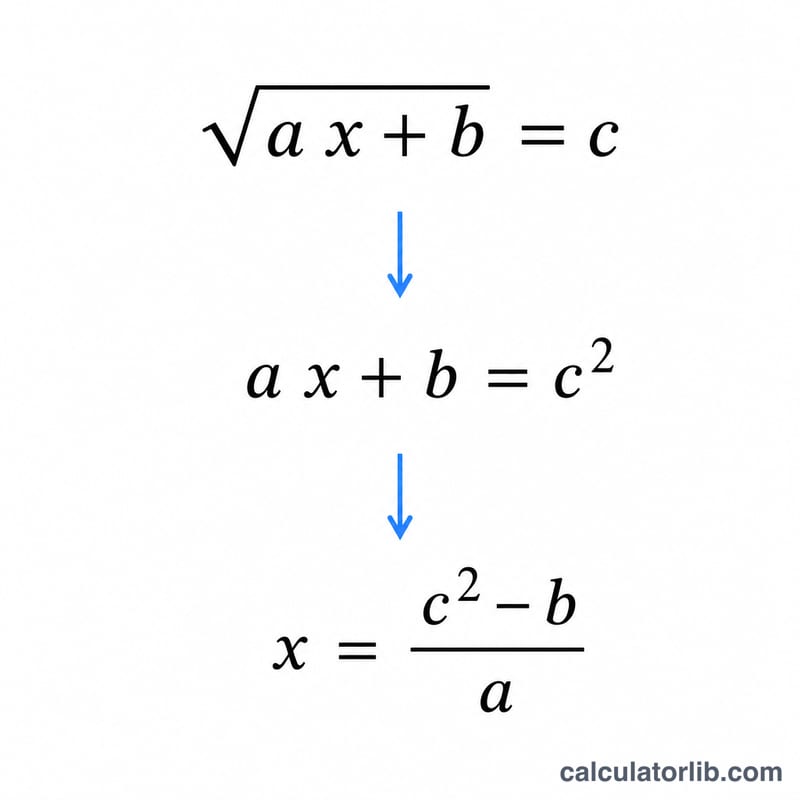
Starting from \(\sqrt{ax + b} = c\), square both sides to remove the radical: \(ax + b = c^{2}\). Subtract b and divide by a to get $$x = \frac{c^{2} - b}{a}$$ Because the square root function only returns non-negative values, the original equation can only be true when \(c \geq 0\). If c is negative there is no real x that satisfies it. The coefficient a must also be non-zero, otherwise x disappears from the equation.
Worked example
Solve \(\sqrt{2x + 1} = 3\). Here \(a = 2\), \(b = 1\), \(c = 3\). Square both sides: \(2x + 1 = 9\). Then \(2x = 8\), so \(x = 4\). Check: \(\sqrt{2 \cdot 4 + 1} = \sqrt{9} = 3\). ✓
FAQ
Why does a negative c give no solution? The principal square root is always \(\geq 0\), so it can never equal a negative number.
What if a = 0? Then the equation has no x term to solve, so the tool returns no solution.
Should I always check my answer? Yes. Squaring can introduce extraneous roots, so substitute x back into the original equation to confirm.