
What this calculator does
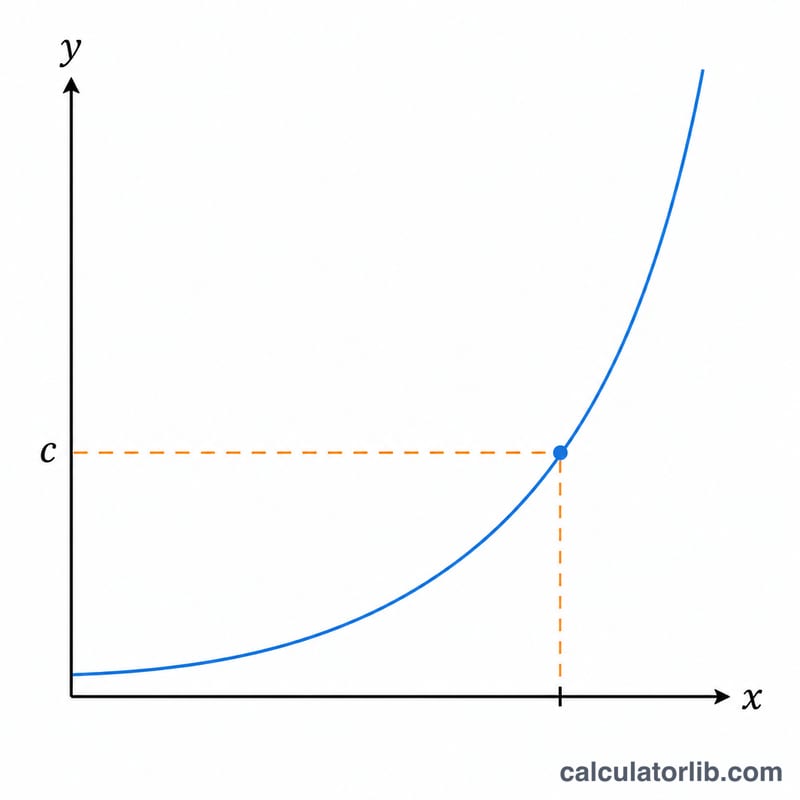
This tool solves exponential equations written in the form \(a \cdot b^{x} = c\) for the unknown exponent x. Exponential equations appear everywhere — compound interest, population growth, radioactive decay, and chemistry — wherever a quantity is repeatedly multiplied by a fixed factor. Instead of guessing, the solver uses logarithms to find x exactly.
How to use it
Enter three numbers: the coefficient a (the value when x = 0), the base b (the growth or decay factor), and the result c (the target value). Click calculate and the tool returns the exponent x, the ratio c/a, and a verification of \(a \cdot b^{x}\) so you can confirm the answer.
The formula explained
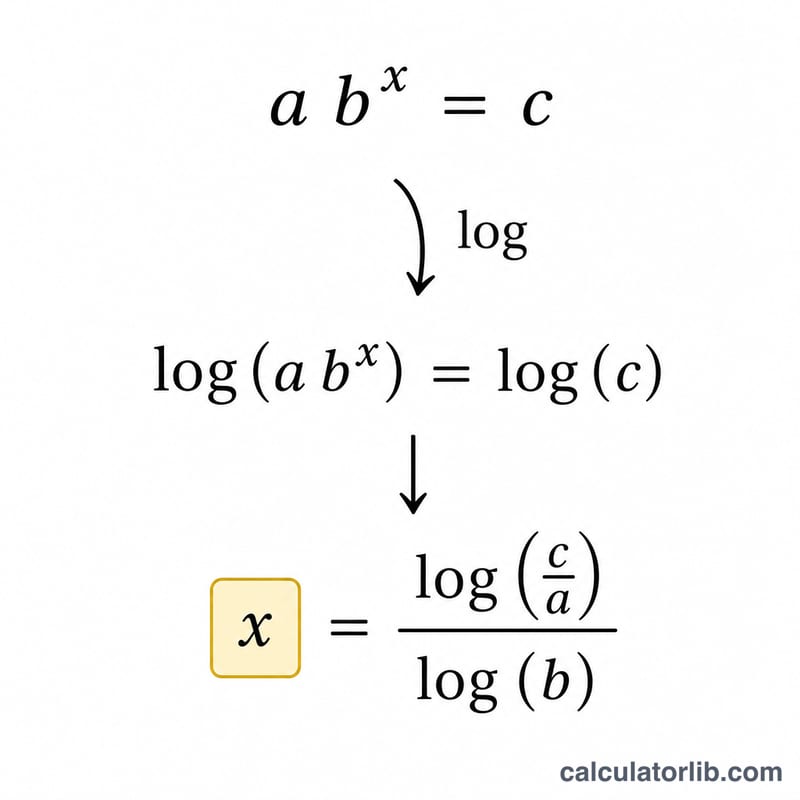
Starting from \(a \cdot b^{x} = c\), divide both sides by a to get \(b^{x} = c/a\). Taking the logarithm of both sides and using the power rule gives \(x \cdot \log(b) = \log(c/a)\). Dividing by log(b) isolates the exponent:
$$x = \frac{\ln\!\left(\dfrac{\text{Result }c}{\text{Coefficient }a}\right)}{\ln\!\left(\text{Base }b\right)}$$Any logarithm base works because the bases cancel in the ratio. A real solution requires \(a \neq 0\), \(c/a > 0\), and base \(b > 0\) with \(b \neq 1\).
Worked example
Solve \(2 \cdot 3^{x} = 54\). First \(c/a = 54/2 = 27\). Then $$x = \frac{\log(27)}{\log(3)} = 3,$$ because \(3^{3} = 27\). Check: \(2 \cdot 3^{3} = 2 \cdot 27 = 54\). ✓
FAQ
Why must c/a be positive? A positive base raised to any real power is always positive, so \(b^{x} = c/a\) can only be solved when \(c/a > 0\).
Can the base be e? Yes — enter \(b = 2.71828\) to solve natural-exponential equations of the form \(a \cdot e^{x} = c\).
What if there is no real answer? If a is zero, the base is invalid, or c/a is not positive, the calculator reports that no real solution exists.