
What this calculator does
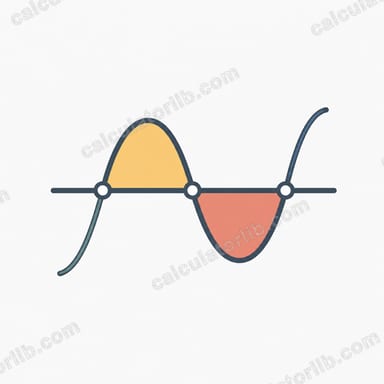
This tool solves the basic trigonometric equations \(\sin\theta = k\), \(\cos\theta = k\), and \(\tan\theta = k\). Because trig functions are periodic, each equation has infinitely many solutions. The calculator returns the principal value (the answer your calculator's inverse function gives) and a specific solution from the general-solution family for an integer n you choose.
How to use it
Pick the function (sin, cos, or tan), enter the right-hand-side value \(k\), and enter an integer \(n\). For sine and cosine, \(k\) must lie between \(-1\) and \(1\); otherwise there is no real solution. Set \(n = 0\) to see the principal value as the solution, then increase or decrease \(n\) to step through the full set of answers.
The formulas explained
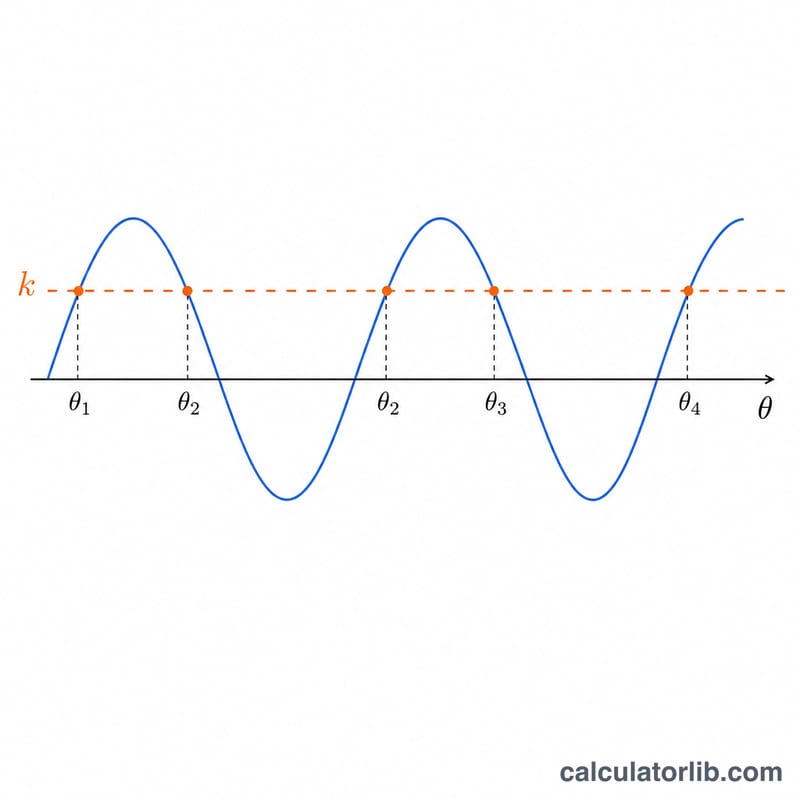
For \(\sin\theta = k\), the general solution is $$\theta = \text{n}\,\pi + (-1)^{\text{n}}\,\arcsin\!\left(\text{k}\right)$$ The \((-1)^{\text{n}}\) factor flips the principal value on odd multiples of \(\pi\), capturing both branches in one expression.
For \(\cos\theta = k\), the general solution is $$\theta = 2\,\text{n}\,\pi \pm \arccos\!\left(\text{k}\right)$$ this calculator uses the \(+\) branch (the \(-\) branch gives the reflected angle). For \(\tan\theta = k\), which has period \(\pi\), the solution is $$\theta = \text{n}\,\pi + \arctan\!\left(\text{k}\right)$$
Worked example
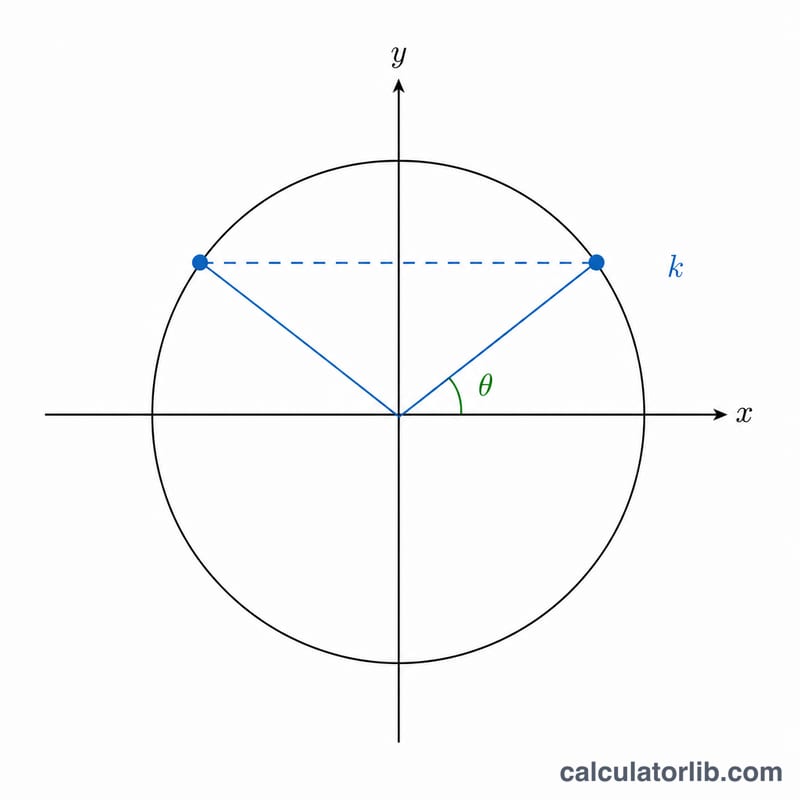
Solve \(\sin\theta = 0.5\). The principal value is $$\arcsin(0.5) = 30^\circ = \frac{\pi}{6}$$ With \(n = 0\) the solution is \(30^\circ\). With \(n = 1\) it becomes $$1\cdot 180^\circ - 30^\circ = 150^\circ,$$ the second angle in \([0^\circ, 360^\circ)\) where sine equals \(0.5\). Both are correct solutions of the same equation.
FAQ
Why does my answer change with n? Trig equations have infinitely many solutions; \(n\) selects which one in the repeating family you see.
Why "no real solution"? Sine and cosine only output values between \(-1\) and \(1\), so \(\sin\theta = 2\) has no real angle solution. Tangent, however, accepts any real \(k\).
Degrees or radians? The result shows both: degrees in the hero box and radians just below.