
What is the Mifflin-St Jeor BMR Calculator?
Your Basal Metabolic Rate (BMR) is the number of calories your body needs at complete rest to keep essential functions running — breathing, circulation, cell production and temperature regulation. This calculator uses the Mifflin-St Jeor equation, published in 1990 and widely regarded as the most accurate predictive formula for healthy adults, recommended by the Academy of Nutrition and Dietetics.
How to use it
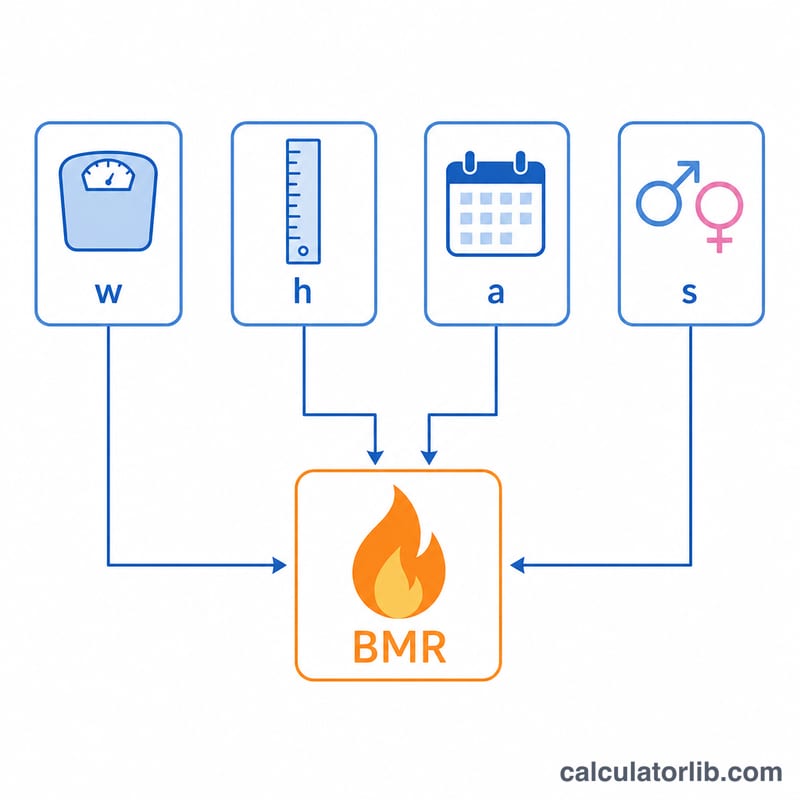
Select your gender, then enter your weight in kilograms, height in centimetres and age in years. The calculator returns your BMR plus a Total Daily Energy Expenditure (TDEE) table that multiplies your BMR by common activity factors, so you can estimate how many calories you actually burn on a typical day.
The formula explained
The equation starts from a common base of \(10 \times \text{weight} + 6.25 \times \text{height} - 5 \times \text{age}\). For men, +5 is added; for women, 161 is subtracted. The result is your resting calorie need.
$$\text{BMR} = 10 \times \text{Weight (kg)} + 6.25 \times \text{Height (cm)} - 5 \times \text{Age} + 5$$To get TDEE, multiply BMR by an activity multiplier: 1.2 sedentary, 1.375 lightly active, 1.55 moderately active, 1.725 very active and 1.9 extra active.
Worked example
A 30-year-old man weighing 70 kg and 175 cm tall:
$$\text{BMR} = 10 \times 70 + 6.25 \times 175 - 5 \times 30 + 5 = 700 + 1093.75 - 150 + 5 = \textbf{1648.75 kcal/day}$$If moderately active, \(\text{TDEE} \approx 1648.75 \times 1.55 \approx 2556\) kcal/day.
Interpreting Your BMR and TDEE
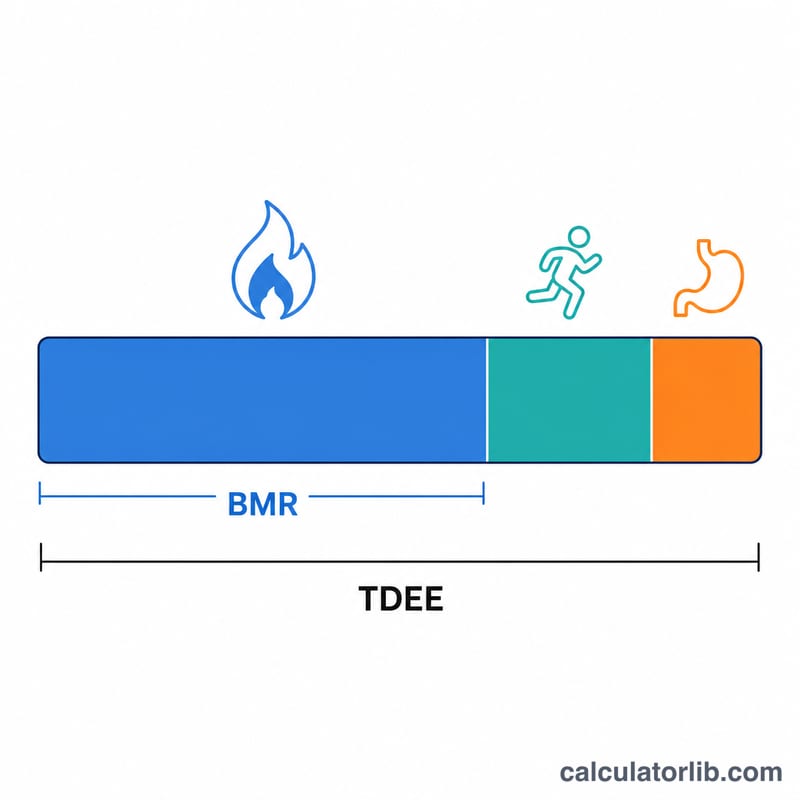
BMR (Basal Metabolic Rate) is the number of calories your body needs at complete rest to keep essential functions running — breathing, circulation, cell repair and brain activity. It is measured in a fasted, awake, resting state and typically accounts for 60–70% of the calories you burn each day.
TDEE (Total Daily Energy Expenditure) builds on BMR by adding the energy used for physical activity, the thermic effect of food, and spontaneous movement. TDEE is the figure most people use to plan eating for weight maintenance, loss or gain, because it reflects real daily burn rather than rest alone.
The Mifflin-St Jeor equation is a population estimate. Validation studies generally find it accurate to within roughly ±10% for most healthy adults, but your true metabolic rate can sit outside that band. Because the formula only uses weight, height, age and sex, it cannot account for differences in body composition: muscle tissue is more metabolically active than fat, so a lean, muscular person of a given weight usually has a higher BMR than the equation predicts, while someone with a higher body-fat percentage may have a lower one. Thyroid disorders, medications, illness, pregnancy and large recent weight changes can also shift actual energy needs.
For these reasons, treat your calculated BMR and TDEE as a starting estimate, not a personalized prescription. The Academy of Nutrition and Dietetics recommends that calorie targets be individualized and, where possible, verified against real-world results — adjusting intake based on how your weight actually trends over 2–4 weeks rather than trusting a single computed number. Use the estimate to set an initial intake, then refine it from observed changes.
This is general educational information, not medical or nutritional advice. For personalized energy needs — especially with a health condition, during pregnancy, or for athletic performance — consult a registered dietitian or physician.
FAQ
BMR vs TDEE — what's the difference? BMR is calories burned at rest; TDEE includes activity and is what you'd eat to maintain weight.
How accurate is it? Mifflin-St Jeor is accurate to within about 10% for most healthy adults but does not account for body composition. Very muscular people may burn more.
Should I eat my BMR to lose weight? No. Eating below BMR long-term is generally not advised; create a modest deficit from your TDEE instead and consult a professional.