
What is the Mifflin-St Jeor BMR Calculator?
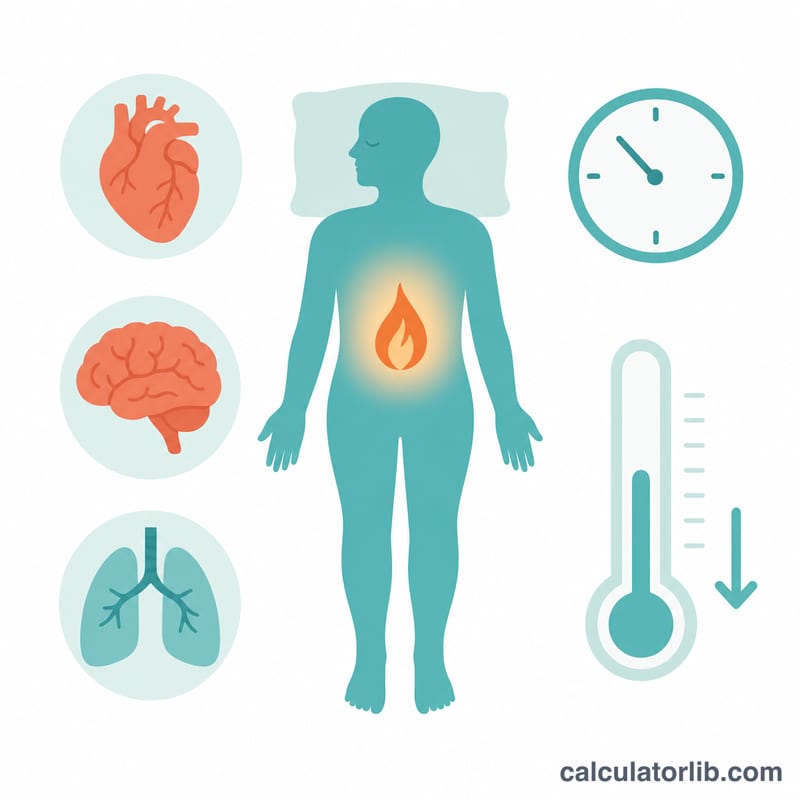
Your Basal Metabolic Rate (BMR) is the number of calories your body burns at complete rest just to keep essential functions running — breathing, circulation, cell production and temperature regulation. This calculator uses the Mifflin-St Jeor equation, published in 1990 and widely regarded as one of the most accurate predictive formulas for healthy adults. It is the equation recommended by many dietitians over the older Harris-Benedict formula.
How to use it
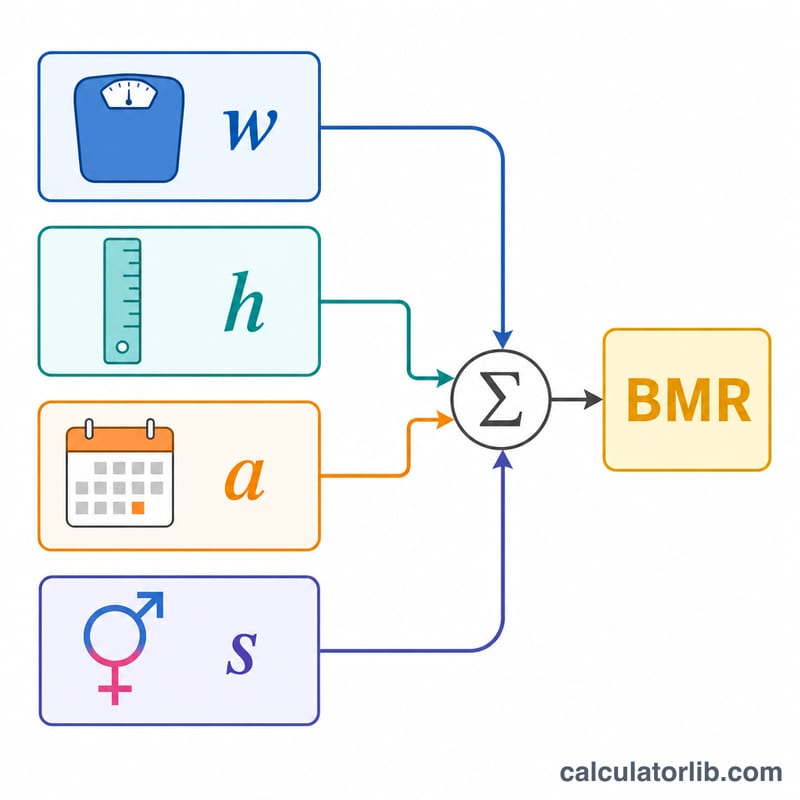
Enter your weight in kilograms, your height in centimetres, your age in years, and select your gender. The calculator instantly returns your estimated BMR in calories per day. This figure represents what you would burn if you did nothing but rest for 24 hours — your total daily energy expenditure will be higher once activity is included.
The formula explained
The Mifflin-St Jeor equation is:
Men: $$\text{BMR} = (10 \times \text{weight kg}) + (6.25 \times \text{height cm}) - (5 \times \text{age}) + 5$$Women: $$\text{BMR} = (10 \times \text{weight kg}) + (6.25 \times \text{height cm}) - (5 \times \text{age}) - 161$$
The only difference between the two is the constant at the end (+5 for men, −161 for women), which accounts for differences in average body composition.
Worked example
Consider a 30-year-old man weighing 70 kg and standing 175 cm tall: $$\text{BMR} = (10 \times 70) + (6.25 \times 175) - (5 \times 30) + 5 = 700 + 1093.75 - 150 + 5 = \mathbf{1648.75 \text{ calories/day}}$$
Activity Multipliers for Total Daily Energy Expenditure
Your BMR represents the calories burned at complete rest. To estimate your Total Daily Energy Expenditure (TDEE) — the calories you actually burn in a day — multiply your BMR by a Physical Activity Level (PAL) factor that reflects your typical weekly exercise:
| Activity level | Multiplier | Typical weekly exercise |
|---|---|---|
| Sedentary | 1.2 | Little or no exercise; desk job |
| Lightly active | 1.375 | Light exercise or sport 1–3 days/week |
| Moderately active | 1.55 | Moderate exercise or sport 3–5 days/week |
| Very active | 1.725 | Hard exercise or sport 6–7 days/week |
| Extra active | 1.9 | Very hard daily exercise, physical job, or training twice a day |
For example, a BMR of 1,600 kcal/day for a moderately active person gives a TDEE of \(1600 \times 1.55 = 2480\) kcal/day. You can apply a chosen activity factor to an existing BMR with a 2,480 kcal/day result.
Interpreting Your BMR Result
Your Basal Metabolic Rate is the number of calories your body needs to keep its essential functions running while completely at rest — maintaining body temperature, breathing, circulation, brain activity and basic cell function. It does not include any energy used for movement, exercise, or digesting food.
The Mifflin-St Jeor figure is a statistical estimate derived from healthy adults. Two people with identical weight, height, age and sex can have genuinely different metabolic rates, so treat the number as a starting point rather than a precise measurement.
Several factors influence your true BMR:
- Muscle mass & body composition: lean tissue is more metabolically active than fat, so a more muscular body tends to have a higher BMR at the same weight.
- Age: BMR generally declines with age (the equation subtracts \(5\) kcal per year), partly due to gradual loss of lean mass.
- Sex: on average men have more lean mass, reflected by the \(+5\) constant for males versus \(-161\) for females.
- Body size: greater weight and height increase the energy needed to sustain the body.
To estimate the calories you burn in a full day, combine your BMR with an activity factor to obtain your TDEE, then adjust intake for goals such as a deficit or surplus. This is general information for healthy adults and is not medical or nutritional advice; consult a qualified professional for individual guidance.
FAQ
Is BMR the same as the calories I should eat? No. BMR is resting energy only. To estimate maintenance calories, multiply BMR by an activity factor (1.2 sedentary to 1.9 very active).
Which is better, Mifflin-St Jeor or Harris-Benedict? Mifflin-St Jeor is generally more accurate for modern populations and is preferred by most nutrition professionals.
Do I need to be exact with measurements? Use accurate, current values for the best estimate. Small errors in weight or height shift the result only slightly.