
What Is the Katch-McArdle BMR Calculator?
This tool estimates your Basal Metabolic Rate (BMR) — the number of calories your body burns at complete rest — using the Katch-McArdle equation. Unlike formulas that rely only on weight, height, and age, Katch-McArdle is based on your lean body mass. Because muscle is far more metabolically active than fat, this approach can be more accurate for lean, muscular, or athletic individuals.
How to Use It
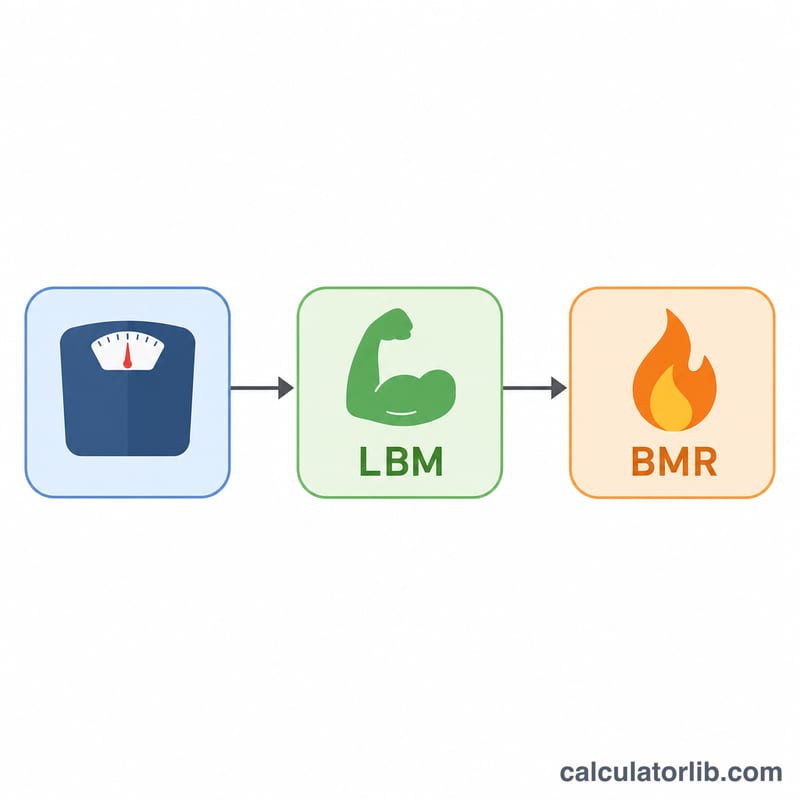
Enter your total body weight in kilograms and your body fat percentage. The calculator first determines your lean body mass (everything that is not fat), then applies the Katch-McArdle formula. To estimate your daily calorie needs, multiply the resulting BMR by an activity factor (typically 1.2 for sedentary up to about 1.9 for very active).
The Formula Explained
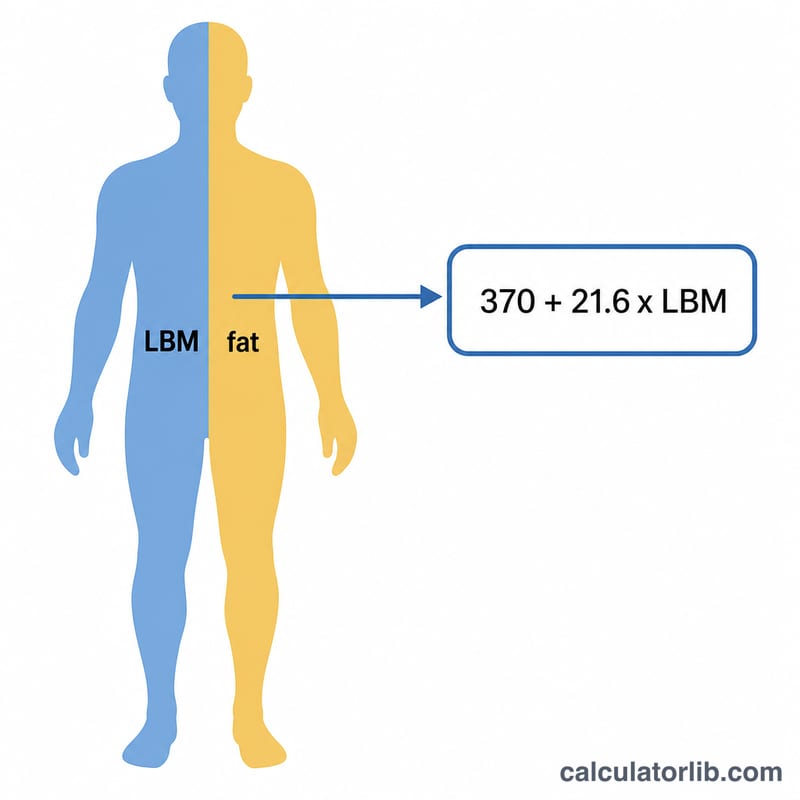
The equation is $$\text{BMR} = 370 + (21.6 \times \text{Lean Body Mass in kg})$$ Lean body mass is calculated as \(\text{weight} \times \left(1 - \frac{\text{body fat\%}}{100}\right)\). The constant 370 represents baseline metabolic activity, while 21.6 calories are added for each kilogram of lean tissue.
Worked Example
Suppose you weigh 75 kg with 20% body fat. Your fat mass is 15 kg, so lean body mass is 60 kg. Then $$\text{BMR} = 370 + (21.6 \times 60) = 370 + 1{,}296 = \mathbf{1{,}666 \text{ calories per day}}$$
FAQ
How is this different from Harris-Benedict? Harris-Benedict and Mifflin-St Jeor use weight, height, and age. Katch-McArdle ignores those and uses only lean mass, making it ideal when you know your body fat percentage.
Where do I get my body fat percentage? Methods include skinfold calipers, bioelectrical impedance scales, or DEXA scans. The more accurate your body fat figure, the more reliable the BMR estimate.
Is BMR the same as daily calorie needs? No. BMR is calories burned at rest. Multiply by an activity factor to get your Total Daily Energy Expenditure (TDEE).