
What Is the Katch-McArdle BMR Formula?
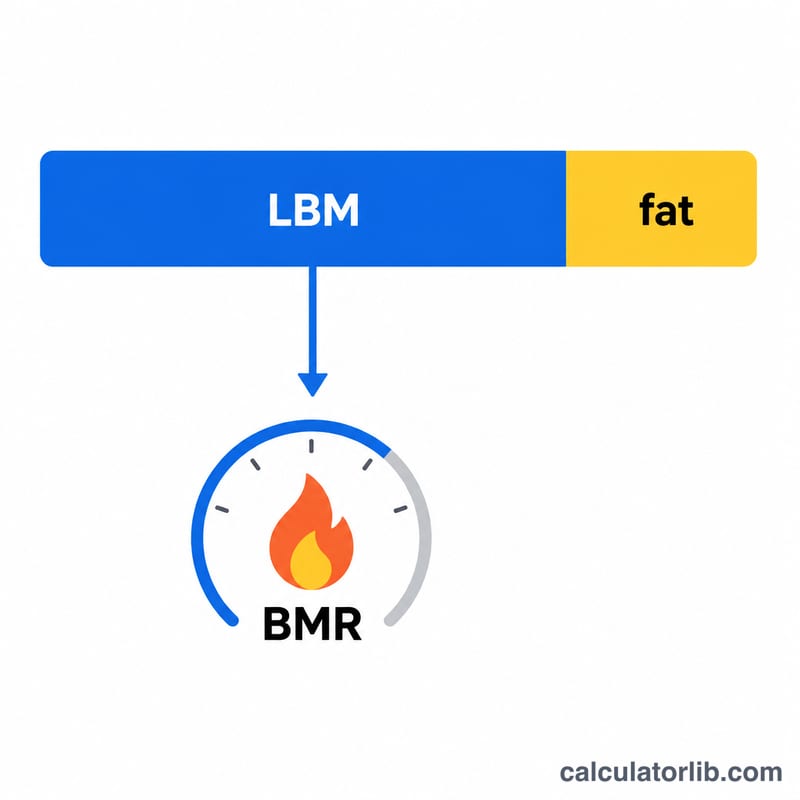
The Katch-McArdle equation estimates your basal metabolic rate (BMR) — the number of calories your body burns at complete rest to keep vital functions running. Unlike the Harris-Benedict or Mifflin-St Jeor formulas that rely on height, weight, age and gender, Katch-McArdle is built entirely on your lean body mass. Because muscle is far more metabolically active than fat, this approach is often considered more accurate for lean, athletic, or very muscular people whose body composition differs from population averages.
How to Use This Calculator
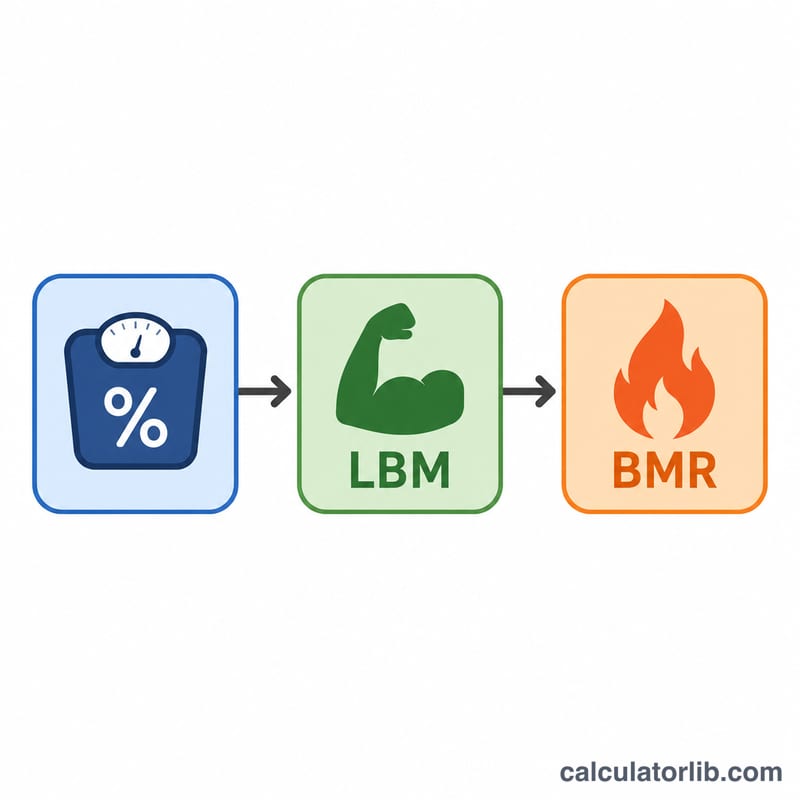
Enter your total body weight in kilograms and your body fat percentage. The calculator first computes your lean body mass, then applies the Katch-McArdle equation. If you don't know your body fat percentage, you can estimate it with calipers, a bioelectrical impedance scale, or a DEXA scan for the most accurate reading.
The Formula Explained
The equation is $$\text{BMR} = 370 + 21.6 \times \text{LBM}$$ where LBM is lean body mass in kilograms. Lean body mass is found by removing the fat fraction from total weight: $$\text{LBM} = \text{weight} \times \left(1 - \frac{\text{bodyfat\%}}{100}\right)$$ The constant 370 represents baseline metabolism, while 21.6 calories per kilogram of lean tissue accounts for the energy cost of maintaining muscle and organs.
Worked Example
Suppose you weigh 80 kg with 20% body fat. Your lean body mass is \(80 \times (1 - 0.20) = 64\) kg. Plugging in: $$\text{BMR} = 370 + 21.6 \times 64 = 370 + 1382.4 = 1752.4 \text{ calories per day}$$ To estimate your full daily needs, multiply this BMR by an activity factor (typically 1.2 for sedentary up to 1.9 for very active).
Typical Body Fat Percentage Ranges
Because the Katch-McArdle formula relies on lean body mass, your body fat percentage directly affects the result. The ranges below follow the commonly cited ACE (American Council on Exercise) classifications and are split by sex, since women carry more essential fat.
| Category | Women | Men |
|---|---|---|
| Essential fat | 10–13% | 2–5% |
| Athletes | 14–20% | 6–13% |
| Fitness | 21–24% | 14–17% |
| Average / acceptable | 25–31% | 18–24% |
| Obese | 32% and higher | 25% and higher |
If you do not know your body fat percentage, you can estimate it from height, weight, age and sex using the Deurenberg BMI-method body fat calculator before entering it here.
BMR Across Different Body Compositions
Two people can weigh exactly the same yet have very different basal metabolic rates, because more lean mass means a higher BMR. The Katch-McArdle formula captures this: \(\text{BMR} = 370 + 21.6 \times \text{LBM}\), where lean body mass (kg) is \(\text{weight} \times (1 - \text{bodyfat}/100)\).
| Person | Weight (kg) | Body fat % | Lean mass (kg) | BMR (kcal/day) |
|---|---|---|---|---|
| A — lean | 80 | 12% | 70.4 | 1891 |
| B — average | 80 | 25% | 60.0 | 1666 |
| C — higher fat | 95 | 32% | 64.6 | 1765 |
Notice that Person A and Person B weigh the same, but A's leaner body gives a BMR roughly 225 kcal higher. Person C weighs 15 kg more than B yet has a similar BMR, because much of that extra weight is fat rather than metabolically active lean tissue. You can break any of these figures into fat and fat-free mass with the body fat mass & fat-free mass calculator.
Interpreting Your BMR Result
Your BMR is the number of calories your body would burn in a 24-hour period at complete rest — just to keep your heart beating, lungs breathing, and cells functioning. It does not include the energy cost of walking, working, exercising or digesting food.
To turn BMR into something useful for diet planning, scale it up to your TDEE using an activity multiplier (see the table above). From there:
- Maintain weight: eat roughly at your TDEE.
- Lose fat: eat below TDEE, commonly a deficit of about 15–25% (often 300–500 kcal).
- Gain muscle: eat a modest surplus above TDEE.
You can map your TDEE onto cutting and bulking targets with the bulking & cutting calorie calculator.
This is an estimate. The Katch-McArdle equation is generally more accurate than weight-only formulas for lean, athletic individuals because it accounts for body composition — but it is only as good as the body fat percentage you supply. Real-world BMR varies with genetics, hormones (especially thyroid function), age, recent dieting history, sleep, body temperature, and medications. Treat the figure as a starting point: track your weight and intake over 2–3 weeks and adjust calories based on actual results rather than relying on the number alone. This is general information, not medical or nutritional advice; consult a qualified professional for personalized guidance.
FAQ
Is Katch-McArdle better than Mifflin-St Jeor? It can be more accurate if you know your body fat percentage and have an athletic build, since it accounts for lean mass directly. For the general population without body fat data, Mifflin-St Jeor is often used.
Does BMR equal my daily calorie needs? No. BMR is resting energy expenditure. Multiply it by an activity multiplier to estimate Total Daily Energy Expenditure (TDEE).
What if I don't know my body fat? Entering 0% would treat your whole weight as lean and overestimate BMR. Use a measured or estimated body fat value for a realistic result.