
What Is the Katch-McArdle BMR Calculator?
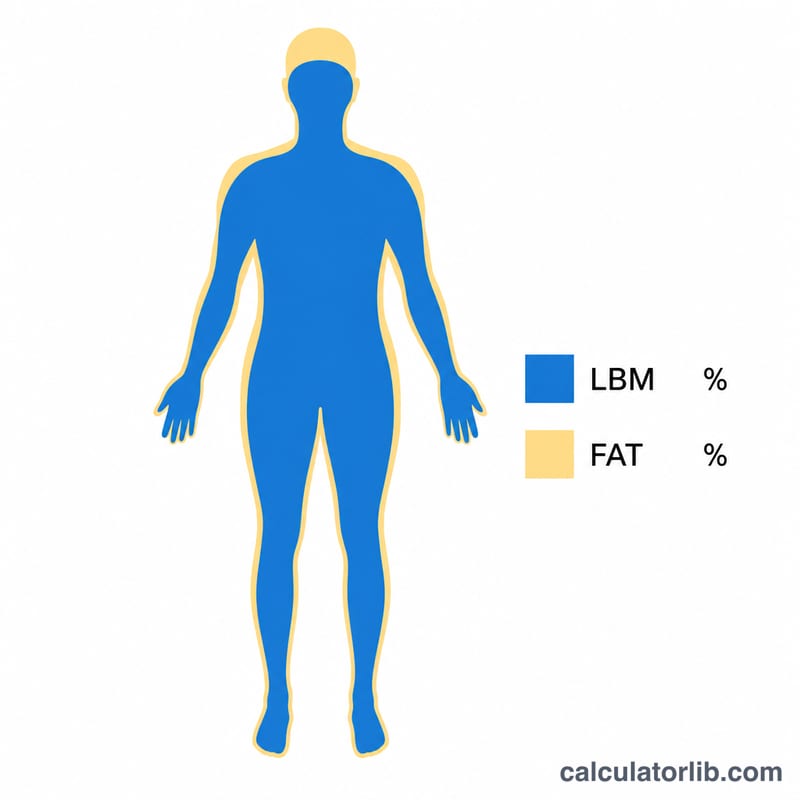
Basal Metabolic Rate (BMR) is the number of calories your body burns at complete rest just to keep vital functions running — breathing, circulation, cell production and temperature regulation. The Katch-McArdle formula estimates BMR from your lean body mass rather than total weight, which makes it especially accurate for athletes and lean or muscular individuals who carry more muscle than a height/weight formula would assume.
How to Use It
Enter your body weight in kilograms and your body fat percentage. The calculator first computes your lean body mass (everything except fat), then applies the Katch-McArdle equation to estimate the calories you burn per day at rest. If you don't know your body fat percentage, a body fat caliper, smart scale, or DEXA scan can provide an estimate.
The Formula Explained
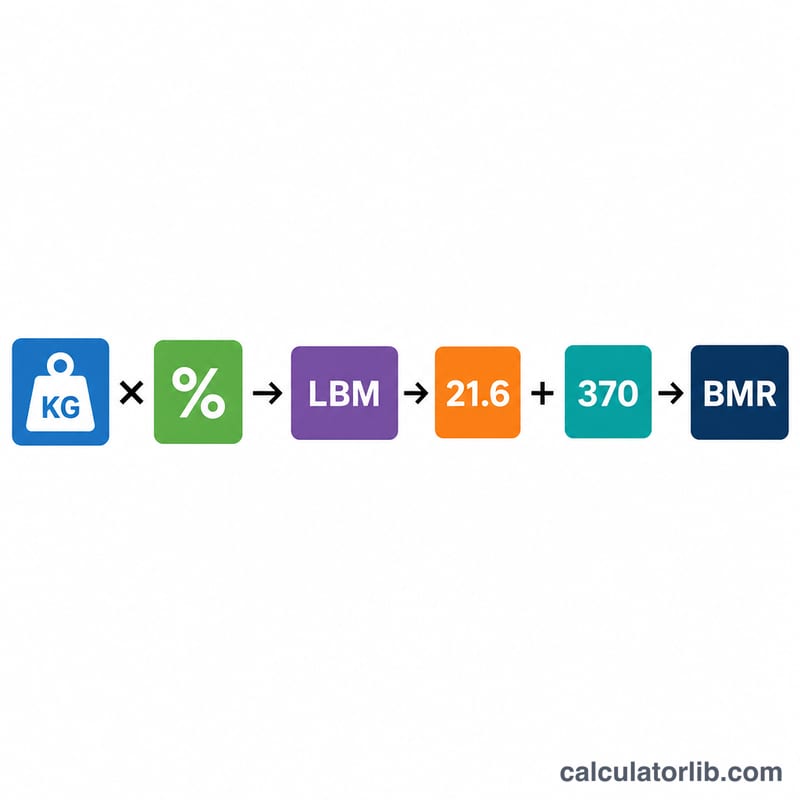
The calculation has two steps. First, lean body mass: \( \text{LBM} = \text{weight} \times \left(1 - \frac{\text{bodyfat\%}}{100}\right) \). Then BMR:
$$\text{BMR} = 370 + 21.6 \times \text{LBM}$$where LBM is in kilograms. Because the equation depends only on lean mass, two people of the same weight but different body composition will get different — and more individualized — results.
Worked Example
Suppose you weigh 75 kg with 20% body fat. Your lean body mass is
$$75 \times (1 - 0.20) = 60 \text{ kg}$$Your BMR is then
$$370 + 21.6 \times 60 = 370 + 1296 = \mathbf{1666} \text{ calories/day}$$To get total daily energy needs, multiply BMR by an activity factor (typically 1.2 for sedentary up to 1.9 for very active).
Activity Multipliers for Total Daily Energy Expenditure
Your Basal Metabolic Rate (BMR) is the foundation for estimating Total Daily Energy Expenditure (TDEE). To convert BMR into TDEE, multiply it by an activity factor that reflects how much you move during a typical day. These multipliers are the standard values used in most online calorie calculators.
| Activity Level | Multiplier | Typical Activity |
|---|---|---|
| Sedentary | 1.2 | Little or no exercise, desk job |
| Lightly active | 1.375 | Light exercise or sports 1–3 days per week |
| Moderately active | 1.55 | Moderate exercise or sports 3–5 days per week |
| Very active | 1.725 | Hard exercise or sports 6–7 days per week |
| Extra active | 1.9 | Very hard daily exercise or a physical job |
For example, a BMR of 1600 kcal/day for a moderately active person gives a TDEE of \(1600 \times 1.55 = 2480\) kcal/day. You can run this conversion with a 2480 kcal/day maintenance estimate.
BMR Across Different Body Compositions
The Katch-McArdle formula bases BMR on lean body mass (LBM) rather than total weight, so two people of the same weight can have different BMRs depending on body fat. The formula is \(\text{BMR} = 370 + 21.6 \times \text{LBM}\), where \(\text{LBM} = \text{Weight} \times (1 - \text{Body Fat}\% / 100)\).
| Weight (kg) | Body Fat % | Lean Body Mass (kg) | BMR (kcal/day) |
|---|---|---|---|
| 60 | 15 | 51.0 | 1472 |
| 70 | 15 | 59.5 | 1655 |
| 70 | 25 | 52.5 | 1504 |
| 80 | 20 | 64.0 | 1752 |
| 80 | 30 | 56.0 | 1580 |
| 90 | 25 | 67.5 | 1828 |
Notice the same-weight pairs: at 70 kg, dropping body fat from 25% to 15% raises BMR by about 150 kcal/day because more of the body is metabolically active lean tissue. If you want to see the underlying fat and lean mass split for any of these, a 52.5 kg fat-free mass corresponds to the 70 kg / 25% row.
Interpreting Your BMR Result
Your BMR is the number of calories your body burns at complete rest in a neutral-temperature environment, in the post-absorptive (fasted) state. It represents the energy needed just to keep essential functions running — breathing, circulating blood, maintaining body temperature, and basic cell activity — with no physical activity and no digestion.
BMR is the largest single component of your daily calorie needs, typically accounting for roughly 60–70% of total energy use. To estimate the calories needed to maintain your current weight (your maintenance calories or TDEE), multiply BMR by an activity factor from the table above. The remainder of daily expenditure comes from physical activity and the thermic effect of digesting food.
Keep in mind that any BMR figure is an estimate. The Katch-McArdle formula depends heavily on an accurate body fat percentage — and methods like calipers, bioelectrical impedance, or BMI-based estimates can each differ by several percentage points. A small error in body fat changes the calculated lean mass and therefore the BMR. Individual factors such as genetics, hormones, age, and metabolic adaptation also cause real variation that no formula captures perfectly. Treat the result as a well-reasoned starting point, then adjust based on how your weight responds over a few weeks.
Key Terms Explained
- Basal Metabolic Rate (BMR)
- The number of calories your body burns at complete rest to sustain vital functions such as breathing, circulation, and cell maintenance. It excludes any energy spent on movement or digestion.
- Lean Body Mass (LBM)
- Your total body weight minus fat mass — including muscle, bone, organs, and water. The Katch-McArdle formula uses LBM directly because lean tissue is metabolically active and drives most of your resting energy use.
- Body Fat Percentage
- The proportion of your total body weight that is fat tissue, expressed as a percent. It is the key input that lets the Katch-McArdle formula separate lean mass from fat mass.
- Total Daily Energy Expenditure (TDEE)
- The total calories you burn in a day, calculated by multiplying BMR by an activity factor. TDEE represents your maintenance calorie level — eating at it keeps weight stable, below it produces a deficit, and above it produces a surplus.
FAQ
How is Katch-McArdle different from Harris-Benedict? Harris-Benedict and Mifflin-St Jeor use weight, height, age and sex. Katch-McArdle uses only lean mass, so it can be more accurate when body fat is known and you are leaner or more muscular than average.
Do I need an accurate body fat percentage? Yes — the result is sensitive to it. A 5% error in body fat shifts your estimated BMR by roughly the same proportion of your fat mass, so use the best measurement you can.
Is BMR the same as calories I should eat? No. BMR is your at-rest baseline. Multiply by an activity multiplier to find maintenance calories, then add or subtract for weight gain or loss.