

What is the MST to EST converter?
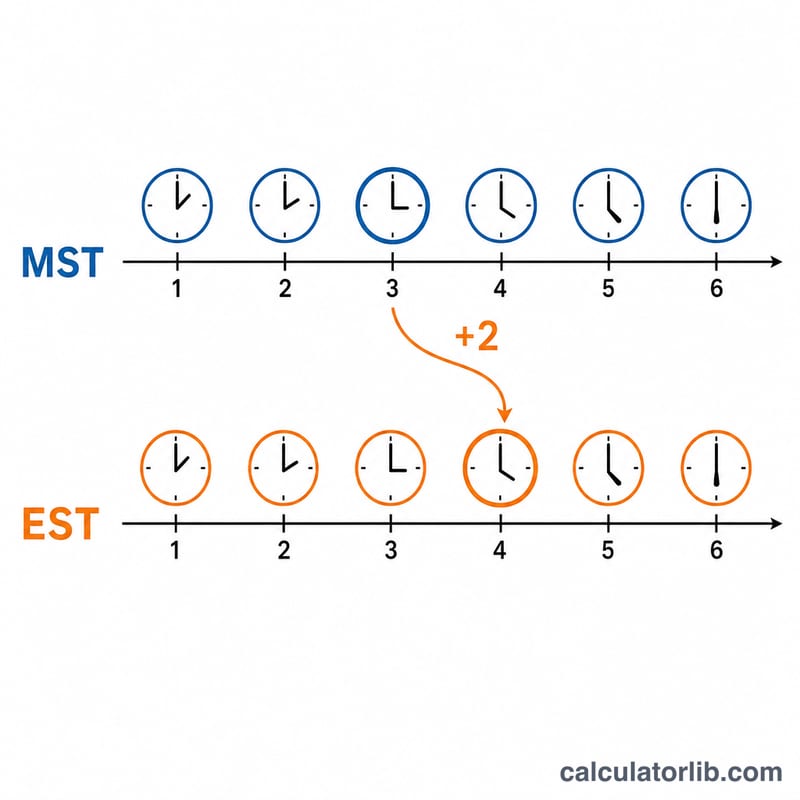
This tool converts a time in Mountain Standard Time (MST, UTC−7) to Eastern Standard Time (EST, UTC−5). These are standard-time zones used in North America. Because EST is two hours ahead of MST, the conversion is simply adding 2 hours to the Mountain time. The tool wraps around midnight using a 24-hour clock, so a late-evening MST time correctly rolls into the next morning's EST.
How to use it
Enter the hour (0–23) and minute (0–59) of the Mountain Standard Time you want to convert, then read the resulting Eastern Standard Time. For example, a 9:00 MST meeting becomes 11:00 EST.
The formula explained
Each US time zone is defined by an offset from Coordinated Universal Time (UTC). Eastern Standard Time is UTC−5 and Mountain Standard Time is UTC−7. The difference is (UTC−5) − (UTC−7) = +2 hours. So EST = MST + 2. The hour value is taken modulo 24 to keep it on a valid 24-hour clock.
$$\text{EST} = \left(\text{Hour (MST)} + 2\right) \bmod 24 : \text{Minute}$$
Worked example
Suppose your flight departs at 23:30 MST. Add 2 hours: \(23 + 2 = 25\), and \(25 \bmod 24 = 1\). The minutes stay the same. The arrival reference time is therefore 1:30 EST the following day.
FAQ
Does this account for Daylight Saving Time? No. This converter uses the fixed standard-time offsets. When both zones observe daylight time (MDT/EDT), the 2-hour difference still holds, but the absolute UTC offsets shift by an hour each.
Is EST always ahead of MST? Yes — Eastern Time is always 2 hours ahead of Mountain Time when both are on standard time.
What about 12 PM noon? 12:00 MST converts to 14:00 EST (2:00 PM Eastern).