
What Is the Work-Energy Theorem?
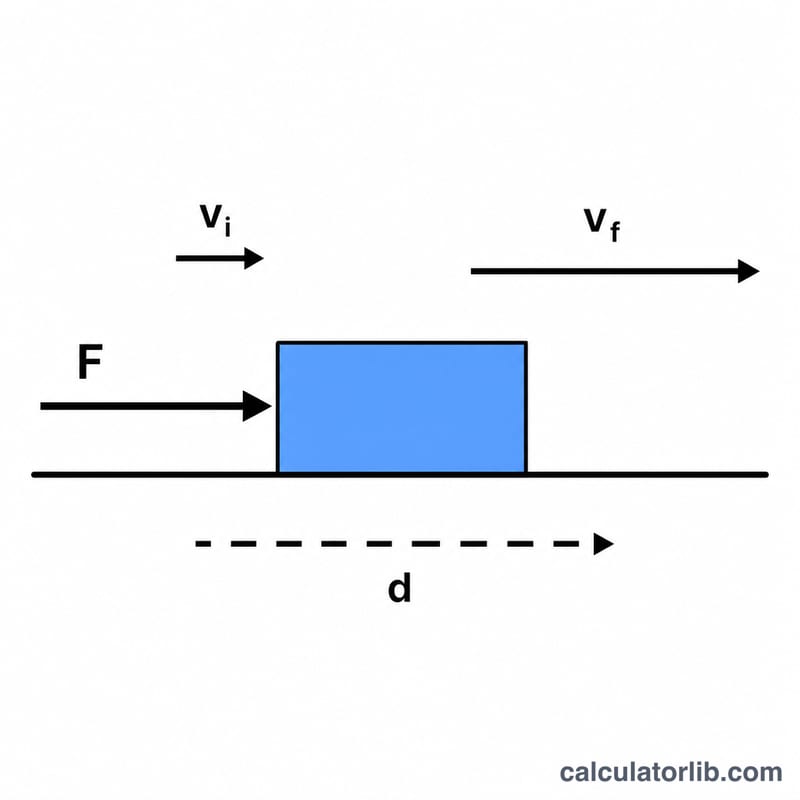
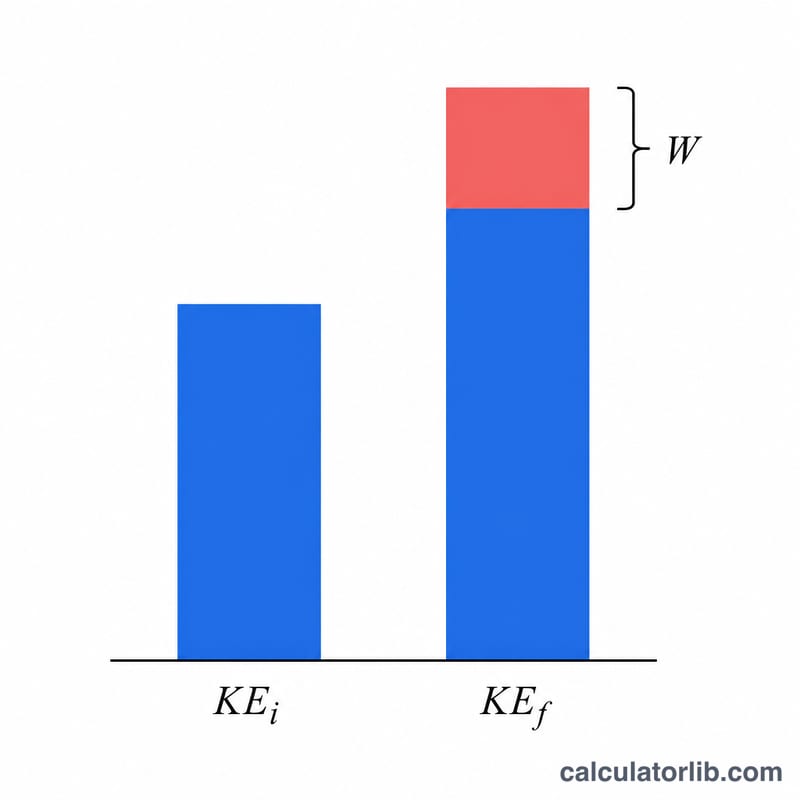
The work-energy theorem states that the net work done on an object equals the change in its kinetic energy. In symbols, \(W_{net} = \Delta KE = \frac{1}{2}m(v_f^{2} - v_i^{2})\). This is a universal result of classical mechanics — it applies to any object regardless of the forces involved, as long as you know its mass and how its speed changed.
How to Use This Calculator
Enter three values: the object's mass in kilograms, its initial velocity, and its final velocity in metres per second. The calculator returns the net work in joules, along with the initial and final kinetic energies so you can see exactly how the energy changed. A positive result means net work was done on the object (it sped up); a negative result means the object did work on its surroundings (it slowed down).
The Formula Explained
Kinetic energy is \(KE = \frac{1}{2}mv^{2}\). The total work from every force acting on the object changes this energy. Subtracting the starting kinetic energy from the final kinetic energy gives the net work:
$$\tfrac{1}{2}mv_f^{2} - \tfrac{1}{2}mv_i^{2} = \tfrac{1}{2}m(v_f^{2} - v_i^{2})$$Because work and energy share the same unit, both are measured in joules (J).
Worked Example
A 2 kg cart speeds up from 3 m/s to 7 m/s. Initial KE = \(\frac{1}{2} \times 2 \times 3^{2} = 9\) J. Final KE = \(\frac{1}{2} \times 2 \times 7^{2} = 49\) J.
$$\text{Net work} = 49 - 9 = 40\ \text{J}$$So 40 joules of net work were done on the cart to accelerate it.
FAQ
Can the work be negative? Yes. If the final speed is less than the initial speed, \(\Delta KE\) is negative, meaning the net force opposed the motion (e.g. friction or braking).
Does direction matter? The theorem uses speed squared, so only the magnitudes of the velocities affect kinetic energy. Sign and direction of velocity do not change the result.
What units should I use? Use kilograms for mass and metres per second for velocity to get work in joules, the SI unit of energy.