
What this calculator does
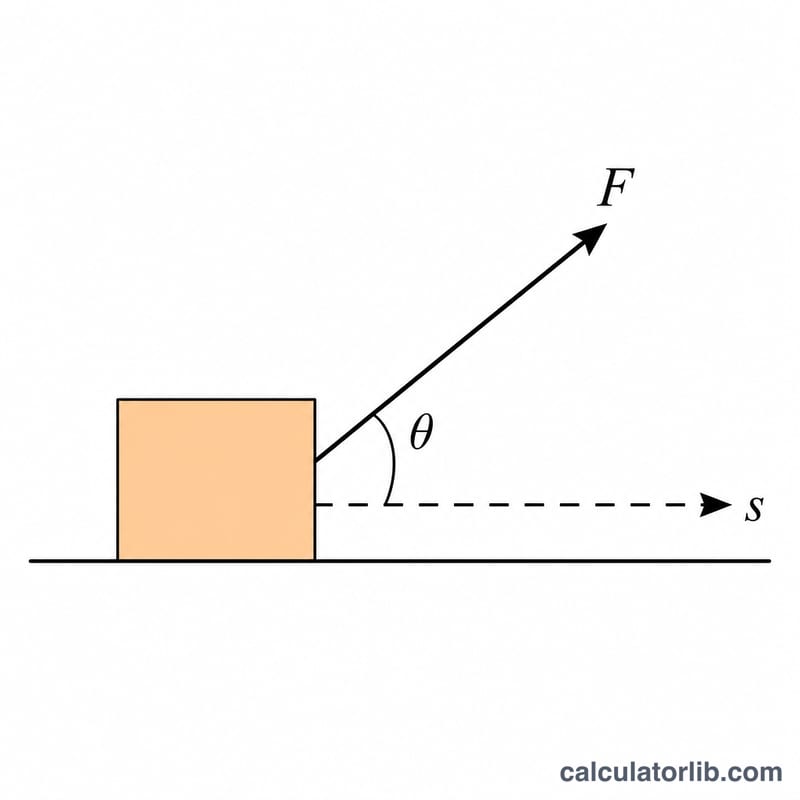
This tool solves the fundamental physics equation for mechanical work, \(W = F \cdot s\), and its angled form \(W = F \cdot s \cdot \cos(\theta)\). Work (W) is measured in joules, force (F) in newtons, and displacement (s) in meters. You can solve for any one of the three quantities by supplying the other two (plus the angle when relevant). It is pure physics, so the same formula applies everywhere with no regional assumptions.
How to use it
Pick what you want to find from the "Choose a Calculation" menu. The first group uses the plain \(W = Fs\) relationship; the second group includes the angle theta between the force vector and the direction of displacement. Enter the known values, choose units for each quantity, and optionally set the angle (in degrees) and the number of significant figures. Every value is converted to SI base units internally, the equation is applied, and the answer is converted back to the unit you selected for the unknown.
The formula explained
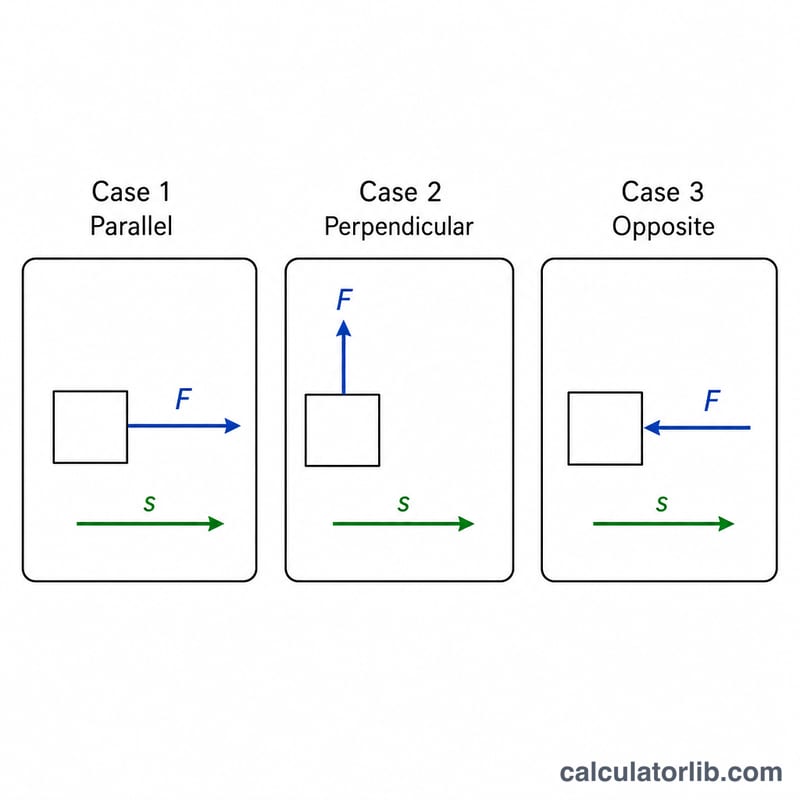
Work is the energy transferred when a force moves an object. Only the force component aligned with the motion contributes, which is why the cosine of the angle appears:
$$W = F\, s \cos(\theta)$$At theta = 0 the force is fully aligned (cos 0 = 1) and \(W = Fs\). At theta = 90 degrees the force is perpendicular, cos 90 = 0, and no work is done. Between 90 and 180 degrees the cosine is negative, giving negative work (energy removed).
Worked example
A 100 N force pushes a crate 5 m while acting at 60 degrees to the displacement. Since cos 60 = 0.5, the work is
$$W = 100 \times 5 \times 0.5 = 250 \text{ J}$$Reversing the problem, if W = 250 J, s = 5 m and theta = 60 degrees, then
$$F = \frac{250}{5 \times 0.5} = 100 \text{ N}$$FAQ
Why can work be negative? When the force opposes the motion (angle greater than 90 degrees), it takes energy away from the object, so the work is negative.
Which BTU and calorie definitions are used? This calculator uses the "mean" definitions: 1 BTU = 1055.87 J and 1 cal = 4.19002 J. These differ slightly from the thermochemical or IT definitions.
What if I solve for force or displacement and the denominator is zero? Dividing by zero is undefined, so the calculator returns an "undefined" message. This happens when displacement is zero (solving for F) or force is zero (solving for s), or when theta = 90 degrees in an angle mode.