
What is a weighted course grade?
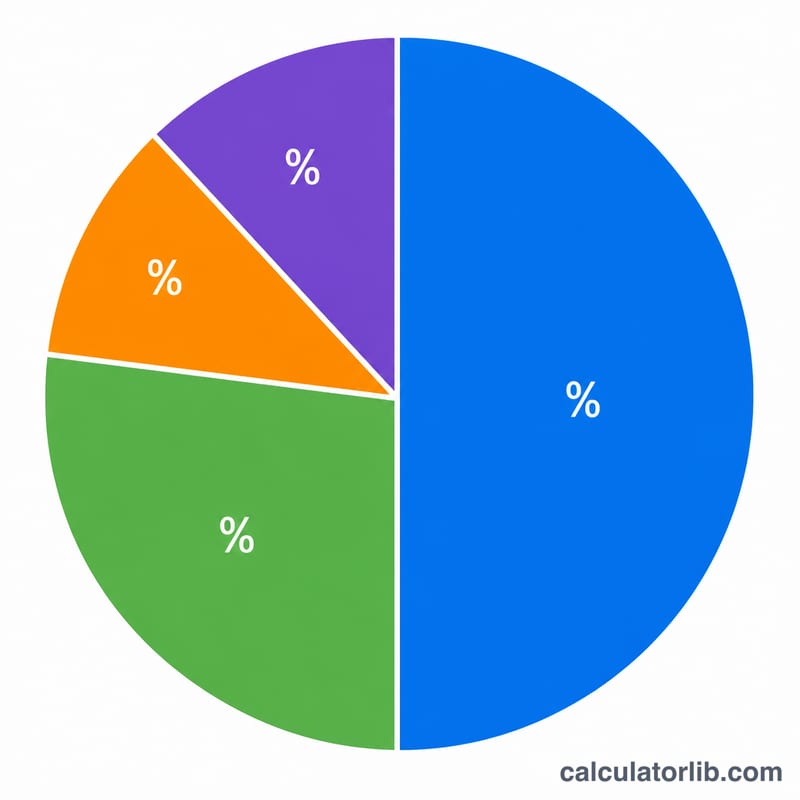
A weighted course grade is your overall grade when different assessments count for different amounts. A final exam worth 50% of your grade matters far more than a 5% quiz, so a simple average would be misleading. This calculator combines every assessment — assignments, quizzes, projects, midterms and finals — into one overall percentage and matching letter grade. It works for college, high school or middle school, by semester or quarter, and it is pure math with no region-specific rules.
How to use it
Choose how many assessment rows you need and whether you will type grades as numbers (0-100) or as letter grades. For each row, optionally name the assessment, enter its grade, and enter its weight. Weights do not have to add up to 100 — you can use 20/30/50 or 2/3/5 and get the same result, because the calculator normalizes them by their own total. Blank rows, or rows missing a grade or weight, are simply ignored.
The formula explained
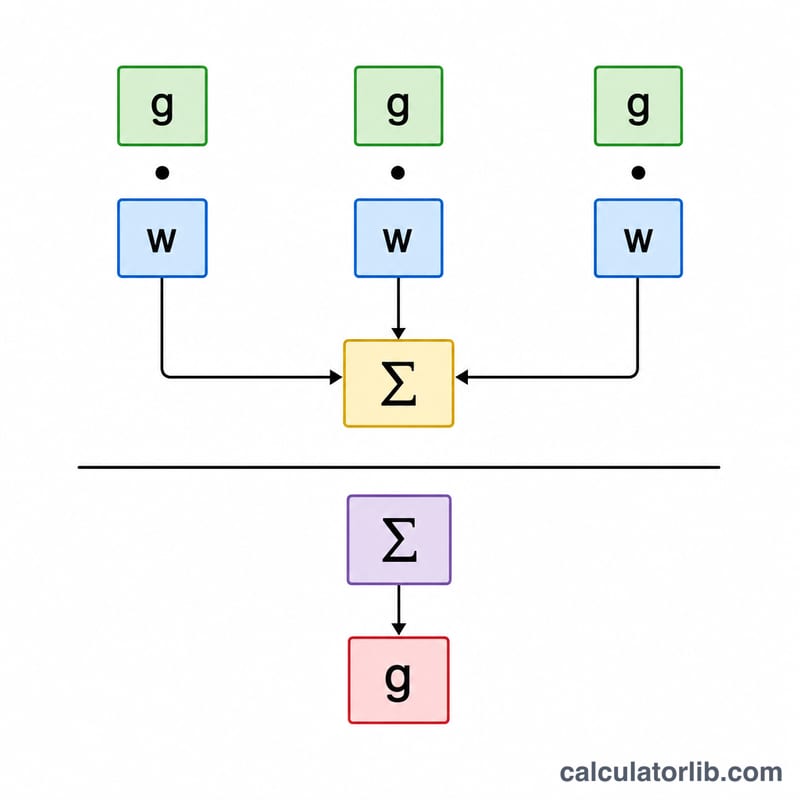
For every valid row the grade g is multiplied by its weight w. Those products are added up and divided by the sum of all weights: $$\text{Weighted Grade} = \dfrac{\sum_i (g_i \times w_i)}{\sum_i w_i}$$ Dividing by \(\sum w\) is what lets weights total anything; if they do happen to sum to 100, the division by 100 gives the familiar percentage result. Letter grades are converted to percentages first using the standard US midpoints (A+=97, A=95, A-=92, B+=88, B=85, B-=82, C+=78, C=75, C-=72, D+=68, D=65, D-=62, F=0).
Worked example
Suppose you have three assessments: grade 90 weight 20, grade 80 weight 30, and grade 95 weight 50. Then $$\sum (g \times w) = 90 \times 20 + 80 \times 30 + 95 \times 50 = 1800 + 2400 + 4750 = 8950$$ and \(\sum w = 100\). $$\text{Weighted Grade} = \frac{8950}{100} = 89.5\%$$ which maps to a letter grade of B+ (87–89.99).
FAQ
Do my weights have to add up to 100? No. The result is normalized by the total weight, so any consistent set of weights gives the correct relative balance.
What happens to empty rows? Rows missing a grade or with a blank/zero weight are skipped entirely — they are not counted as zeros.
How is the letter grade assigned? The final percentage is matched against a standard cutoff scale: A+ ≥ 97, A 93–96.99, A- 90–92.99, B+ 87–89.99, and so on down to F below 60.