
What is the Random PIN Generator?
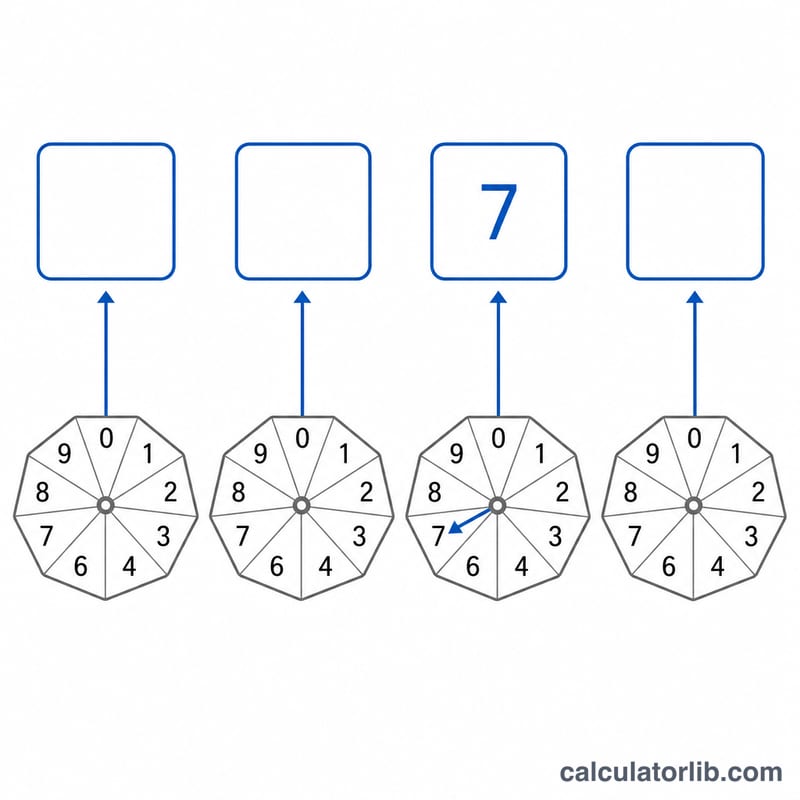
This tool creates a random PIN (Personal Identification Number) — a string of digits used for ATM cards, online banking, phone locks and other login security. You choose how many digits you want (from 1 up to 100) and whether the same digit may appear more than once. Every time you run it, a fresh random code is produced.
How to use it
Enter the PIN length you need in the "Generate a PIN this many digits long" box (4 and 6 are the most common). Leave "Allow Repeat Numbers" checked to let digits repeat (the usual setting), or uncheck it to force every digit to be unique. Click calculate to get your code. Because the output is a digit string, leading zeros are kept — "036784" is a perfectly valid 6-digit PIN.
The formula explained
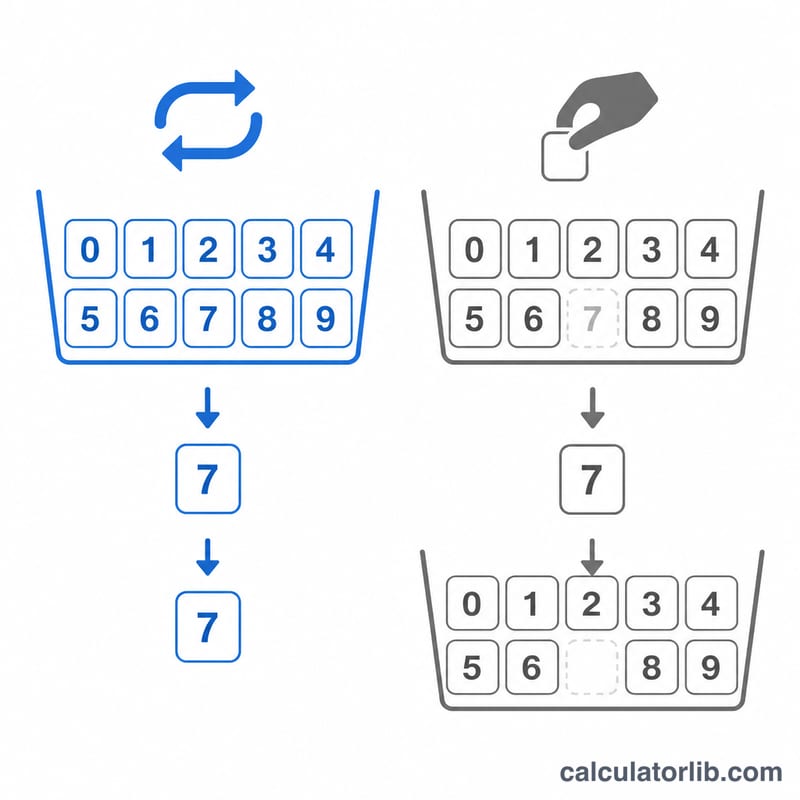
With repeats allowed, each position is filled by an independent uniform draw: \(d = \lfloor \text{rand()} \times 10 \rfloor\), where \(\text{rand()}\) returns a value in \([0,1)\). This gives each digit 0-9 an equal \(1/10\) chance and a total of \(10^N\) possible PINs:
$$N_{\text{possible}} = 10^{\,\text{PIN Length}}$$Without repeats, the ten digits [0-9] are shuffled with a Fisher-Yates shuffle and the first N are taken, so all digits are distinct; the number of possibilities is the permutation count:
$$N_{\text{possible}} = \frac{10!}{\left(10 - \text{PIN Length}\right)!}$$Since there are only ten distinct digits, a no-repeat PIN can be at most 10 digits long — for longer lengths the tool automatically allows repeats.
Worked example
For length 6 with repeats allowed, suppose the random fractions are 0.36, 0.61, 0.38, 0.74, 0.85, 0.42. Multiplying each by 10 and flooring gives
$$\lfloor 0.36 \times 10 \rfloor,\ \lfloor 0.61 \times 10 \rfloor,\ \lfloor 0.38 \times 10 \rfloor,\ \lfloor 0.74 \times 10 \rfloor,\ \lfloor 0.85 \times 10 \rfloor,\ \lfloor 0.42 \times 10 \rfloor = 3, 6, 3, 7, 8, 4$$so the PIN is "363784" — note the digit 3 repeats, which is permitted. For length 4 with no repeats, a shuffle of [0-9] might start [7,2,9,0,...]; taking the first four gives "7290", all distinct.
FAQ
Can a PIN start with zero? Yes. The result is treated as text, so leading zeros are preserved and never dropped.
Why can't I make a 12-digit no-repeat PIN? There are only ten unique digits (0-9). Any PIN longer than ten digits must reuse digits, so the tool switches to repeats-allowed automatically.
Is this secure enough for real accounts? It uses a standard pseudo-random generator with no cryptographic guarantee. It is great for everyday convenience, but for high-security keys use a dedicated cryptographic tool.