What is the Random Number Generator 1-10?
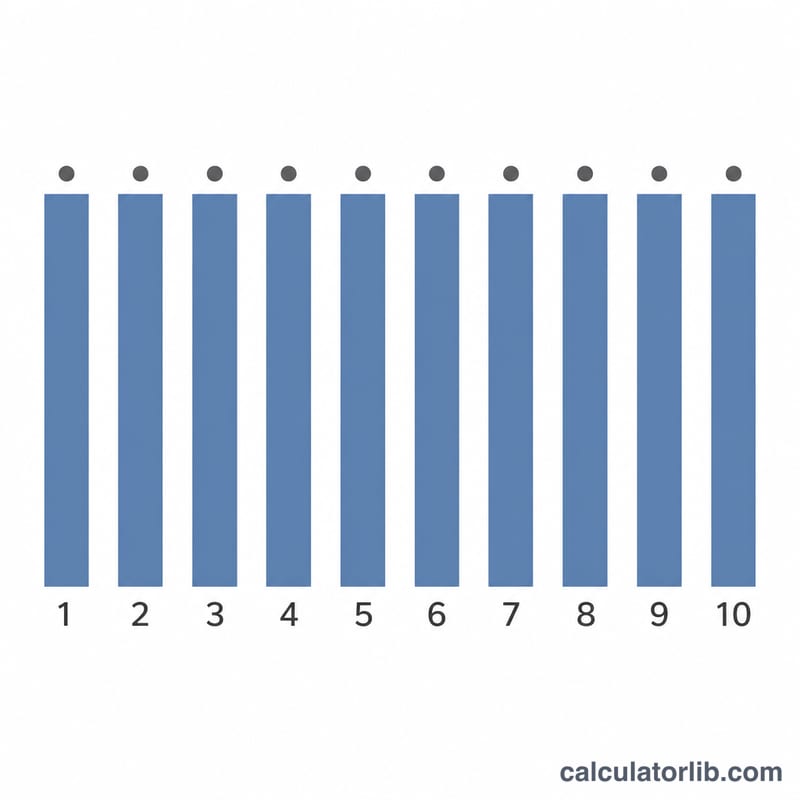
This tool draws a random whole number between 1 and 10 (inclusive). It uses a pseudo-random number generator (PRNG) so every press of the Pick button produces a fresh, independent result. Each of the ten numbers has exactly the same 1-in-10 chance, making it ideal for games, raffles, classroom activities, decision-making, and any situation where you need a quick, fair pick.
How to use it
Just press Pick. The big number is your Answer, and the "Pick #" counter shows how many times you have drawn during this session. Press Pick again to draw a new number; the counter increases by one each time. Press Reset to set the counter back to 1 and start over.
The formula explained
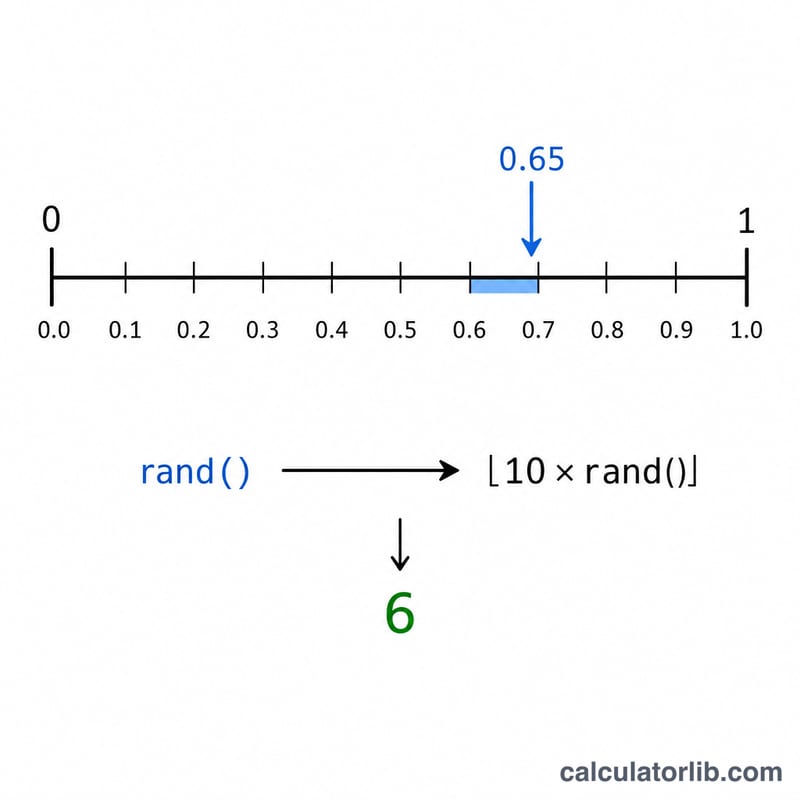
The generator uses a uniform discrete draw over the range [min, max]. With min = 1 and max = 10, the count of possible values is \(\text{max} - \text{min} + 1 = 10\). The result is computed as $$R = \left\lfloor 1 + \text{rand}() \times 10 \right\rfloor, \quad 1 \le R \le 10$$ where rand() returns a uniform real number in [0, 1). The floor function turns that into an index 0-9, and adding the minimum shifts it to 1-10. A guard clamps the output so it never exceeds the maximum even if the generator ever returned exactly 1.0: $$R = \min\!\left(10,\; 1 + \left\lfloor \text{rand}() \times 10 \right\rfloor\right)$$
Worked example
Suppose rand() returns 0.4732 on a Pick. Then $$R = 1 + \left\lfloor 0.4732 \times 10 \right\rfloor = 1 + \left\lfloor 4.732 \right\rfloor = 1 + 4 = 5$$ so the Answer is 5. On the next Pick with \(\text{rand}() = 0.987\), $$R = 1 + \left\lfloor 9.87 \right\rfloor = 1 + 9 = 10$$ giving Answer 10 at Pick # 2. The probability of any one specific number, such as 7, is $$P = \frac{1}{10} = 0.1 = 10\%$$
Probability Reference Table for 1-10 Picks
Every pick from this generator is a uniform discrete draw: each of the ten integers 1, 2, …, 10 has exactly the same chance, and each pick is independent of the ones before it. That makes all of the probabilities below exact — they are computed from the counting rules, not estimated from observed runs.
For a single pick, the probability of any event is simply the count of favourable numbers divided by 10:
$$P(\text{event}) = \frac{\text{favourable outcomes}}{10}$$Single pick
| Event (one pick, 1-10) | Fraction | Decimal | Percent |
|---|---|---|---|
| One specific number (e.g. exactly 7) | 1/10 | 0.1 | 10% |
| Not that number (anything but 7) | 9/10 | 0.9 | 90% |
| Even number (2, 4, 6, 8, 10) | 5/10 = 1/2 | 0.5 | 50% |
| Odd number (1, 3, 5, 7, 9) | 5/10 = 1/2 | 0.5 | 50% |
| In the range 1-3 | 3/10 | 0.3 | 30% |
| Greater than 5 (6-10) | 5/10 = 1/2 | 0.5 | 50% |
| Either of two specific numbers (e.g. 3 or 7) | 2/10 = 1/5 | 0.2 | 20% |
Repeated picks
Because the picks are independent, the chance of missing a target number \(n\) times in a row is \((9/10)^n\), so the chance of getting it at least once is the complement:
$$P(\text{at least one 7 in } n \text{ picks}) = 1 - \left(\frac{9}{10}\right)^{n}$$| Event over multiple picks | Fraction / expression | Decimal | Percent |
|---|---|---|---|
| At least one 7 in 2 picks | \(1-(9/10)^2 = 19/100\) | 0.19 | 19.00% |
| At least one 7 in 5 picks | \(1-(9/10)^5\) | 0.40951 | 40.95% |
| At least one 7 in 10 picks | \(1-(9/10)^{10}\) | 0.651322 | 65.13% |
| At least one 7 in 20 picks | \(1-(9/10)^{20}\) | 0.878423 | 87.84% |
| Same number twice in a row (second pick matches the first, whatever it was) | 1/10 | 0.1 | 10% |
| Two specific numbers in order (e.g. 4 then 9) | \(1/10 \times 1/10 = 1/100\) | 0.01 | 1% |
| All 10 picks distinct (a full permutation of 1-10 in 10 picks) | \(10!/10^{10} = 3{,}628{,}800/10^{10}\) | 0.00036288 | ≈ 0.036% |
Expected counts
The expected number of times a given number appears in \(n\) picks is \(n \times 1/10 = n/10\):
| Number of picks \(n\) | Expected count of any one number \(n/10\) |
|---|---|
| 10 | 1 |
| 50 | 5 |
| 100 | 10 |
| 1,000 | 100 |
Worked example — the chance of seeing at least one 7 in five picks, substituted in full:
$$1 - \left(\frac{9}{10}\right)^{5} = 1 - 0.59049 = 0.40951 = 40.951\%$$All figures on this page assume independent, uniform draws with replacement (repeats allowed). They describe the long-run mathematics of the process, not a guarantee about any particular short run — a sequence of ten picks can easily contain three 4s and no 7s without anything being wrong.
Key Terms and Definitions
- Uniform discrete distribution
- A distribution over a finite list of outcomes in which every outcome is equally likely. Here the outcomes are the integers 1 through 10 and each has probability \(p = 1/10 = 0.1\). The ten probabilities sum to 1.
- Inclusive range [min, max]
- A range that contains both endpoints. For 1 to 10, both 1 and 10 can be drawn, so the number of possible outcomes is \(\text{max} - \text{min} + 1 = 10 - 1 + 1 = 10\). The "+1" is what keeps the endpoint in; forgetting it is the classic off-by-one error that makes a generator never return 10.
- rand()
- A function returning a uniformly distributed real number in the half-open interval [0, 1) — zero is possible, exactly 1 is not. Multiplying it by 10 gives a value in [0, 10), which is why the formula can be floored and shifted into 1-10 without ever overflowing to 11.
- Floor function ⌊x⌋
- The greatest integer less than or equal to \(x\). Example: \(\lfloor 7.93 \rfloor = 7\). Applied to this tool's formula with \(\text{rand}() = 0.6931\): \(\lfloor 1 + 0.6931 \times 10 \rfloor = \lfloor 7.931 \rfloor = 7\). Each of the ten equal-width sub-intervals of [0, 10) maps to exactly one output, which is what preserves uniformity.
- Pseudo-random number generator (PRNG)
- An algorithm that produces a sequence of numbers that looks random but is computed deterministically: given the same starting state, it reproduces the identical sequence every time. PRNGs are fast and statistically well-behaved, which is ideal for games, raffles, teaching and simulation.
- Seed
- The initial internal state of a PRNG. Identical seed → identical output sequence. This is a feature when you want reproducible results (re-running a simulation) and a liability when the seed is guessable.
- CSPRNG and true RNG
- A cryptographically secure PRNG (CSPRNG) is designed so that observing past outputs gives no practical advantage in predicting future ones; a true (hardware) RNG derives bits from a physical process such as thermal noise. An ordinary PRNG offers neither guarantee, so a general-purpose number picker should not be used to generate passwords, cryptographic keys, lottery draws or anything else where predictability has real consequences.
- Independent events / no memory
- The outcome of one pick carries no information about the next. After four consecutive 3s, the probability that the fifth pick is a 3 is still 10%. Expecting a "correction" is the gambler's fallacy.
- Sampling with replacement
- Each draw comes from the full set of ten numbers, so repeats are allowed — this is what this generator does by default. Over 10 picks you will usually see duplicates; getting ten distinct values has probability \(10!/10^{10} \approx 0.036\%\).
- Sampling without replacement
- Each drawn number is removed from the pool, so no value repeats and the probabilities shift after every draw (1/10, then 1/9, then 1/8, …). Use this model for shuffling, assigning unique turn orders or dealing — not for independent picks.
- Expected value
- The probability-weighted average of the outcomes. For a uniform draw on 1-10:
Note that 5.5 is not itself a possible pick — the expected value is the long-run average of many picks, not a prediction of any one pick.
- Law of large numbers
- As the number of independent picks grows, the observed frequency of each number converges toward its true probability of 10%, and the running average of the picks converges toward 5.5. This is why 30 picks can look lopsided while 30,000 picks look almost perfectly even — the proportions settle down even though the raw counts keep drifting apart in absolute terms.
- Relative frequency
- The count of a given outcome divided by the total number of picks — the empirical counterpart to probability. Comparing the pick counter's tallies against the expected \(n/10\) per number is a simple sanity check on fairness.
FAQ
Are the numbers truly random? They are pseudo-random: statistically fair for everyday use but not cryptographically secure, so do not use them for security or lottery-grade purposes.
Can the same number repeat? Yes. Each draw is independent and results are not deduplicated, so repeats are normal and expected.
Why does my distribution look uneven? Over a small number of picks, results can look lopsided. Over many draws each number trends toward 10% of the total.