
What this tool does
The Random Name Picker / List Calculator takes any list you paste — names, numbers, or plain text tokens — and randomly selects or shuffles items from it. Use it to draw raffle winners, choose students, assign teams, randomize a playlist, or simply scramble an order. Every click produces a fresh, uniformly random result.
How to use it
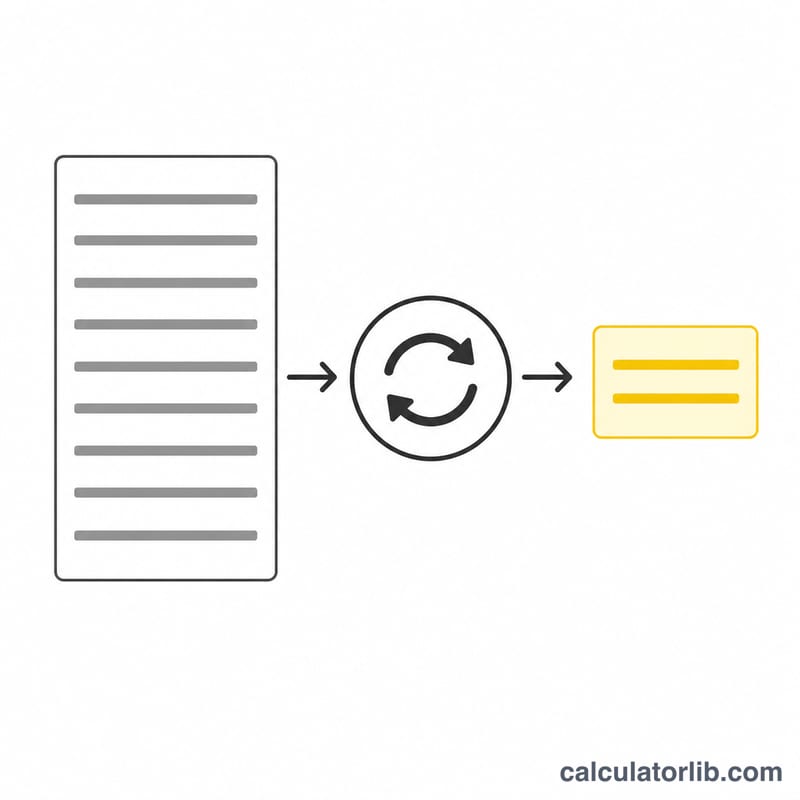
Paste your items into the box, separating them with new lines or commas (you can mix both). Set Pick how many list items to the number you want drawn. Choose Allow repeats = No for a draw without replacement (each item used at most once) or Yes to allow the same item to be picked more than once. Optionally sort the result low-to-high / A-Z or the reverse, and pick a copy format for pasting into a spreadsheet or message.
The formula explained
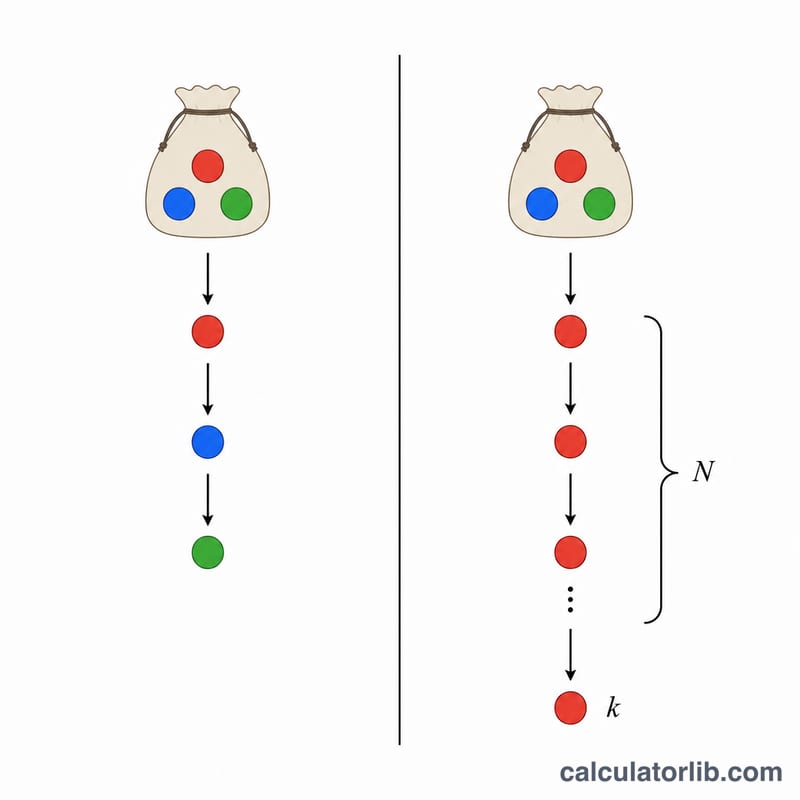
Let \(N\) be the number of parsed items and \(k\) the count you request. Without repeats the tool runs a Fisher-Yates shuffle (for i from N-1 down to 1, swap item i with a random earlier item) and returns the first m = min(k, N) items, so when k is large you simply get the whole list shuffled.
$$m = \min(k, N) \quad \text{(without replacement)}$$With repeats it performs \(k\) independent draws, each choosing a random index \(j = \lfloor \text{rand}() \times N \rfloor\), so items may recur and \(k\) can exceed \(N\). Sorting uses a natural comparator: tokens that look like numbers compare numerically, everything else compares as case-insensitive text.
Worked example
List: Liam, Ethan, Haley, 34, 25, 16, A, B, C (\(N = 9\)). Pick = 9, repeats = No, sort = none. Because \(k\) equals \(N\), this is a full shuffle, so all 9 items are returned in one of \(9! = 362{,}880\) equally likely orders, for example: 34, Ethan, B, A, 25, C, Liam, 16, Haley.
FAQ
Why is my result different each time? The draw is random, so re-running gives a new order or selection on purpose.
What if I ask for more items than my list has? Without repeats the count is capped at the list size (you get the whole list shuffled). With repeats you get exactly the number you asked for.
How are commas and spaces handled? Items are split on commas and new lines, empty tokens (like a trailing comma) are dropped, and surrounding spaces are trimmed for cleaner results.