

What this calculator does
This tool lists the next leap years on or after a start year you choose, following the standard Gregorian calendar rule. Enter a start year of AD 1582 or later (the year the Gregorian calendar was introduced) and pick how many leap years you want to list: 10, 100, 500, or 1000. The result is a numbered list of years in increasing order, beginning with the first leap year that is greater than or equal to your start year.
How to use it
Type a start year (for example 2020) and select the number of entries. If your start year is itself a leap year, it appears as the first entry. The calculator keeps scanning forward year by year until it has collected exactly the number of leap years you requested, so large counts simply reach further into the future.
The formula explained
A year is a leap year when it is divisible by 4, with one exception: years divisible by 100 are NOT leap years unless they are also divisible by 400. So 1600, 2000 and 2400 are leap years, but 1700, 1800, 1900, 2100, 2200 and 2300 are common years. Formally:
$$\text{Leap}(Y) \iff \left(Y \bmod 4 = 0\right) \,\wedge\, \left(Y \bmod 100 \neq 0 \,\vee\, Y \bmod 400 = 0\right)$$where
$$\left\{ \begin{aligned} Y &\ge \text{Start year} \ge 1582 \\ N &= \text{Number of entries} \end{aligned} \right.$$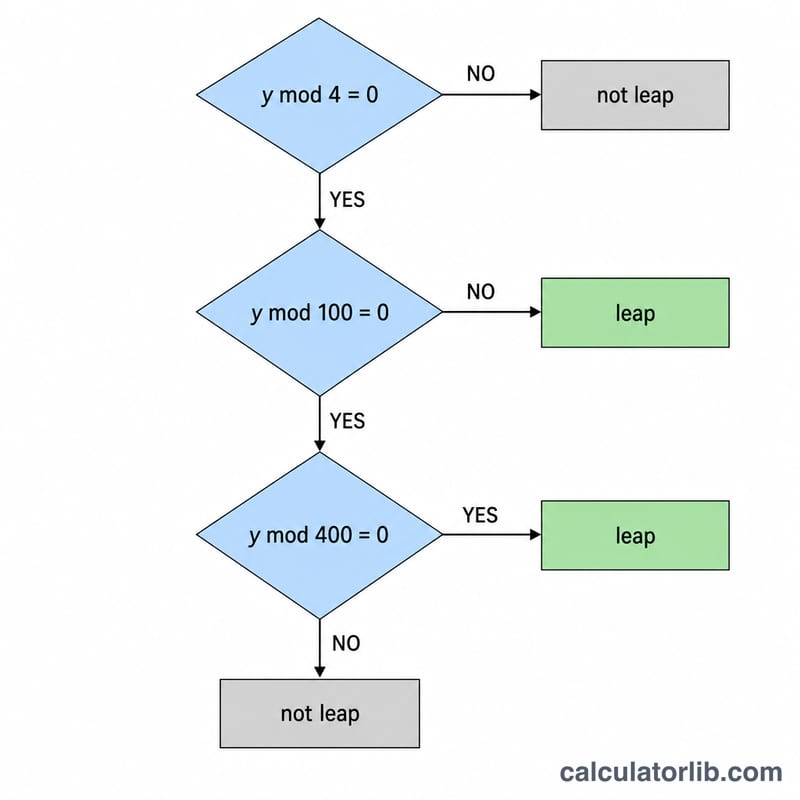
Worked example
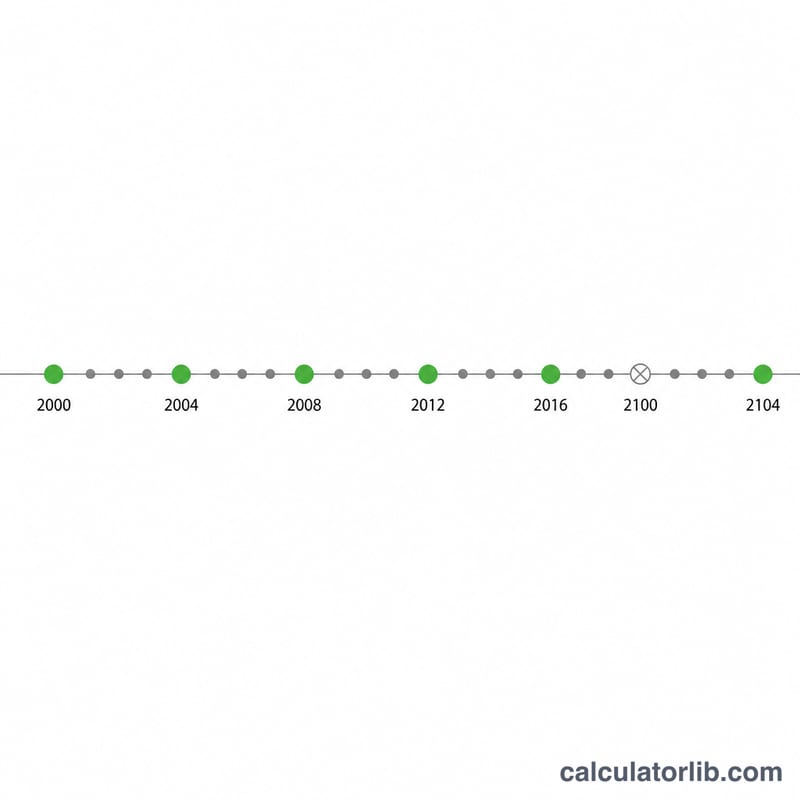
Start year 2020, 10 entries gives: \(2020, 2024, 2028, 2032, 2036, 2040, 2044, 2048, 2052, 2056\). Note how the century exception works: starting at 2096 the list is \(2096, 2104, 2108, 2112, 2116\) — the year 2100 is skipped because it is divisible by 100 but not by 400.
FAQ
Why must the start year be 1582 or later? Before the Gregorian reform of October 1582 the Julian calendar applied, where every fourth year was a leap year with no century exception, so this rule would give historically wrong results.
Is a leap year always exactly every 4 years? No. Most are 4 years apart, but at century boundaries that are not divisible by 400 the gap stretches to 8 years.
Does this work worldwide? Yes — the Gregorian calendar is the global civil standard, so the rule is universal for modern dates.