What this calculator does
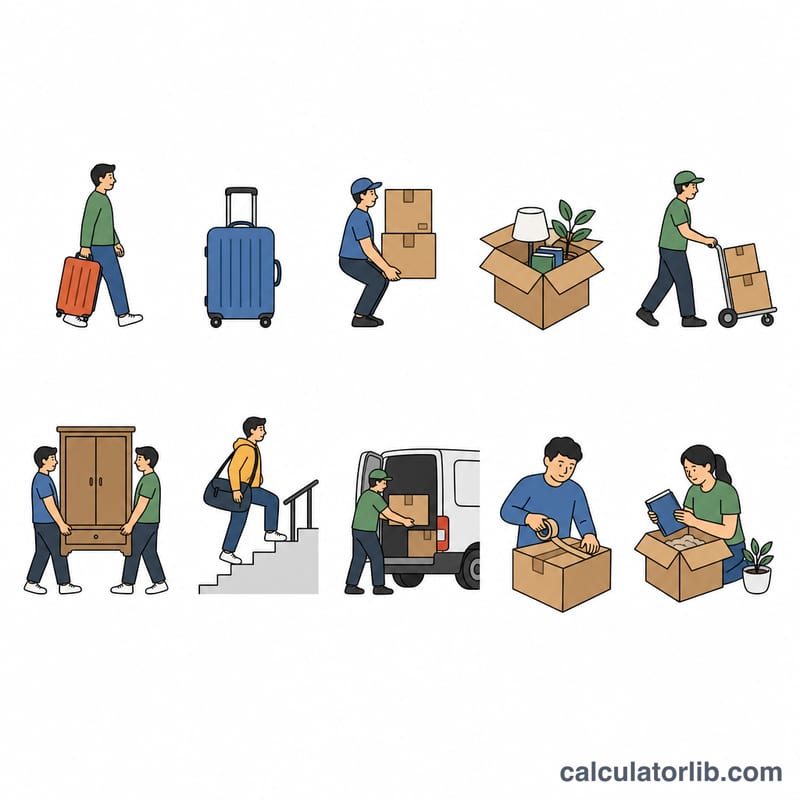
Moving house, hauling boxes and carrying luggage is real exercise. This calculator estimates the total calories you burn while moving by adding up the energy spent on ten distinct moving-related activities — from packing boxes and tidying furniture to carrying heavy loads up the stairs. Each activity has its own intensity, expressed as a MET (metabolic equivalent of task) value.
The formula
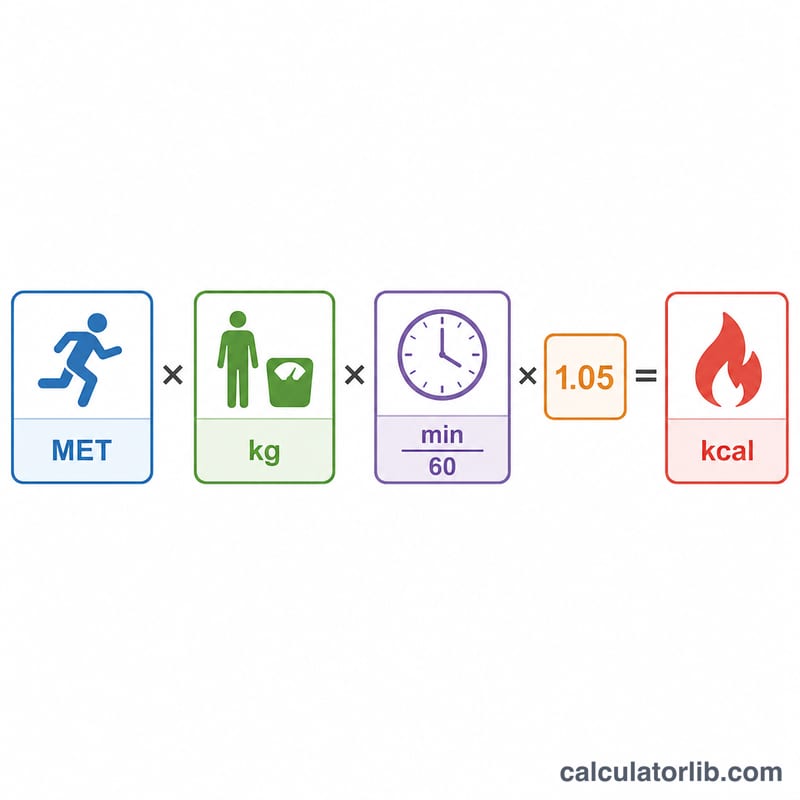
It uses the standard MET-based energy expenditure equation. For a single activity:
$$\text{calories (kcal)} = \text{MET} \times \text{body weight (kg)} \times \left(\text{minutes} \div 60\right) \times 1.05$$
The MET value represents how intense the task is relative to sitting still (1 MET). Body weight is used directly in kilograms, time is converted from minutes to hours by dividing by 60, and 1.05 is the standard constant that approximates kilocalories burned per MET-hour per kilogram. The MET values follow the Compendium of Physical Activities, the same source behind Japan's Ministry of Health, Labour and Welfare "Physical Activity Reference for Health Promotion 2013" — so the formula is universal, not country-specific.
How to use it
Enter your body weight in kilograms, then type how many minutes you spent on each moving activity. Leave any activity at 0 if you did not do it. The tool computes calories per activity and sums them into a total estimate.
Worked example
At 65 kg, carrying a heavy load (MET 8.0) for 120 minutes:
$$8.0 \times 65 \times \left(120 \div 60\right) \times 1.05 = 8.0 \times 65 \times 2 \times 1.05 = \textbf{1092 kcal}$$
Filling in a typical moving day across all rows yields roughly 1320 kcal.
MET Values for the 10 Moving Activities
A MET (metabolic equivalent of task) expresses an activity's energy cost as a multiple of resting energy use. The calculator applies one fixed MET value to each of the ten moving and luggage-handling activities below. You enter the minutes spent on each one.
| Activity (input field) | MET |
|---|---|
| Tidying household goods (tidyingHouseholdGoods) | 3.0 |
| Packing (packing) | 3.0 |
| Descending stairs (descendingStairs) | 3.5 |
| Carrying a light load (carryingLightLoad) | 3.5 |
| Loading/unloading a car (loadingUnloadingCar) | 3.5 |
| Ascending stairs, slow pace (ascendingStairsSlow) | 4.0 |
| Moving furniture (movingFurniture) | 5.8 |
| Carrying heavy loads (carryingHeavyLoad) | 8.0 |
| Ascending stairs, fast pace (ascendingStairsFast) | 8.8 |
| Carrying a load upstairs (carryingLoadUpstairs) | 9.0 |
Source note: MET values of this kind come from the Compendium of Physical Activities, a published research reference that assigns average MET values to activities. They are population averages, so individual results vary. The calculator uses only the values listed above. Calories are then calculated as \(1.05 \times \text{kg} \times \sum \text{MET}_i \times t_i/60\).
Calories Burned by Body Weight and Duration
This table uses carrying heavy loads (MET 8.0) and the formula \(\text{kcal} = 8.0 \times \text{kg} \times \frac{\text{min}}{60} \times 1.05\). At 8.0 MET, the rate is 8.4 kcal per kg per hour.
| Body weight | 30 min | 60 min | 120 min |
|---|---|---|---|
| 50 kg | 210 kcal | 420 kcal | 840 kcal |
| 65 kg | 273 kcal | 546 kcal | 1092 kcal |
| 80 kg | 336 kcal | 672 kcal | 1344 kcal |
Worked check (65 kg, 60 min): \(8.0 \times 65 \times \frac{60}{60} \times 1.05 = 520 \times 1.05 = 546\) kcal.
Worked check (80 kg, 120 min): \(8.0 \times 80 \times \frac{120}{60} \times 1.05 = 1280 \times 1.05 = 1344\) kcal.
Energy use scales linearly with both body weight and time. Doubling the duration doubles the result.
Interpreting Your Result
The total is a MET-based estimate of gross activity energy. It includes the energy your body would use at rest during those same minutes, not only the extra energy caused by the work. It is an average-based estimate, not a measurement.
Factors that change real expenditure
- Load weight: heavier boxes or bags raise effort, while the calculator applies one fixed MET value per activity.
- Stairs: climbing costs more than descending, and carrying a load upstairs is among the highest values (9.0 MET).
- Pace: the same stairs have a higher MET at a fast pace (8.8) than at a slow pace (4.0).
- Fitness and technique: trained or efficient movers may use somewhat different amounts of energy than the average.
- Rest breaks: only count the minutes actually spent working. Pauses, waiting and driving should not be entered as activity time.
Intensity context by MET category
Activities are commonly grouped as light (under 3 MET), moderate (3–6 MET) and vigorous (above 6 MET). Under that scheme:
- Tidying, packing, light-load carrying, car loading and descending stairs (3.0–3.5) are moderate, at the low end.
- Slow stair climbing (4.0) and moving furniture (5.8) are moderate.
- Heavy-load carrying (8.0), fast stair climbing (8.8) and carrying a load upstairs (9.0) are vigorous.
Because a moving day mixes many tasks, the combined total depends on how your minutes are split across activities. This result is general information only.
FAQ
Is this an exact figure? No — it is an estimate. Real expenditure varies with your fitness, the actual weight of the load and the distance carried.
Why minutes instead of hours? Moving tasks are usually short bursts, so minutes are easier to enter; the formula converts them to hours internally.
What is a MET? A MET is the ratio of an activity's energy cost to your resting rate. A 3 MET task burns three times the calories of sitting quietly.