
What this calculator does
This tool estimates how many calories you burn playing badminton. It uses the widely accepted MET (Metabolic Equivalent of Task) method, which scales energy expenditure by exercise intensity, your body weight and how long you play. The MET values for badminton come from the Compendium of Physical Activities and Japan's Ministry of Health "Physical Activity Standards 2013," but the formula and constants are universal, so anyone, anywhere can use this calculator.
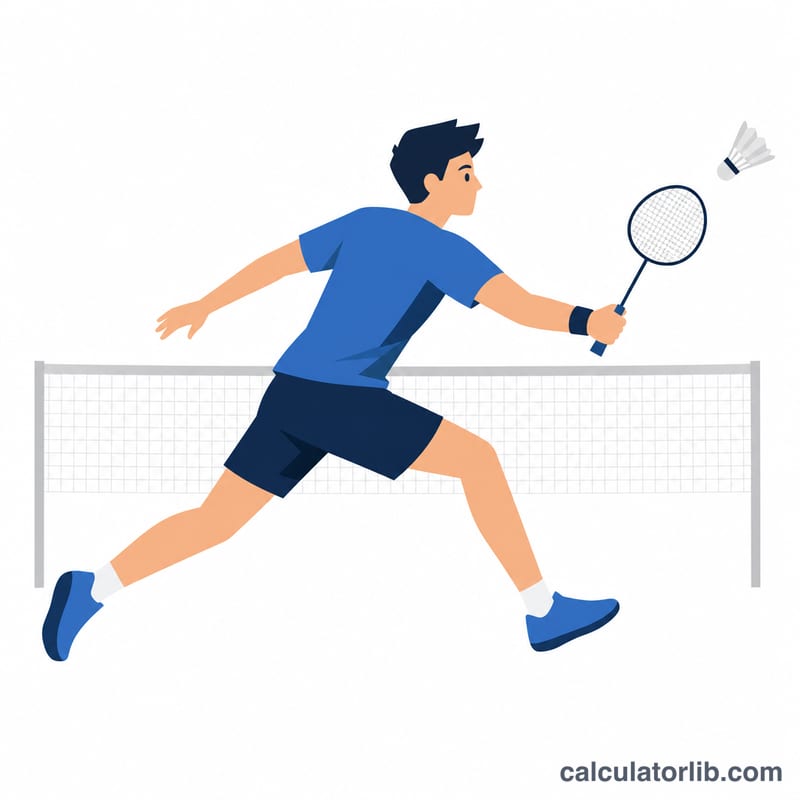
How to use it
Pick your badminton intensity: casual play (5.5 METs) or a competitive match (7 METs) - these values apply to both singles and doubles. Enter how long you played in minutes and your body weight in kilograms, then read off the estimated calories burned. The tool also echoes the MET value used so you can see the intensity assumption.
The formula explained
The calculation is: $$\text{Calories (kcal)} = \text{METs} \times \text{body weight (kg)} \times \text{duration in hours} \times 1.05$$. Duration is converted from minutes to hours by dividing by 60. The 1.05 factor reflects that one MET corresponds to roughly 1.05 kcal burned per kilogram of body weight per hour. This is a gross-energy estimate: it represents total expenditure during the activity and does not subtract your resting metabolism.
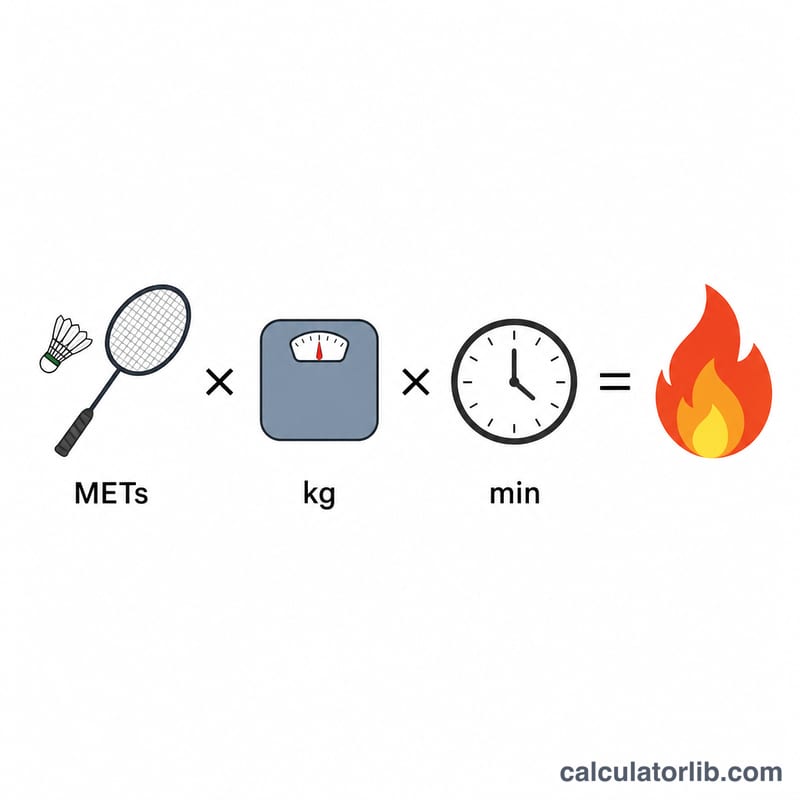
Worked example
Suppose you play a competitive match (7 METs) for 120 minutes at a body weight of 60 kg. First convert time: \(120 / 60 = 2.0\) hours. Then: $$7 \times 60 \times 2.0 \times 1.05 = 882 \text{ kcal}$$ So you would burn about 882 kcal in that session.
Calories Burned by Weight and Duration
The table below estimates calories burned during badminton using the MET-based formula \(\text{Calories} = \text{METs} \times \text{Weight (kg)} \times \frac{\text{Time (min)}}{60} \times 1.05\). Two intensities are shown: casual / social play (5.5 METs) and competitive / vigorous play (7 METs). For example, a 70 kg player in a 60-minute competitive match burns \(7 \times 70 \times \frac{60}{60} \times 1.05 = \) 514.5 kcal.
| Weight | Casual play (5.5 METs) | Competitive play (7 METs) | ||||
|---|---|---|---|---|---|---|
| 30 min | 60 min | 90 min | 30 min | 60 min | 90 min | |
| 50 kg | 144 | 289 | 433 | 184 | 368 | 551 |
| 60 kg | 173 | 347 | 520 | 221 | 441 | 662 |
| 70 kg | 202 | 404 | 606 | 257 | 515 | 772 |
| 80 kg | 231 | 462 | 693 | 294 | 588 | 882 |
| 90 kg | 260 | 520 | 779 | 331 | 662 | 992 |
Values are rounded to the nearest kilocalorie. Actual energy expenditure varies with fitness, playing style, rest intervals and individual metabolism.
Key Terms Explained
- MET (Metabolic Equivalent of Task)
- A unit expressing the energy cost of an activity as a multiple of resting metabolic rate. One MET is the energy used while sitting quietly, defined as roughly \(1\,\text{kcal}\) per kilogram of body weight per hour (≈ 3.5 mL of oxygen per kg per minute). Social badminton is rated at about 5.5 METs and competitive play at about 7 METs, meaning they burn 5.5 to 7 times as much energy as rest.
- Gross vs. net energy expenditure
- Gross energy expenditure is the total calories burned during the activity, including the energy you would have used at rest anyway. Net energy expenditure subtracts that resting cost to show only the calories attributable to the exercise itself. The MET formula used here estimates gross calories; to approximate net, you can subtract roughly 1 MET (the resting baseline) from the activity MET value.
- kcal (kilocalorie)
- The "calorie" reported on food labels and by fitness trackers. One kilocalorie equals 1,000 small calories, the energy needed to raise the temperature of one kilogram of water by 1 °C. It is the standard unit for both food energy and exercise energy expenditure.
- Body weight
- Your mass, entered in kilograms in the formula. Heavier individuals burn more calories for the same activity and duration because moving a larger mass requires more energy. If you know your weight in pounds, divide by 2.205 to convert to kilograms before calculating.
- The 1.05 conversion factor
- A small adjustment used in the common MET formula \(\text{Calories} = \text{METs} \times \text{kg} \times \text{hours} \times 1.05\). Because 1 MET corresponds to slightly more than 1 kcal/kg/hour for many people, multiplying by 1.05 refines the estimate so that calories burned more closely match measured oxygen consumption. Some simplified versions omit it, giving a result about 5% lower.
FAQ
Is this accurate for me? MET-based estimates are good population averages. Individual burn varies with fitness, technique and effort, so treat the number as a guide.
Why is a match higher than casual play? Competitive play involves more sustained movement and rallies, raising the intensity from 5.5 to 7 METs.
Does it matter if I play singles or doubles? The source MET values apply to both, so the calculator uses the same figures for either format.