
What is wet bulb temperature?
The wet bulb temperature is the lowest temperature air can be cooled to by the evaporation of water at constant pressure. It combines heat and humidity into a single value and is a key indicator of heat stress on the human body. When the wet bulb temperature approaches body temperature, sweat can no longer evaporate effectively, making high values dangerous.
How to use this calculator
Enter the air (dry-bulb) temperature in degrees Celsius and the relative humidity as a percentage between 0 and 100. The calculator returns the wet bulb temperature in both °C and °F using the Stull approximation, a widely cited empirical formula valid at standard sea-level pressure for typical surface conditions.
The formula explained
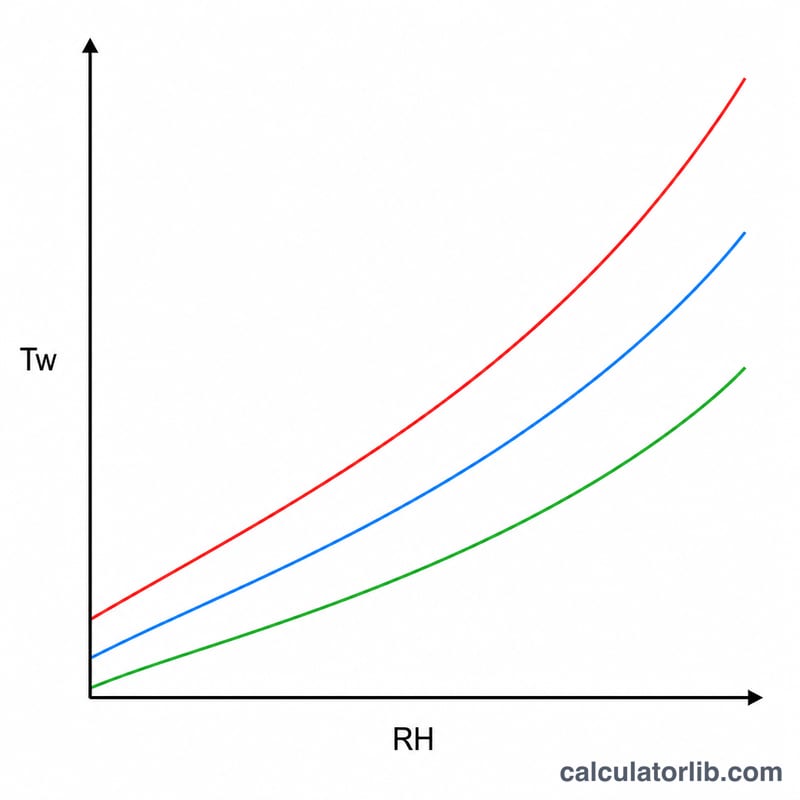
The Stull formula uses arctangent terms (computed in radians) of the temperature and humidity to approximate the psychrometric wet bulb temperature without iterative solving:
$$T_w = T \cdot \arctan\!\left(0.151977\sqrt{RH + 8.313659}\right) + \arctan(T + RH) - \arctan(RH - 1.676331) + 0.00391838\,RH^{1.5}\arctan(0.023101\,RH) - 4.686035$$
It is accurate to within about \(\pm 1\,^\circ\text{C}\) over the range \(-20\,^\circ\text{C}\) to \(50\,^\circ\text{C}\) and 5%–99% relative humidity.
Worked example
For \(T = 30\,^\circ\text{C}\) and \(RH = 50\%\): the formula gives a wet bulb temperature of about \(21.92\,^\circ\text{C}\), which equals roughly \(71.45\,^\circ\text{F}\). This means the air could be cooled to about \(21.9\,^\circ\text{C}\) purely by evaporative cooling.
FAQ
Is this accurate at high altitude? The Stull approximation assumes standard sea-level pressure (\(\approx 1013\,\text{hPa}\)); accuracy decreases at high elevations.
What wet bulb temperature is dangerous? A sustained wet bulb temperature above about \(35\,^\circ\text{C}\) is considered the theoretical survivability limit for humans, and values above \(30\text{–}31\,^\circ\text{C}\) are already extremely hazardous.
Why does my result differ slightly from a psychrometric chart? This is an empirical approximation, not an exact thermodynamic solution, so small differences of a fraction of a degree are expected.