What is the feels-like temperature?
The feels-like temperature (also called apparent temperature) describes how hot or cold the air actually feels to the human body, accounting for humidity when it's warm and wind when it's cold. This calculator follows the U.S. National Weather Service (NWS) convention and works in degrees Fahrenheit and miles per hour.
How it chooses a method
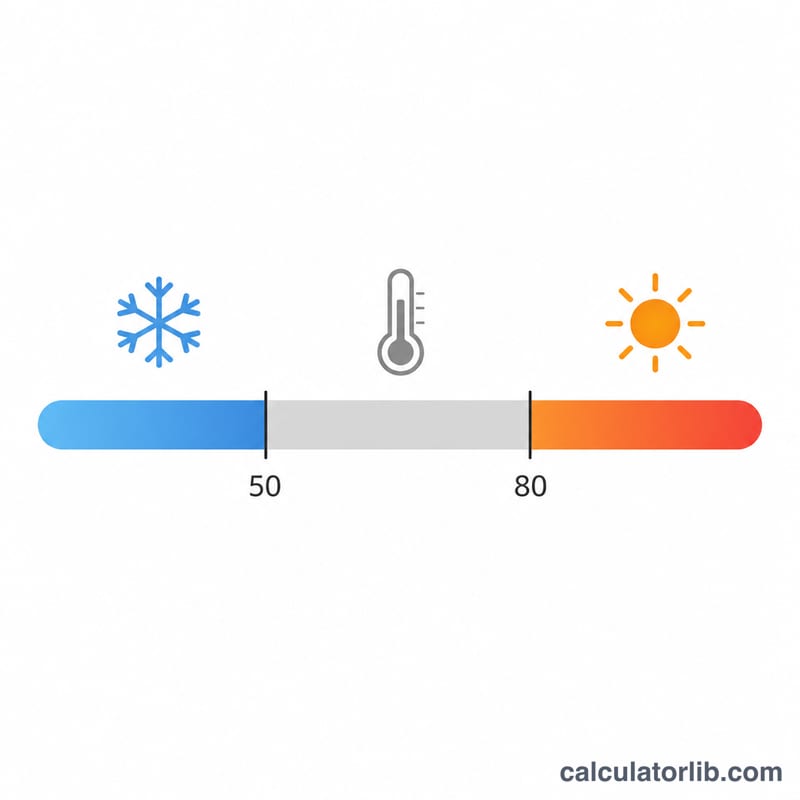
The tool applies a simple, standard decision rule: if the air temperature is at or above 80°F it uses the Heat Index (humidity matters most when it's hot); if the temperature is at or below 50°F and the wind exceeds 3 mph it uses Wind Chill (wind matters most when it's cold); otherwise the feels-like value equals the actual temperature.
The formulas explained
The Heat Index uses the Rothfusz regression, a polynomial fit of temperature (\(T\)) and relative humidity (\(R\)), with small correction terms for very dry (\(R < 13\%\)) or very humid (\(R > 85\%\)) conditions:
$$\begin{gathered} \text{HI} = -42.379 + 2.04901523\,T + 10.14333127\,R - 0.22475541\,T R \\ -\,0.00683783\,T^2 - 0.05481717\,R^2 + 0.00122874\,T^2 R \\ +\,0.00085282\,T R^2 - 0.00000199\,T^2 R^2 \\[1.4em] \text{where}\quad \left\{ \begin{aligned} T &= \text{Temperature (°F)} \\ R &= \text{Humidity (\%)} \end{aligned} \right. \end{gathered}$$The Wind Chill formula combines temperature and wind speed raised to the 0.16 power to model convective heat loss from exposed skin:
$$\begin{gathered} \text{WC} = 35.74 + 0.6215\,T - 35.75\,V^{0.16} + 0.4275\,T\,V^{0.16} \\[1.4em] \text{where}\quad \left\{ \begin{aligned} T &= \text{Temperature (°F)} \\ V &= \text{Wind Speed (mph)} \end{aligned} \right. \end{gathered}$$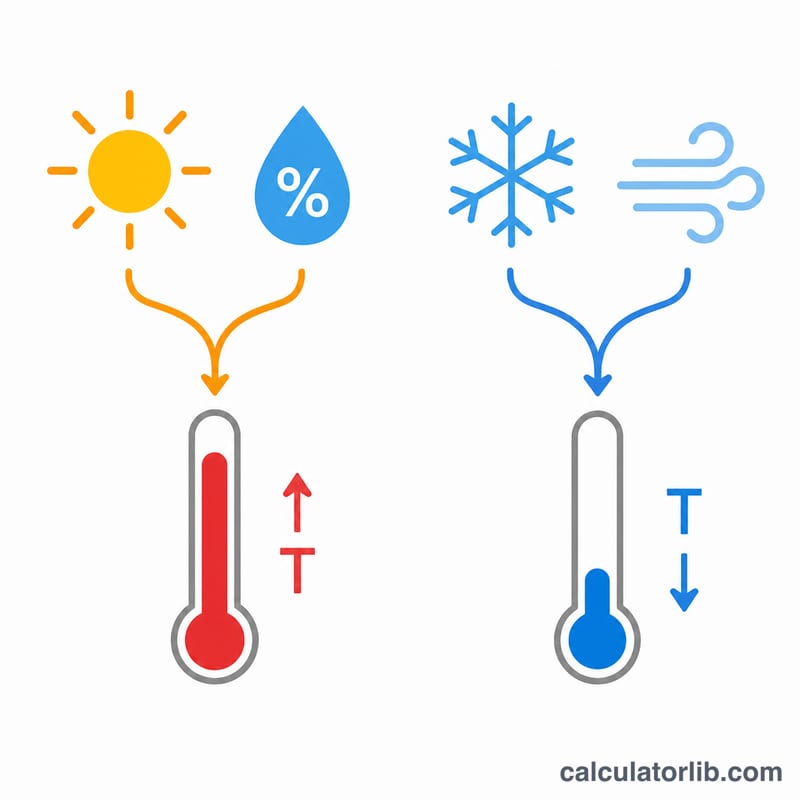
Worked example
At 90°F with 70% relative humidity, the Rothfusz regression returns about \(105.9\,\text{°F}\) — noticeably hotter than the thermometer reading because high humidity slows the body's ability to cool by sweating. On a 30°F day with a 15 mph wind, the Wind Chill formula gives about \(19\,\text{°F}\), so it feels roughly 11 degrees colder than the air temperature.
Interpreting Your Feels-Like Temperature
The feels-like value is an index published by the US National Weather Service (NWS), in °F and mph. It is not a measured air temperature. It estimates how the weather affects the human body: humid heat slows the body's cooling, and wind in the cold speeds up heat loss from exposed skin.
NWS Heat Index risk categories
| Heat Index (°F) | NWS category | Possible effects |
|---|---|---|
| 80–90 | Caution | Fatigue possible with prolonged exposure and activity |
| 91–103 | Extreme Caution | Heat cramps and heat exhaustion possible |
| 103–124 | Danger | Heat cramps and heat exhaustion likely; heat stroke possible |
| 125 and above | Extreme Danger | Heat stroke highly likely |
Wind Chill and frostbite guidance
The NWS Wind Chill chart (2001 formula) gives approximate times for frostbite on exposed skin:
- Wind chill of -18°F or lower: frostbite possible in about 30 minutes.
- Wind chill of -35°F or lower: frostbite possible in about 10 minutes.
- Wind chill of -48°F or lower: frostbite possible in about 5 minutes.
These times are NWS reference values for exposed facial skin. They are not predictions for any individual. When the result is neither a heat index nor a wind chill (not hot enough, or not cold and windy enough), the calculator shows the actual temperature.
Key Terms and Validity Limits
- Apparent temperature
- The temperature a person perceives, given air temperature plus other factors such as humidity or wind. Heat Index and Wind Chill are both kinds of apparent temperature.
- Heat Index
- The NWS measure of how hot it feels when relative humidity is combined with air temperature. It is calculated from temperature \(T\) in °F and relative humidity \(R\) in %.
- Wind Chill
- The NWS measure of how cold it feels on exposed skin because of wind. The 2001 formula, with \(T\) in °F and wind speed \(V\) in mph, is: $$WC = 35.74 + 0.6215\,T - 35.75\,V^{0.16} + 0.4275\,T\,V^{0.16}$$
- Relative humidity
- The amount of water vapor in the air as a percentage of the maximum the air can hold at that temperature. High humidity slows sweat evaporation, so the body cools less effectively.
- Wind speed
- The speed of moving air, in mph here. In cold weather it carries heat away from the skin faster, which lowers the wind chill.
Validity limits
- Wind Chill is defined only for temperatures at or below 50°F and wind speeds above 3 mph.
- Heat Index is designed for temperatures of 80°F or higher and relative humidity of 40% or higher.
- The NWS first computes the simple Steadman-based estimate: $$HI_{\text{simple}} = 0.5\left[T + 61.0 + 1.2\,(T - 68.0) + 0.094\,R\right]$$ It applies the full Rothfusz regression (the long polynomial shown with this calculator) only when the average of this value and the temperature is 80°F or above.
- Both formulas assume shade. The Heat Index assumes light wind, and neither accounts for direct sun or other radiation. In full sun the heat index can feel up to about 15°F higher.
- These are US NWS formulas in °F and mph. Other countries may use different apparent-temperature indices.
FAQ
Why does humidity make it feel hotter? Sweat evaporates more slowly in humid air, reducing the body's main cooling mechanism, so the effective temperature rises.
Why is wind only used when cold? Wind strips away the thin warm layer near the skin, accelerating heat loss. This effect is the basis of wind chill and is only meaningful at low temperatures.
What if it's a mild day? Between 50°F and 80°F (or with little wind), neither effect is significant, so the feels-like temperature is reported as the actual temperature.