What is the YouTube Revenue Calculator?
This tool estimates how much money a YouTube channel can earn from advertising, based on the number of video views and your RPM (revenue per mille, i.e. per 1,000 views). RPM represents the amount the creator actually receives after YouTube takes its share, making it the most accurate single number for forecasting ad income.
How to use it
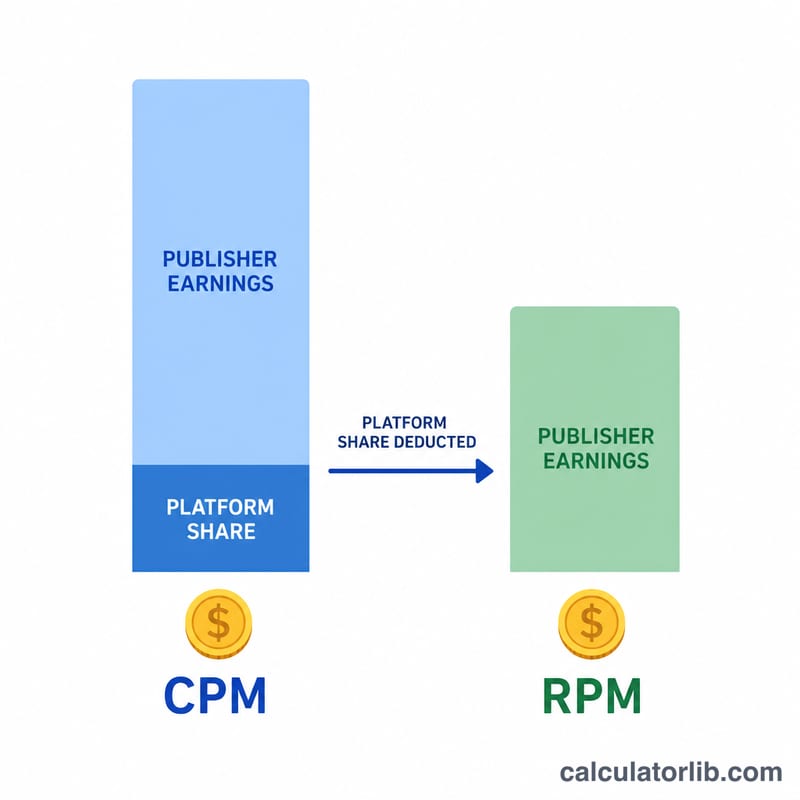
Enter your monthly video views and your channel's RPM in US dollars. The calculator instantly shows your estimated monthly earnings, plus daily and yearly projections. If you only know your CPM (what advertisers pay), remember creators typically keep about 55% of it, so your RPM is usually lower than your CPM.
The formula explained
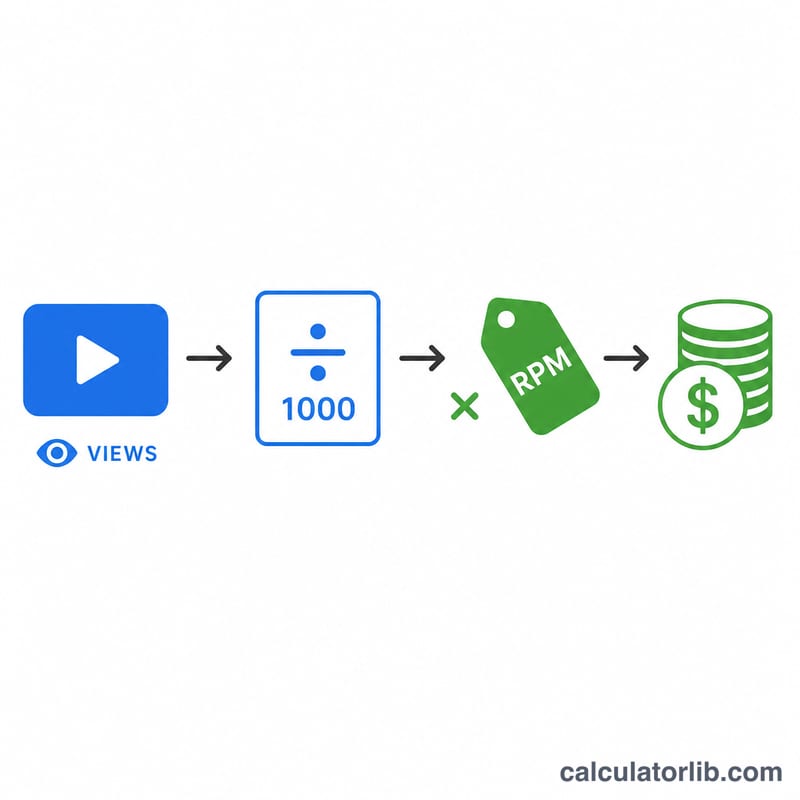
The math is simple: divide your views by 1,000 to get the number of "mille" units, then multiply by the RPM. $$\text{Earnings} = \left(\frac{\text{Views}}{1000}\right) \times \text{RPM}$$. Yearly earnings multiply the monthly figure by 12, and daily earnings divide it by 30.
Worked example
Suppose a channel gets 100,000 monthly views with an RPM of $5. $$\text{Earnings} = \left(\frac{100{,}000}{1{,}000}\right) \times 5 = 100 \times 5 = \$500 \text{ per month}$$. That projects to roughly $16.67 per day and $6,000 per year.
Typical YouTube RPM by Niche and Audience Country
RPM (revenue per mille) is what you actually keep per 1,000 views on your channel: it is calculated after YouTube takes its 45% share of long-form ad revenue and it is divided by all views, including views that never served an ad. CPM is the different, larger number advertisers pay per 1,000 ad impressions before the split. Because only a fraction of views are monetized and the creator keeps 55% of long-form ad revenue, a channel's RPM is normally several times smaller than its CPM.
The figures below are approximate ranges reported by creators in US dollars for long-form, ad-monetized video. They are not rates published or guaranteed by YouTube, and individual channels fall outside them in both directions. The RPM shown in your own YouTube Studio Analytics is the only authoritative figure for your channel — use these tables only to sanity-check an estimate before you have your own data.
Approximate RPM by content niche (US-heavy audience, long-form)
| Niche | Typical RPM range (USD) | Corresponding CPM band (USD) |
|---|---|---|
| Personal finance, investing, insurance | $10 – $40 | $20 – $70 |
| Business, B2B software, marketing | $8 – $25 | $15 – $45 |
| Technology and product reviews | $5 – $15 | $10 – $30 |
| Education, how-to, professional skills | $4 – $12 | $8 – $25 |
| Health, fitness, wellness | $4 – $12 | $8 – $25 |
| Travel and lifestyle | $3 – $8 | $6 – $16 |
| Gaming | $2 – $6 | $4 – $12 |
| Entertainment, vlogs, reaction | $2 – $6 | $4 – $12 |
| Music, kids / "made for kids" content | $0.50 – $3 | $1 – $6 |
Content flagged as "made for kids" cannot serve personalized ads under the US Children's Online Privacy Protection Act (COPPA) and comparable rules elsewhere, which is the main structural reason that row sits so low.
Approximate RPM by top audience geography
| Audience tier | Example markets | Typical RPM range (USD) |
|---|---|---|
| Tier 1 | United States, Canada, Australia, United Kingdom, Nordics, Switzerland, Germany | $5 – $20 |
| Tier 2 | France, Italy, Spain, Netherlands, Japan, South Korea, Ireland, New Zealand | $2 – $8 |
| Tier 3 | Latin America, Southeast Asia, India, much of Africa and Eastern Europe | $0.30 – $2 |
Geography and niche multiply rather than add: a finance channel with a mostly Indian audience will land far below the finance row above, and a gaming channel with a mostly US audience can sit above the gaming row. Your blended RPM is a weighted average across every country your views come from, which is why the "Geography" report in YouTube Studio is usually the first place to look when an estimate and reality disagree.
Earnings Across Common View and RPM Scenarios
Every cell below uses the calculator's formula, with yearly revenue as twelve times the monthly figure:
$$\text{Monthly Revenue} = \frac{\text{Monthly Views}}{1000} \times \text{RPM}$$Three RPM columns are shown: a low case of $1.50 (typical of entertainment or gaming with a Tier 3 audience), a mid case of $5 (a broad general-interest channel with a mixed audience), and a high case of $12 (a business, finance or education channel with a Tier 1 audience).
| Monthly views | RPM $1.50 | RPM $5.00 | RPM $12.00 | |||
|---|---|---|---|---|---|---|
| Monthly | Yearly | Monthly | Yearly | Monthly | Yearly | |
| 10,000 | $15 | $180 | $50 | $600 | $120 | $1,440 |
| 50,000 | $75 | $900 | $250 | $3,000 | $600 | $7,200 |
| 100,000 | $150 | $1,800 | $500 | $6,000 | $1,200 | $14,400 |
| 500,000 | $750 | $9,000 | $2,500 | $30,000 | $6,000 | $72,000 |
| 1,000,000 | $1,500 | $18,000 | $5,000 | $60,000 | $12,000 | $144,000 |
| 5,000,000 | $7,500 | $90,000 | $25,000 | $300,000 | $60,000 | $720,000 |
Worked check on the marked mid-case cell, with the full substitution:
$$\text{Monthly Revenue} = \frac{100{,}000}{1000} \times \$5.00 = 100 \times \$5.00 = \$500.00$$And the annual figure for the same channel:
$$\text{Yearly Revenue} = \$500.00 \times 12 = \$6{,}000.00$$Note the single most important feature of the table: the spread between the low and high RPM columns is 8× at every view count. A channel with 100,000 monthly views and a $12 RPM out-earns a channel with 500,000 monthly views and a $1.50 RPM. Views and RPM matter equally in this formula.
All figures are gross ad revenue only, before any tax. They exclude YouTube Premium revenue share, channel memberships, Super Chat and Super Thanks, Shopping affiliate commission, and every off-platform income stream such as brand sponsorships, affiliate links and product sales — which for many established channels are larger than ad revenue. The yearly columns also assume the monthly view count and RPM hold steady for twelve months, which, as the next section explains, they generally do not.
Interpreting Your Estimated Revenue
The number this calculator returns is estimated gross ad revenue before tax, and already net of YouTube's share. Under the YouTube Partner Program terms, YouTube retains 45% of long-form ad revenue and pays the creator 55%; because RPM is defined as the creator's own revenue per 1,000 views, that 45% has already been deducted before RPM is reported. You should not subtract it again.
RPM also already absorbs the dilution from non-monetized views. It is calculated over every view a video receives — views where no ad was served, views from users with ad blockers, views from YouTube Premium subscribers, and views on videos with monetization limited or disabled. This is precisely what separates RPM from CPM, and it is why RPM is the correct input for a views-based revenue estimate while CPM is not.
Seasonality distorts any single-month figure
Advertiser demand on YouTube follows a strong annual cycle. The fourth quarter — and December in particular — carries the highest ad rates of the year as retail and brand budgets are spent; January is consistently the weakest month as those budgets reset. The swing between the two is routinely a factor of two or more for the same channel with the same audience. Consequences for your estimate:
- An RPM taken from December and multiplied by twelve will overstate the annual run rate.
- An RPM taken from January and multiplied by twelve will understate it.
- A trailing twelve-month RPM, or at minimum a trailing 90-day RPM, gives a far more stable annual projection than any single month.
Eligibility and format conditions
No ad revenue accrues at all until the channel is accepted into the YouTube Partner Program. The published thresholds for the ad-revenue tier are 1,000 subscribers plus either 4,000 valid public watch hours in the previous 12 months or 10 million valid public Shorts views in the previous 90 days, together with compliance with YouTube's monetization policies, an active AdSense account, and availability of the program in your country. Below those thresholds, the calculator's output describes potential revenue that is not yet being earned.
Format matters as much as eligibility. Shorts are monetized from a separate pooled-revenue mechanism rather than per-video pre-roll and post-roll ads, and after music licensing costs the creator share of that pool is 45%. The practical result is that Shorts RPMs are typically an order of magnitude or more below long-form RPMs — often well under $1 per 1,000 views, where long-form on the same channel might earn several dollars. Entering a Shorts-dominated view count against a long-form RPM will produce a large overestimate; estimate the two formats separately.
Estimated revenue is not money received
Revenue accrues through the month, is finalized by Google in the following month, and is only paid out once the balance clears the AdSense payment threshold — US$100 for accounts paid in US dollars, with an equivalent amount set per currency — and once identity and tax information are verified. Balances below the threshold roll forward rather than being paid. Figures reported in YouTube Studio during the current month are also provisional and are subject to invalid-traffic adjustments before finalization.
Finally, the output is pre-tax. How it is taxed depends entirely on where you are resident and how you operate, and that is outside the scope of any views × RPM arithmetic. One rule specific to the United States is worth knowing because it applies globally: under US tax law Google may withhold tax on the portion of earnings generated from US viewers, and the rate applied to a non-US creator depends on the tax information submitted in AdSense and on whether a relevant tax treaty applies. This article is general information about how the calculation works, not tax, financial or professional advice; consult a qualified professional about your own situation.
FAQ
What's the difference between RPM and CPM? CPM is what advertisers pay per 1,000 ad impressions; RPM is what you actually earn per 1,000 video views after YouTube's cut and across all monetized and non-monetized views.
What is a typical RPM? RPM varies widely by niche and audience location, commonly ranging from about $1 to $10, with finance and tech channels often higher.
Does this include sponsorships? No. This estimates ad revenue only. Sponsorships, memberships, and merchandise are additional income streams not captured by RPM.