

What Is Marginal Revenue?
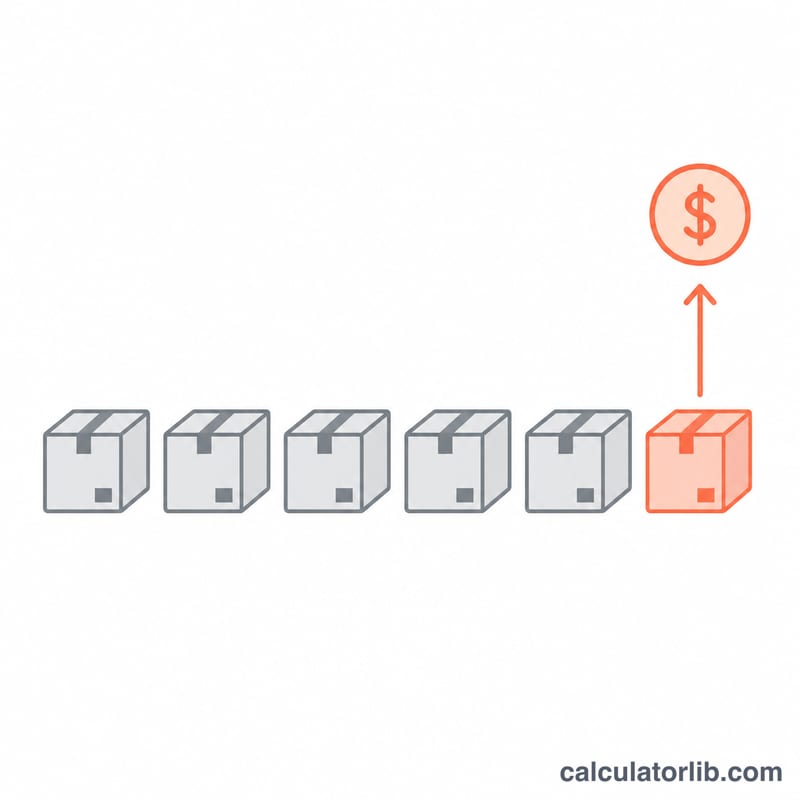
Marginal revenue (MR) is the additional revenue a business earns from selling one more unit of a good or service. It is a core concept in microeconomics and managerial decision-making because firms maximize profit where marginal revenue equals marginal cost. This calculator measures MR as the change in total revenue divided by the change in quantity sold.
How to Use This Calculator
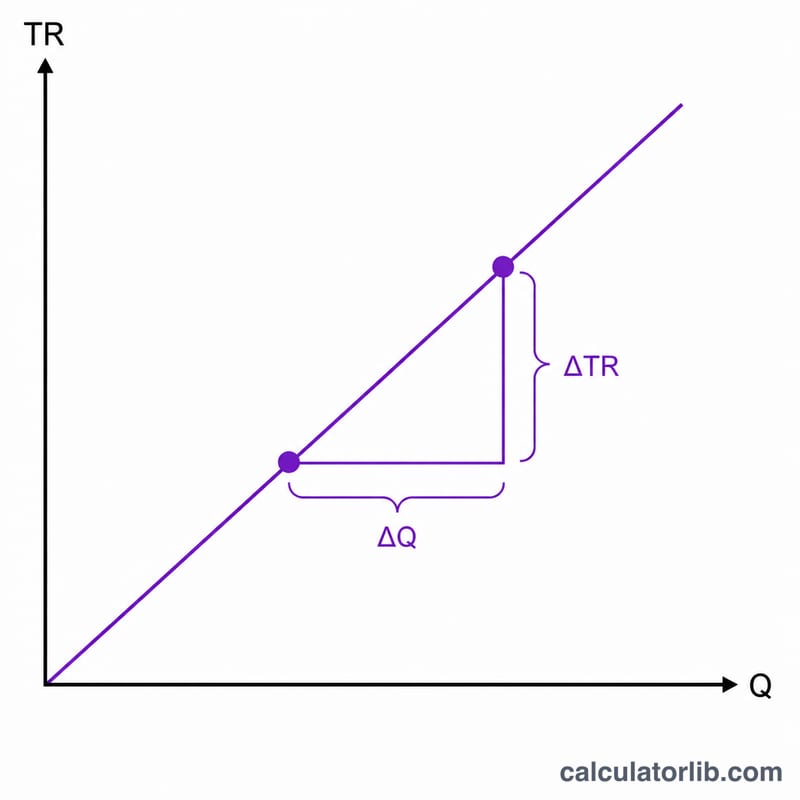
Enter your initial total revenue and quantity, then your new total revenue and quantity after a change in output. The tool computes the change in total revenue (\(\Delta TR\)) and the change in quantity (\(\Delta Q\)), then divides one by the other to give marginal revenue per additional unit.
The Formula Explained
The formula is $$\text{MR} = \frac{\Delta TR}{\Delta Q}$$ where \(\Delta TR = TR_2 - TR_1\) and \(\Delta Q = Q_2 - Q_1\). In a perfectly competitive market, MR equals the constant market price. For a firm with market power (a monopoly or monopolistic competitor), MR falls as quantity rises because the price must be lowered to sell more units.
Worked Example
Suppose a company's total revenue rises from $1,000 to $1,400 when it increases sales from 100 to 120 units. \(\Delta TR = \$1{,}400 - \$1{,}000 = \$400\), and \(\Delta Q = 120 - 100 = 20\) units. Marginal revenue $$= \frac{\$400}{20} = \$20 \text{ per unit}$$ Each of the extra 20 units brought in $20 of additional revenue on average.
FAQ
How is marginal revenue different from price? Under perfect competition they are equal, but with downward-sloping demand MR is below price because selling more requires cutting the price on all units.
Can marginal revenue be negative? Yes. If lowering price to sell more units reduces total revenue, MR becomes negative — a sign you are in the inelastic part of the demand curve.
Why does MR matter? Profit is maximized when marginal revenue equals marginal cost (\(\text{MR} = \text{MC}\)), making MR essential for pricing and output decisions.