
What Is Month-Over-Month Growth?
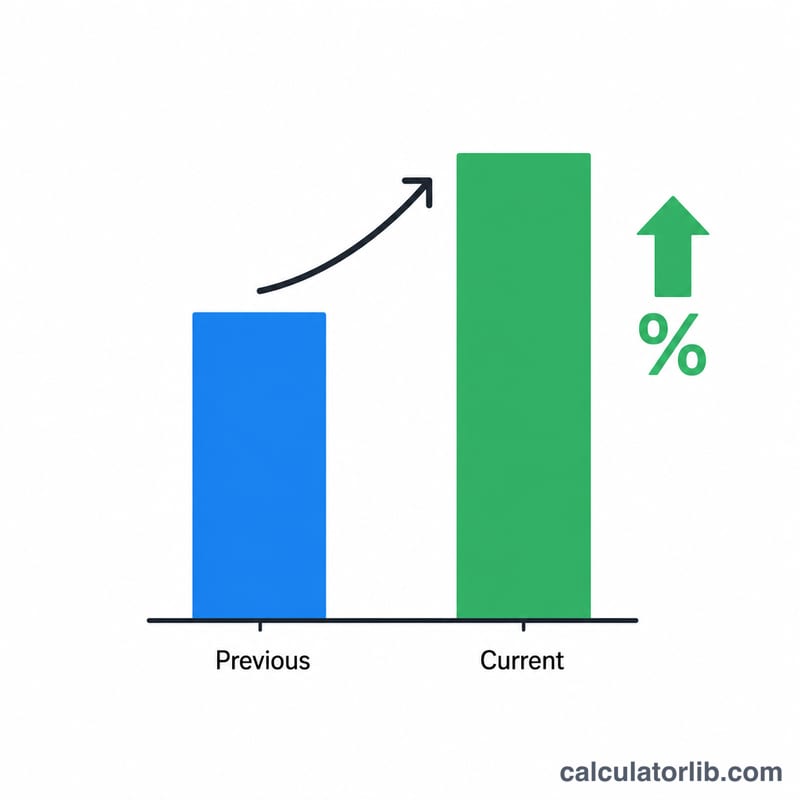
Month-over-month (MoM) growth measures how a metric changes from one month to the next, expressed as a percentage. It is one of the most common ways businesses, analysts, and marketers track short-term momentum in revenue, users, sales, subscribers, website traffic, or any value that is recorded monthly.
How to Use This Calculator
Enter the value from the previous month and the value from the current month, then read the result. A positive percentage means growth, while a negative percentage means a decline. The calculator also shows the absolute change so you can see the raw difference alongside the percentage.
The Formula Explained
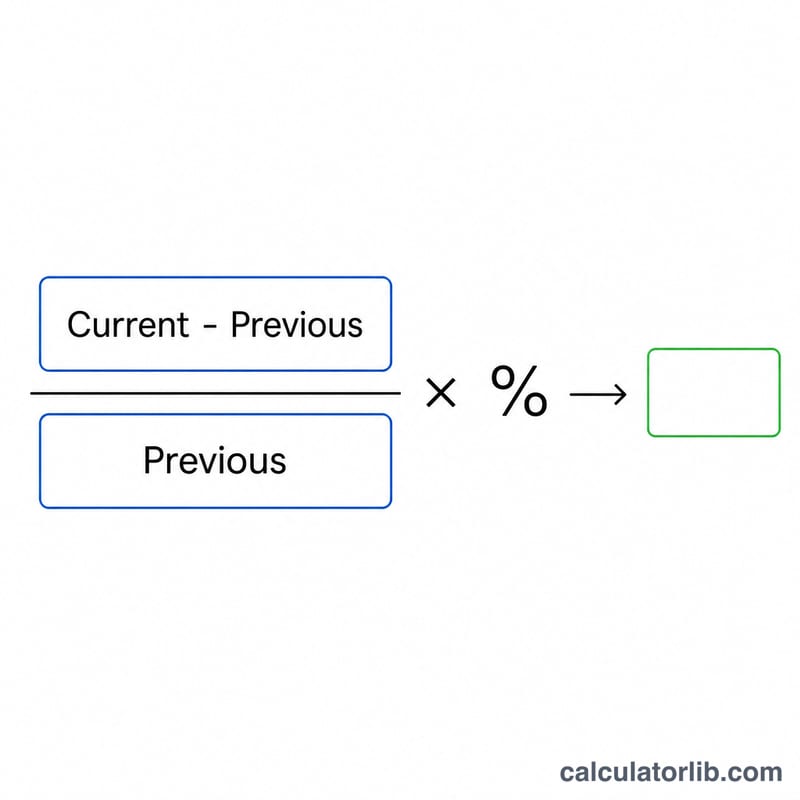
The month-over-month growth rate is calculated as:
$$\text{MoM \%} = \frac{\text{Current Month} - \text{Previous Month}}{\text{Previous Month}} \times 100$$
First subtract the previous month's value from the current month's value to find the change. Then divide that change by the previous month's value to express it relative to the starting point, and multiply by 100 to turn the ratio into a percentage.
Worked Example
Suppose your store earned $10,000 last month and $12,500 this month. The change is \(\$12{,}500 - \$10{,}000 = \$2{,}500\). Dividing by the previous month gives \(2{,}500 \div 10{,}000 = 0.25\), and multiplying by 100 yields a 25% month-over-month growth rate.
FAQ
What does a negative MoM result mean? A negative percentage indicates the metric fell compared with the previous month.
Can the previous month be zero? No. Division by zero is undefined, so a previous value of 0 cannot produce a percentage growth rate.
How is MoM different from year-over-year? MoM compares two consecutive months, while year-over-year (YoY) compares the same month across two different years, smoothing out seasonal swings.