
What Is Net Debt?
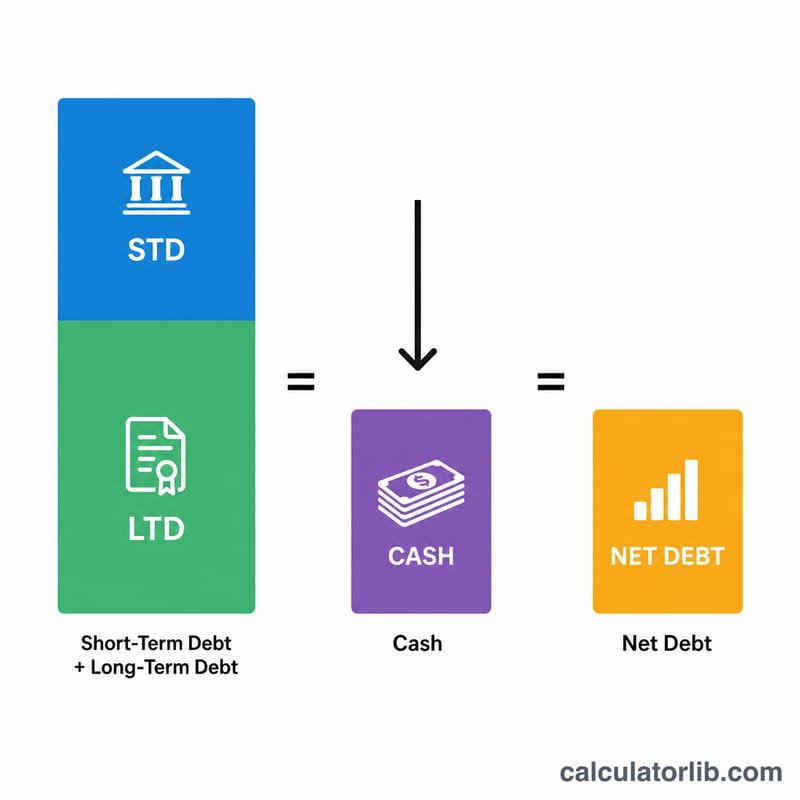
Net debt is a financial liquidity metric that measures how much debt a company would still owe if it used all of its available cash and cash equivalents to pay down its obligations. It is calculated by adding together a company's short-term and long-term interest-bearing debt and subtracting its most liquid assets. Investors, lenders, and analysts use net debt to gauge a firm's true leverage and its ability to meet obligations.
How to Use This Calculator
Enter three figures pulled directly from the balance sheet: short-term debt (debt due within one year), long-term debt (debt due beyond one year), and cash and cash equivalents (cash, money-market funds, and other highly liquid investments). The calculator instantly returns net debt along with total debt so you can see the breakdown.
The Formula Explained
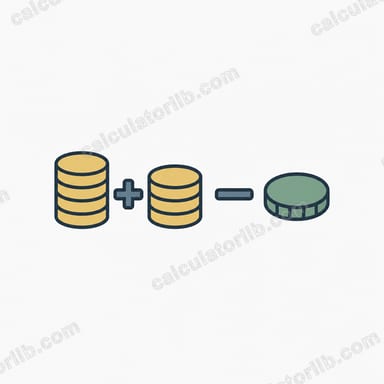
The formula is simple: $$\text{Net Debt} = \text{Short-Term Debt} + \text{Long-Term Debt} - \text{Cash and Cash Equivalents}$$ A positive result means the company owes more than its cash on hand. A negative net debt (a "net cash" position) means the company holds more cash than total debt, which is generally viewed as a sign of financial strength.
Worked Example
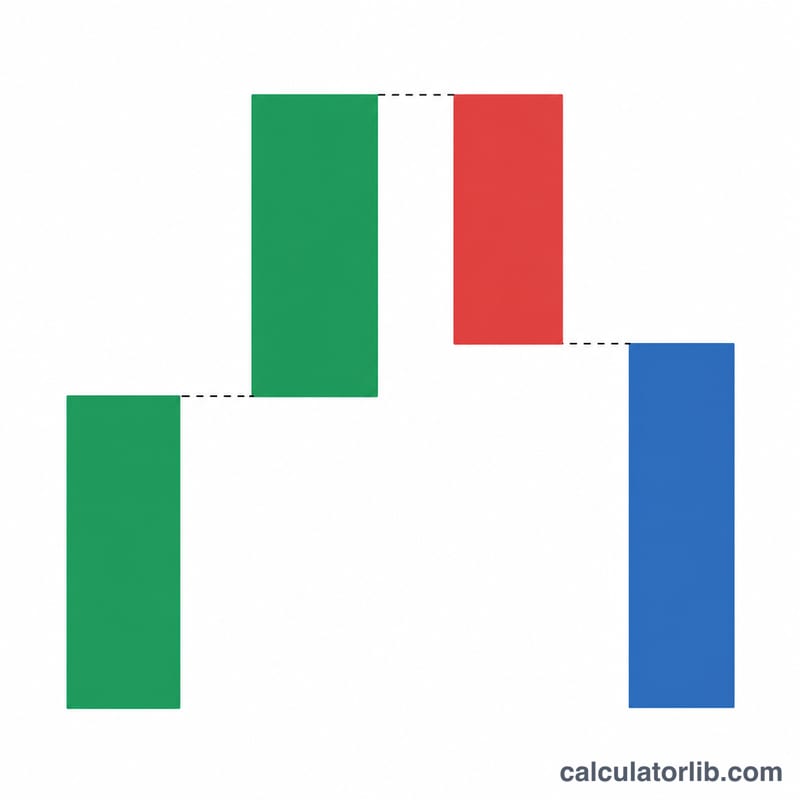
Suppose a company reports $50,000 in short-term debt, $200,000 in long-term debt, and $30,000 in cash and equivalents. Total debt is $$\$50{,}000 + \$200{,}000 = \$250{,}000$$ Subtracting $30,000 in cash gives a net debt of $220,000.
FAQ
Is a lower net debt always better? Generally yes, since it indicates less reliance on borrowed money. However, some debt can be efficient if it funds profitable growth.
What counts as cash equivalents? Short-term, highly liquid investments readily convertible to known amounts of cash, typically with maturities of three months or less.
Can net debt be negative? Yes. When cash exceeds total debt, the company is in a net cash position, which is common for cash-rich firms.