

What Is Net Profit Margin?
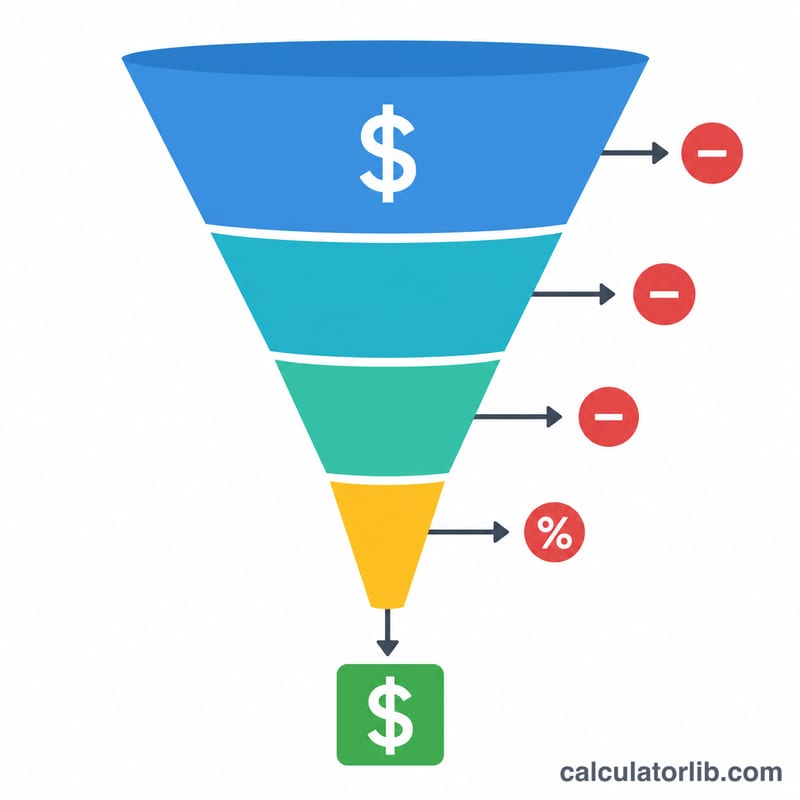
Net profit margin is one of the most important profitability ratios in business. It measures how much of every dollar of revenue a company keeps as profit after all expenses — including cost of goods sold, operating costs, interest, and taxes — have been deducted. A higher margin means a more efficient, profitable business.
How to Use This Calculator
Enter your total revenue (all sales or income for the period) and your net profit (what remains after every expense). The calculator divides net profit by revenue and multiplies by 100 to express the result as a percentage. Use figures from the same period — a month, quarter, or year — for an accurate ratio.
The Formula Explained
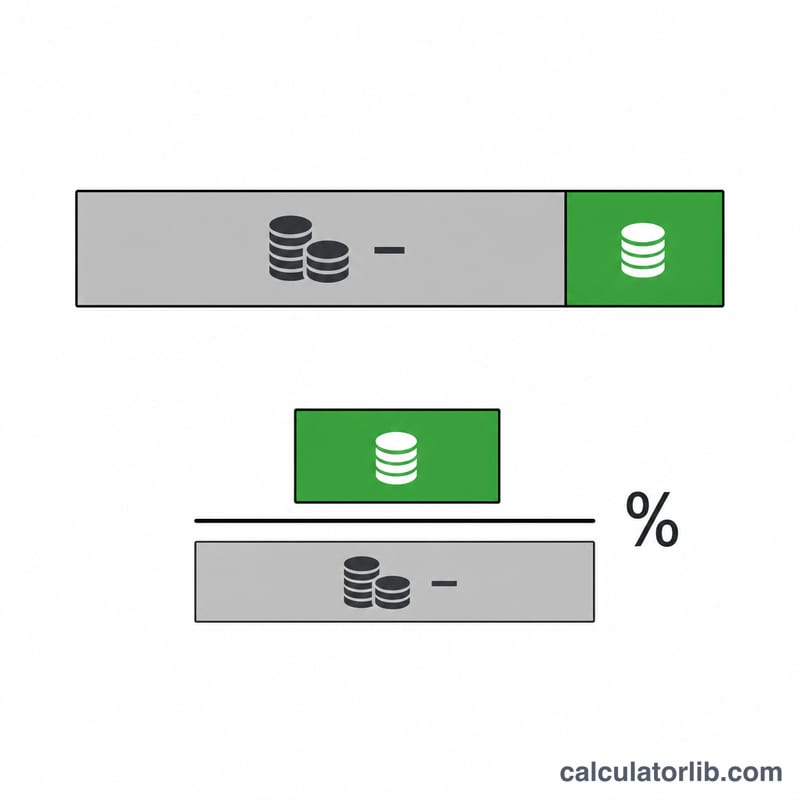
The calculation is straightforward:
$$\text{Net Profit Margin} = \frac{\text{Net Profit (\$)}}{\text{Total Revenue (\$)}} \times 100\%$$
Net profit (also called the bottom line) is total revenue minus all expenses. Revenue is the total income before any deductions. The result is a percentage that lets you compare profitability across companies and time periods regardless of size.
Worked Example
Suppose a business earns $200,000 in revenue and, after all expenses, has a net profit of $30,000. The net profit margin is $$(30{,}000 \div 200{,}000) \times 100 = 15\%$$ This means the company keeps 15 cents of profit for every dollar of sales.
Frequently Asked Questions
What is a good net profit margin? It varies by industry. A 10% margin is considered average, 20% is high, and 5% is low — but capital-intensive or low-margin industries (like retail) operate well below this.
How is net profit margin different from gross profit margin? Gross margin only subtracts the cost of goods sold, while net margin subtracts all expenses including operating costs, interest, and taxes.
Can net profit margin be negative? Yes. If expenses exceed revenue, net profit is negative, producing a negative margin — meaning the business is operating at a loss.