
What Is the Productivity Calculator?
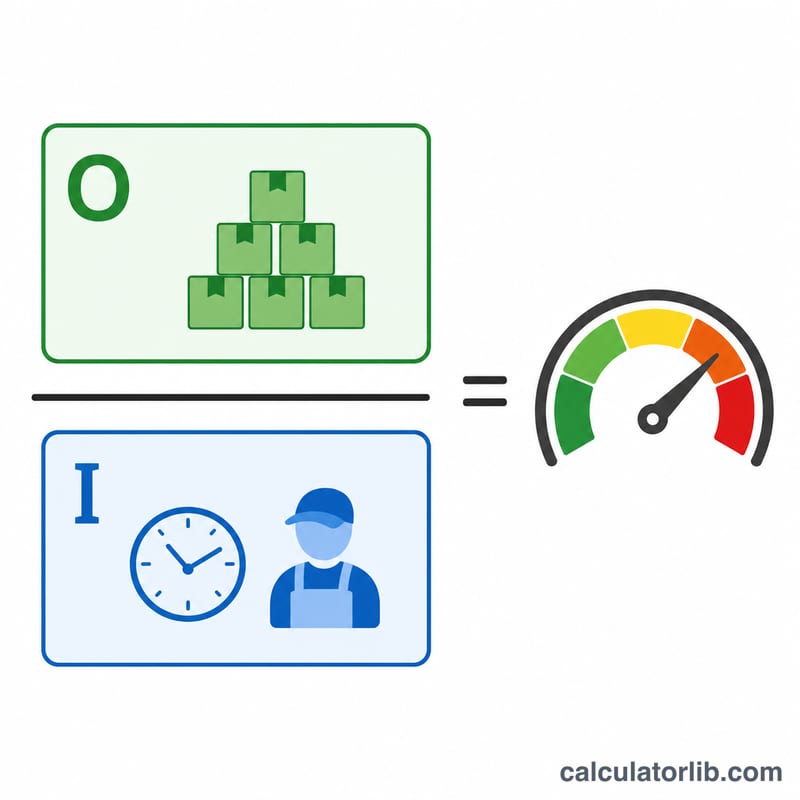
Productivity is a simple efficiency measure: how much output you generate for each unit of input. This calculator divides your total output (units produced, revenue earned, tasks completed) by your total input (labor hours, cost, or number of workers) to give a single, comparable productivity ratio. A higher number means you are getting more done per unit of resource.
How to Use It
Enter your Output — anything you can count: items manufactured, dollars of revenue, support tickets closed. Then enter your Input — the resource consumed to create that output, such as hours worked, money spent, or headcount. The calculator returns output per unit of input. Keep your units consistent across comparisons so the numbers stay meaningful over time.
The Formula Explained
The core equation is $$\text{Productivity} = \frac{\text{Output}}{\text{Input}}$$ If you produced 1,000 units using 40 labor hours, your productivity is \(1{,}000 \div 40 = 25\) units per hour. To improve productivity you either raise output without adding input, or hold output steady while reducing input.
Worked Example
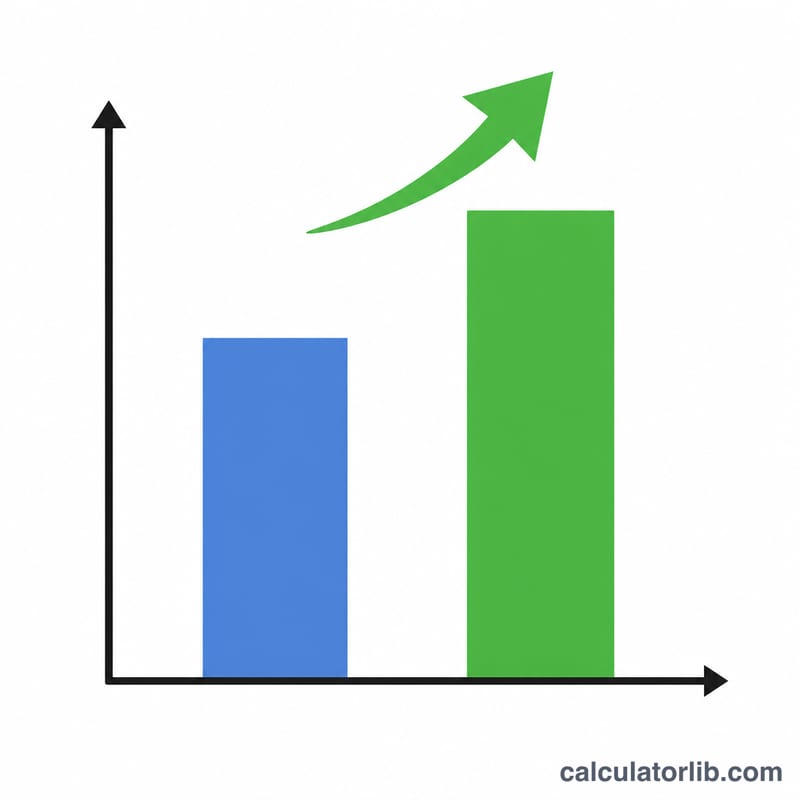
A team writes 1,200 lines of tested code in 30 hours. $$\text{Productivity} = 1{,}200 \div 30 = 40 \text{ lines per hour}$$ Next sprint they write 1,400 lines in 28 hours: \(1{,}400 \div 28 = 50\) lines per hour — a clear productivity gain.
FAQ
What units should I use? Any, as long as output and input are consistent each time you measure so results are comparable.
Can productivity be a decimal less than 1? Yes. If input exceeds output (e.g. 40 hours for 20 units), productivity is \(20 \div 40 = 0.5\) units per hour.
Is higher always better? Generally yes for efficiency, but always weigh it against quality and sustainability — pushing input too hard can hurt long-term output.