
What Is the Receivables Turnover Ratio?
The receivables turnover ratio measures how many times a business collects its average accounts receivable during a period. A higher ratio indicates efficient collection of credit sales and healthy cash flow, while a lower ratio may signal slow-paying customers or overly generous credit terms.
How to Use This Calculator
Enter your net credit sales for the period (sales made on credit, excluding cash sales and returns), then enter the beginning and ending accounts receivable balances. The calculator averages the two AR figures, divides net credit sales by that average, and reports the turnover ratio along with the equivalent days sales outstanding (DSO).
The Formula Explained
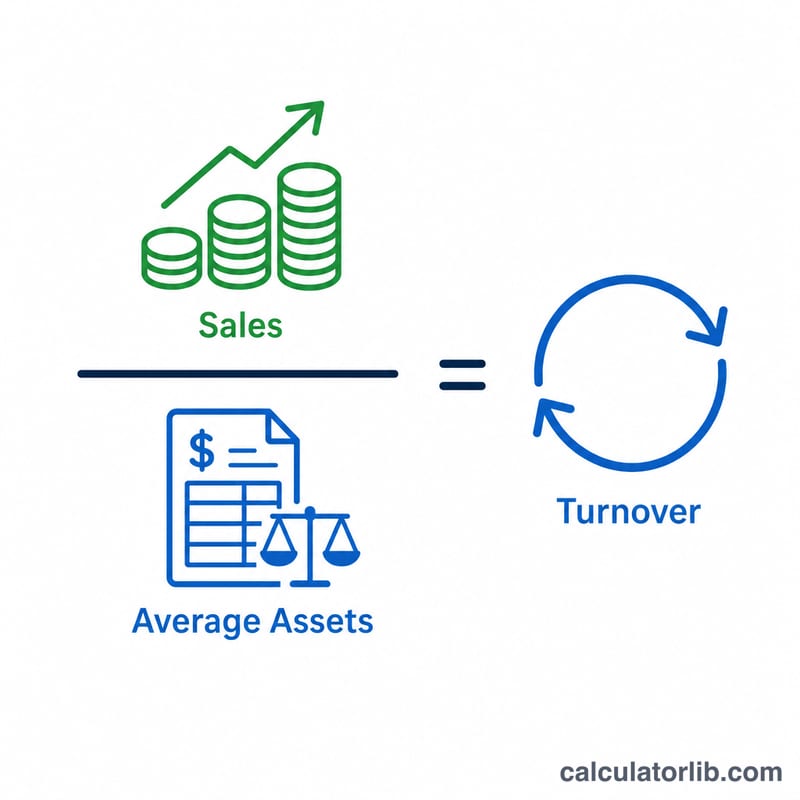
Receivables Turnover = Net Credit Sales ÷ Average Accounts Receivable, where Average AR = (Beginning AR + Ending AR) ÷ 2. To convert the ratio into days, divide 365 by the turnover ratio — this gives the average number of days it takes to collect a receivable.
$$\text{Turnover} = \frac{\text{Net Credit Sales}}{\dfrac{\text{Beginning AR} + \text{Ending AR}}{2}}$$
Worked Example
Suppose a company has net credit sales of $500,000, beginning AR of $40,000, and ending AR of $60,000. Average AR = \((40{,}000 + 60{,}000) \div 2 = \$50{,}000\). Turnover = \(500{,}000 \div 50{,}000 =\) 10 times. Days sales outstanding = \(365 \div 10 =\) 36.5 days, meaning the company collects its receivables roughly every 36 days.
$$\text{Turnover} = \frac{500{,}000}{\dfrac{40{,}000 + 60{,}000}{2}} = \frac{500{,}000}{50{,}000} = 10$$
FAQ
What is a good receivables turnover ratio? It varies by industry, but a higher ratio generally means faster collection. Compare against industry peers and your own history.
Should I use total sales or only credit sales? Use net credit sales for accuracy. If credit sales are unavailable, total net sales can be used as an approximation.
What does days sales outstanding tell me? DSO converts the ratio into the average number of days to collect payment, making it easier to interpret against your credit terms.