
What Is the Total Asset Turnover Ratio?
The total asset turnover ratio measures how efficiently a company uses its assets to generate revenue. It tells you how many dollars of net sales the business produces for every dollar invested in total assets. A higher ratio generally signals more efficient asset use, while a lower ratio may suggest underused or excess assets.
How to Use This Calculator
Enter the company's net sales for the period, then the total assets reported at the beginning and end of that period. The calculator averages the two asset figures and divides net sales by that average to produce the turnover ratio.
The Formula Explained
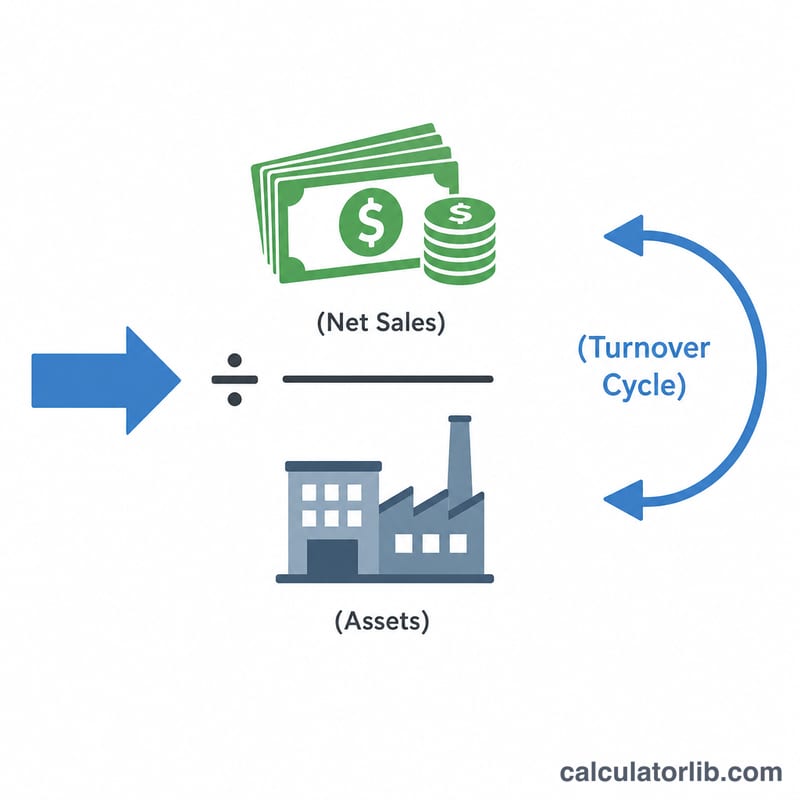
$$\text{Asset Turnover} = \frac{\text{Net Sales}}{\dfrac{\text{Beginning Assets} + \text{Ending Assets}}{2}}$$ where \(\text{Average Total Assets} = \dfrac{\text{Beginning Assets} + \text{Ending Assets}}{2}\). Using the average smooths out changes in the asset base across the period, giving a fairer view of efficiency than a single point-in-time balance.
Worked Example
Suppose a company has net sales of $500,000, beginning total assets of $200,000, and ending total assets of $300,000. $$\text{Average Total Assets} = \frac{200{,}000 + 300{,}000}{2} = 250{,}000$$ $$\text{Asset Turnover} = \frac{500{,}000}{250{,}000} = 2.0$$ The company generates $2.00 in sales for every $1.00 of assets.
FAQ
What is a good asset turnover ratio? It varies by industry. Retailers and service firms often have high ratios, while capital-intensive industries like utilities and manufacturing tend to have lower ratios. Compare against industry peers.
Why use average total assets instead of ending assets? Sales are earned over the whole period, so averaging the opening and closing balances better reflects the assets available throughout that period.
Can the ratio be less than 1? Yes. A ratio below \(1\) means the company generates less than a dollar of sales per dollar of assets, common in asset-heavy industries.