

What Is Working Capital?
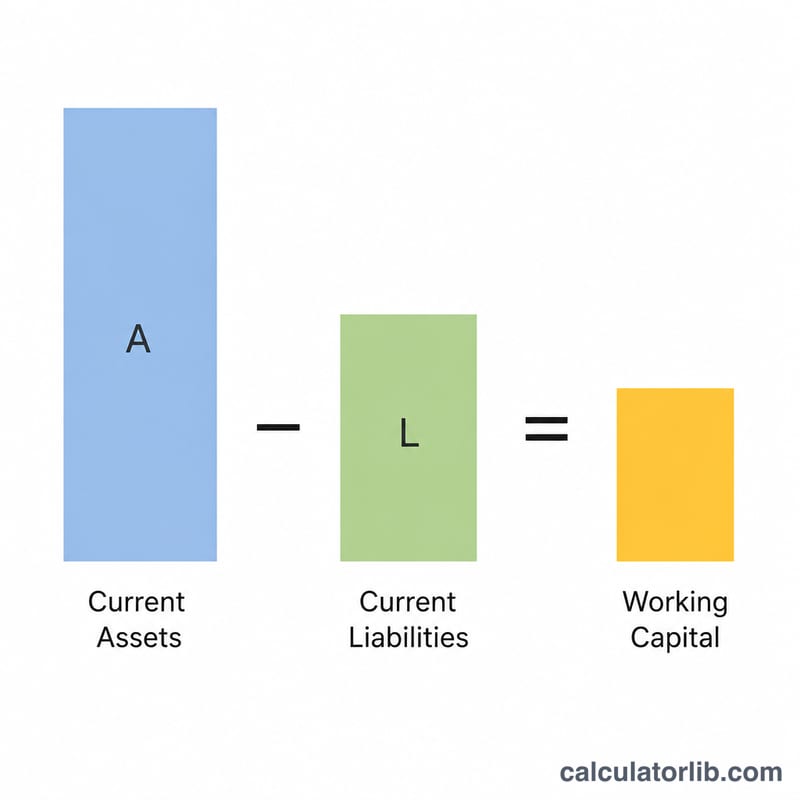
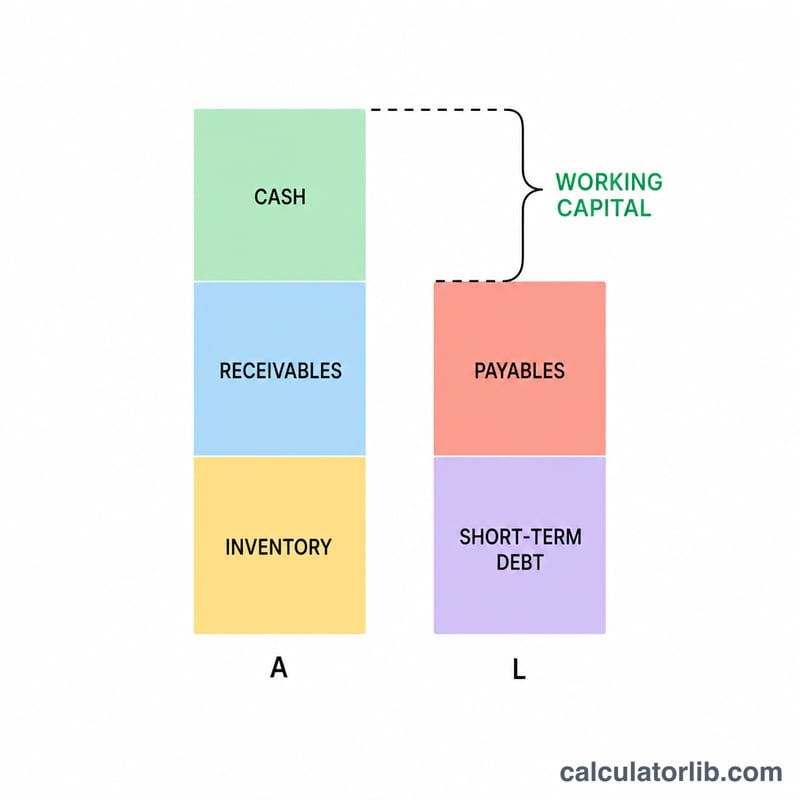
Working capital is the money a business has available to fund its day-to-day operations. It is calculated by subtracting current liabilities (debts and obligations due within one year) from current assets (cash, receivables, inventory, and other assets expected to convert to cash within a year). Positive working capital means a company can comfortably cover its short-term obligations; negative working capital can signal liquidity problems.
How to Use This Calculator
Enter your total current assets and total current liabilities in dollars. The calculator instantly returns your working capital and your current ratio. Use figures from your most recent balance sheet for the most accurate snapshot of liquidity.
The Formula Explained
The core equation is simple: $$\text{Working Capital} = \text{Current Assets} - \text{Current Liabilities}$$ We also compute the $$\text{Current Ratio} = \frac{\text{Current Assets}}{\text{Current Liabilities}}$$ a related metric where a value above 1.0 generally indicates the business can pay its short-term debts.
Worked Example
Suppose a company has $150,000 in current assets and $90,000 in current liabilities. $$\text{Working Capital} = \$150{,}000 - \$90{,}000 = \$60{,}000$$ The current ratio $$= \$150{,}000 \div \$90{,}000 \approx 1.67$$ meaning current assets cover liabilities about 1.67 times over.
FAQ
Is more working capital always better? Not necessarily. Excessive working capital may mean idle cash or too much inventory that could be invested more productively.
What is negative working capital? It occurs when current liabilities exceed current assets, which may indicate cash flow stress — though some efficient retail businesses operate this way intentionally.
What's a healthy current ratio? A ratio between 1.5 and 3.0 is often considered healthy, but ideal levels vary by industry.