

What Is the Capital Gains Tax Calculator?
This calculator estimates US federal capital gains tax when you sell an asset such as stocks, mutual funds, crypto, or real estate. It applies to United States federal taxes only and uses 2024-era rules; it does not include state taxes, the 3.8% Net Investment Income Tax, or special collectibles/real-estate-depreciation rates. Always confirm figures with a tax professional.
How to Use It
Enter your cost basis (what you paid, including commissions) and the sale price (your proceeds). Choose whether the holding period was long term (more than one year) or short term (one year or less). Then enter the relevant tax rate: for long-term gains the federal rate is 0%, 15%, or 20% based on your taxable income; for short-term gains use your ordinary marginal income rate (10%–37%).
The Formula Explained
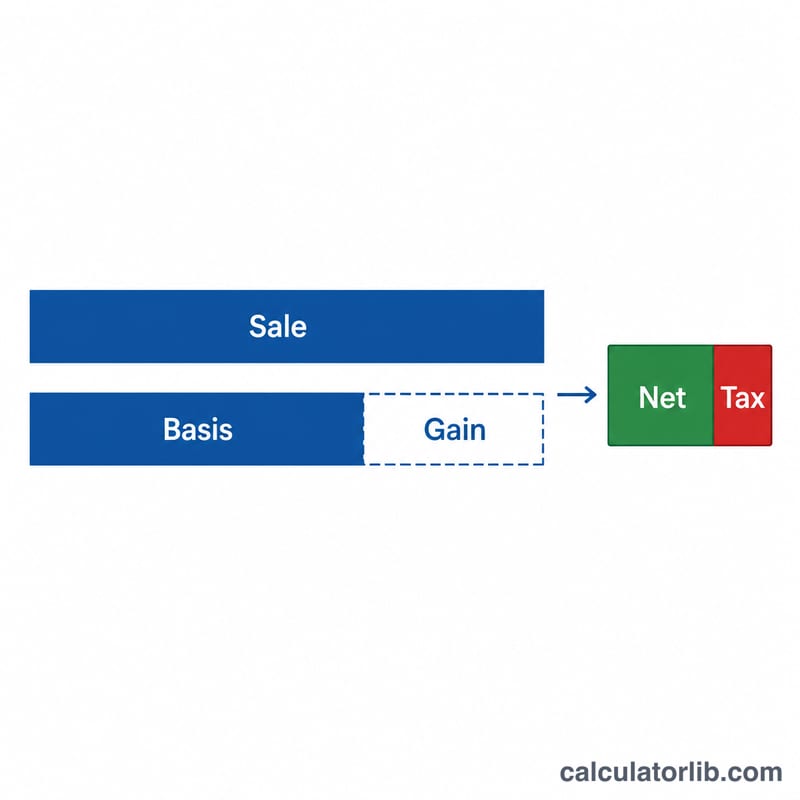
First the gain is computed as Sale Price − Cost Basis. If the gain is positive, the tax is Gain × Rate, where the rate depends on the holding period. Long-term gains receive preferential rates, which is why holding an asset past one year can significantly reduce tax. If there is no gain (a loss or break-even), no capital gains tax is due.
$$\text{Tax} = \left( \text{Sale} - \text{Purchase} \right) \times \frac{\text{LTCG Rate (\%)}}{100}$$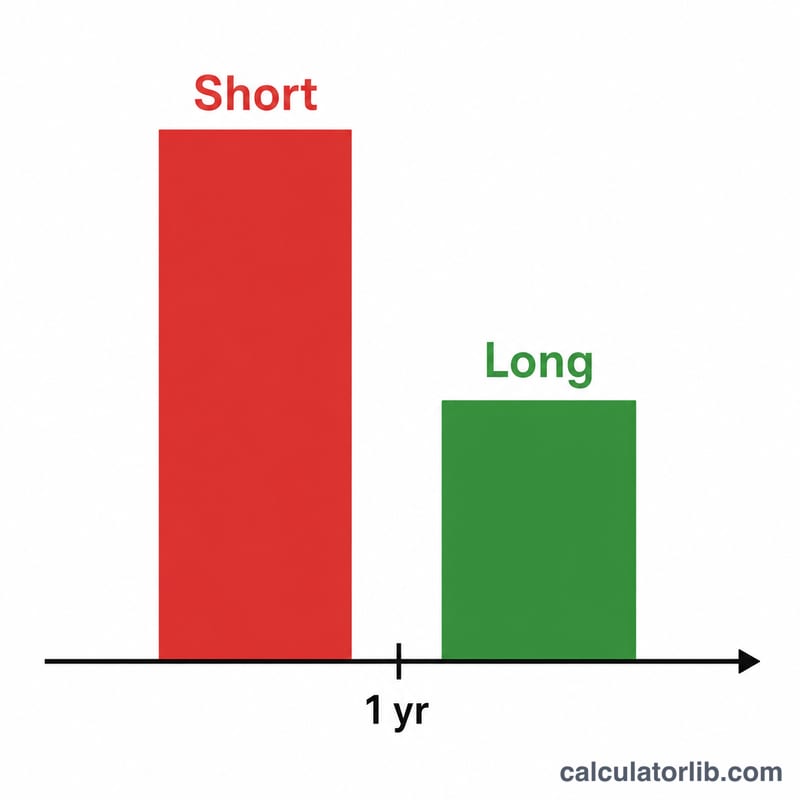
Worked Example
Suppose you bought stock for $10,000 and sold it for $15,000, holding it over a year, with a 15% LTCG rate. Your gain is \(\$15{,}000 - \$10{,}000 = \$5{,}000\). The tax is \(\$5{,}000 \times 15\% = \$750\). Your net gain after tax is $4,250 and your net proceeds are $14,250. Had this been a short-term gain at a 24% marginal rate, the tax would be $1,200 instead.
FAQ
What is the difference between long-term and short-term? Assets held more than one year qualify for lower long-term rates; assets held one year or less are taxed as ordinary income.
Does this include state taxes? No. Many states also tax capital gains. Add your state rate separately for a full picture.
What if I sold at a loss? A loss produces no capital gains tax here and may be deductible against other gains or income on your return.