
What is the Oval Tank Volume Calculator?
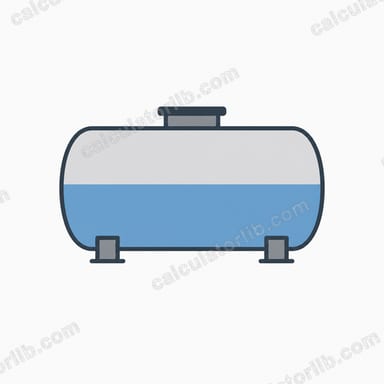
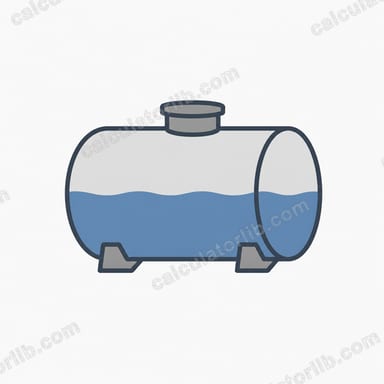
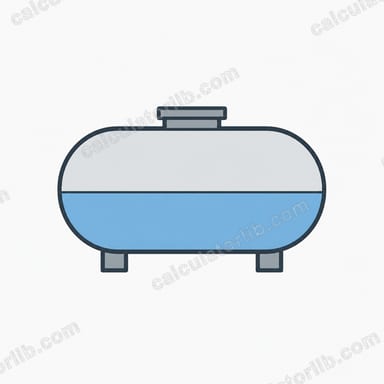
This tool computes the capacity of an oval — also called a stadium or capsule — tank. The cross-section is a flat-sided shape with two perfectly rounded (semicircular) ends, common in fuel tanks, water cisterns, fish tanks and many tanker trailers. Enter the overall width, height and length and the calculator returns the volume in liters, cubic centimeters and US gallons.
How to use it
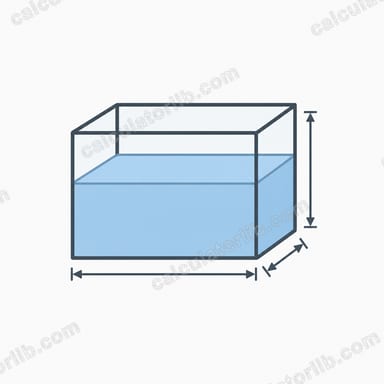
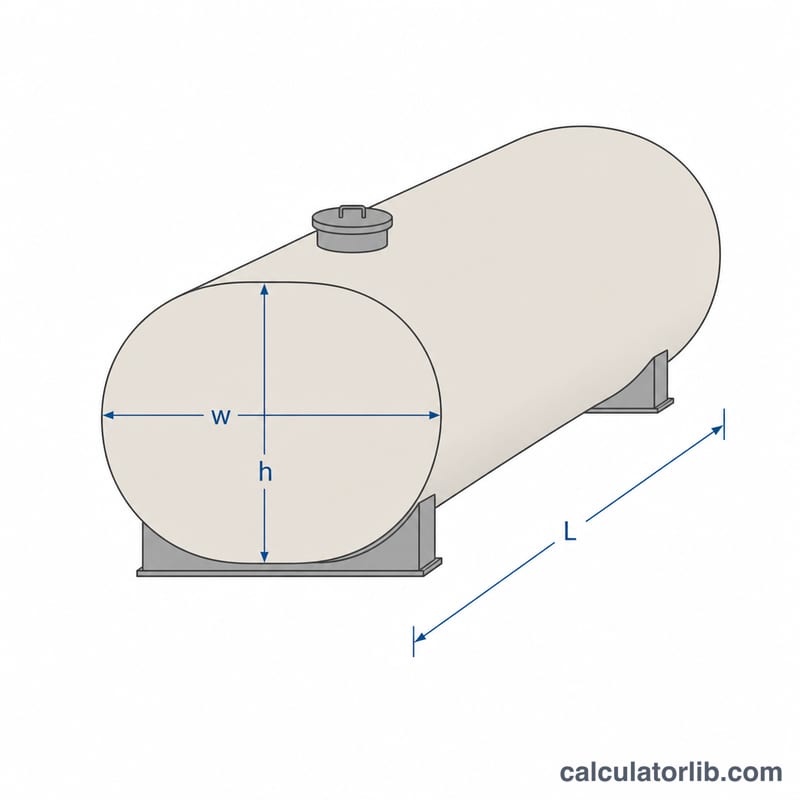
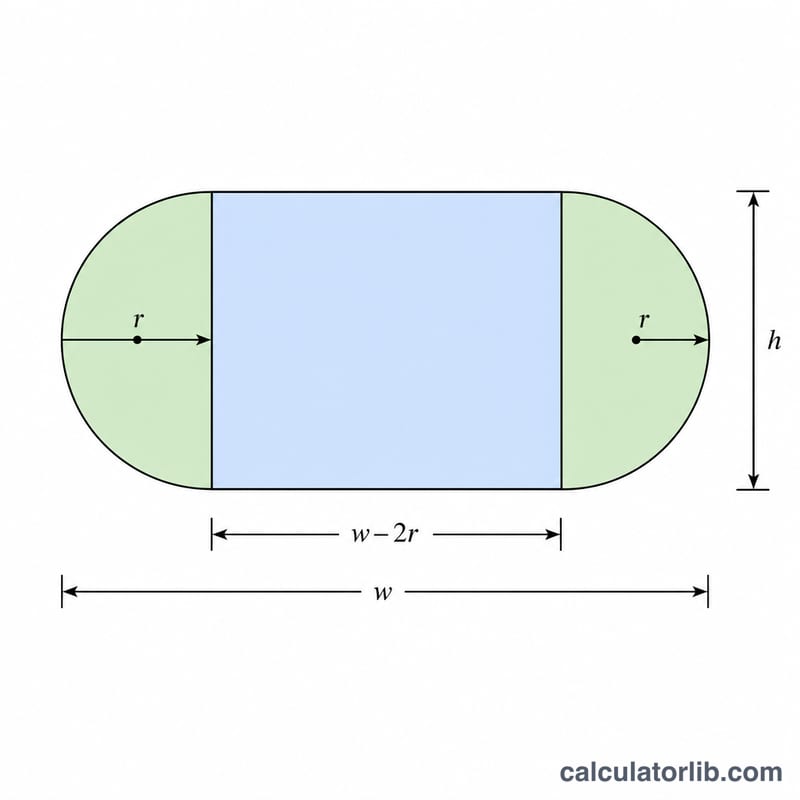
Measure the three dimensions of the tank with consistent units (centimeters here). Width is the longest horizontal span of the oval face, height is the vertical span, and length is the straight depth of the tank. Type the values and read off the result. Because the rounded ends use a radius of half the height, the width must be at least equal to the height for a true stadium shape.
The formula explained
The end caps form two semicircles of radius \(r = h/2\), which together make one full circle of area \(\pi r^{2}\). Between them sits a rectangle whose height equals the full height (\(2r\)) and whose width is what is left over, \((w - 2r)\). So the cross-sectional area is $$A = \pi r^{2} + 2r(w - 2r).$$ Multiplying by the tank length \(L\) gives the volume: $$V = A \cdot L.$$ Dividing cm³ by 1000 yields liters; dividing by 3785.41 yields US gallons.
Worked example
For a tank with width 120 cm, height 80 cm and length 200 cm: \(r = 40\) cm. $$\text{Area} = \pi \cdot 40^{2} + 2 \cdot 40 \cdot (120 - 80) = 5026.548 + 3200 = 8226.548 \text{ cm}^{2}.$$ $$V = 8226.548 \times 200 = 1{,}645{,}309.6 \text{ cm}^{3} \approx 1{,}645.31 \text{ liters} \approx 434.6 \text{ US gallons}.$$
FAQ
What if width equals height? Then \(w - 2r = 0\) and the shape becomes a pure cylinder lying on its side, \(V = \pi r^{2} L\).
Can I use other units? Yes — just keep all three dimensions in the same unit. If you enter inches, the cm³ value is actually cubic inches, so use a unit converter for liters/gallons.
Does this account for wall thickness? No. It calculates the geometric internal volume from the dimensions you provide, so measure inside dimensions for true fill capacity.