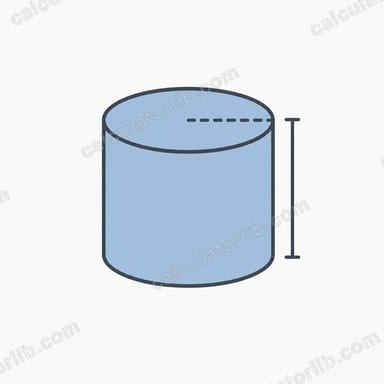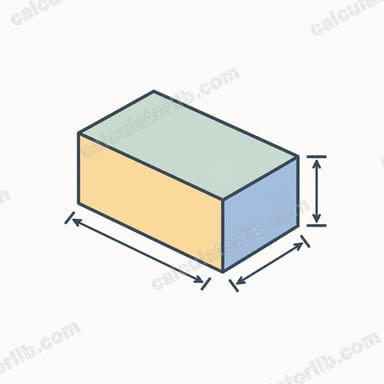

What is the Bucket Volume Calculator?
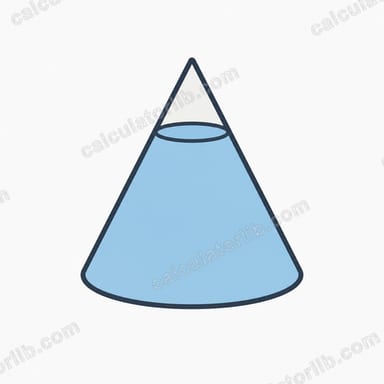
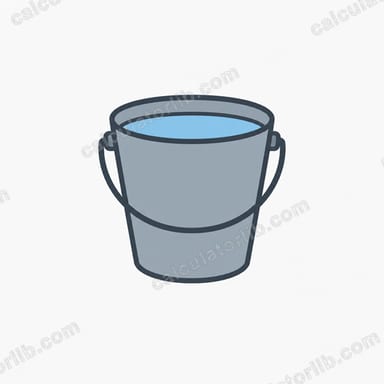
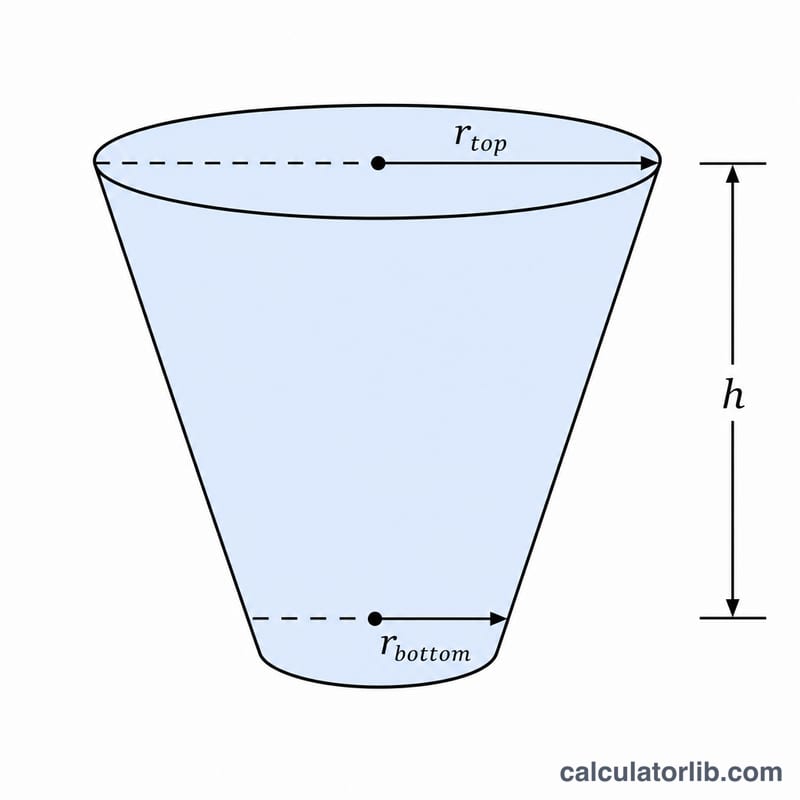
Most buckets are not simple cylinders — they taper, with a wider opening at the top than the base. This makes them a conical frustum (a cone with the tip sliced off). This calculator computes the true capacity of such a bucket from three measurements: the top diameter, the bottom diameter, and the vertical height. Results are shown in liters, US gallons, and UK (imperial) gallons.
How to use it
Measure the inside diameter across the top opening, the inside diameter across the bottom, and the inside height of the bucket — all in centimeters. Enter the three values and the calculator returns the brim-full capacity. For a straight-sided cylindrical container, simply enter the same value for both the top and bottom diameter.
The formula explained
The volume of a frustum is V = (πh/3)(r₁² + r₁r₂ + r₂²), where r₁ and r₂ are the top and bottom radii and h is the height. Because radius is half the diameter, the equation is equivalent to V = (πh/12)(D_top² + D_top·D_bottom + D_bottom²). The result is in cubic centimeters; dividing by 1000 gives liters, and dividing liters by 3.7854 or 4.5461 gives US or UK gallons.
Worked example
A bucket with a 26 cm top diameter, 22 cm bottom diameter and 30 cm height has radii of 13 cm and 11 cm. V = (π·30/3)(13² + 13·11 + 11²) = (10π)(169 + 143 + 121) = 10π·433 ≈ 13,603 cm³ ≈ 13.6 liters, or about 3.59 US gallons.
Practical Fill Recommendations
The calculated volume is the brim-full capacity — the amount a bucket holds right up to the rim. In real use you almost never want to fill that high, so apply these guidelines:
- Leave freeboard. Fill to roughly 85–90% of the brim-full volume so liquid does not slosh over when you lift or carry the bucket. For the 22.8 L pail above, a safe working fill is about \(22.8 \times 0.88 \approx 20\) liters.
- Measure the inside dimensions. Use the internal top and bottom diameters and the internal height, not the outside of the bucket. Wall thickness, a rolled rim and a recessed base can each shave off useful volume.
- Round down for working volume. When mixing recipes (paint, concrete, feed, cleaning solution) round the result down to a convenient number. It is easier to add a little more than to deal with an overflow.
- Account for displacement. If the bucket will hold objects, tools or a submerged item (like a second container), reduce the available liquid volume accordingly.
- Mind the carry weight. Water weighs about 1 kg per liter, so a 20 L fill is roughly 20 kg plus the bucket — often the real limit on how much you should put in.
This is general guidance for everyday measuring and mixing tasks; for applications with safety, dosing or regulatory requirements, follow the relevant product or professional instructions.
FAQ
Does it account for the taper? Yes — using both diameters models the true cone shape, unlike a simple cylinder estimate.
Is this brim-full or working volume? It is the full geometric volume. Subtract a margin for practical fill levels.
Can I use inches? This version expects centimeters. Convert inches to cm by multiplying by 2.54 first.