What This Calculator Does
The Hot Tub Volume Calculator estimates how much water your spa holds, in US gallons, liters and cubic feet. Knowing your tub's capacity is essential for correctly dosing chemicals like chlorine, bromine, pH adjusters and shock, since dosing instructions are almost always given "per gallons of water." It also helps you estimate fill time and heating costs.
How to Use It
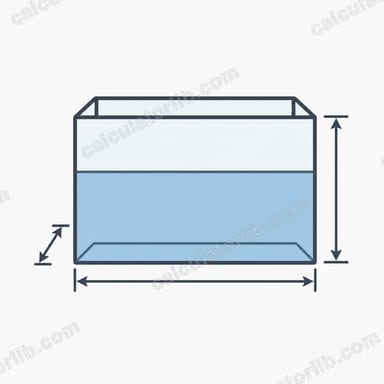
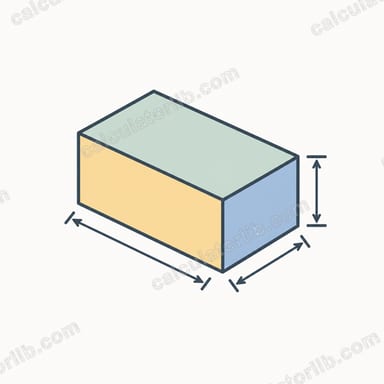
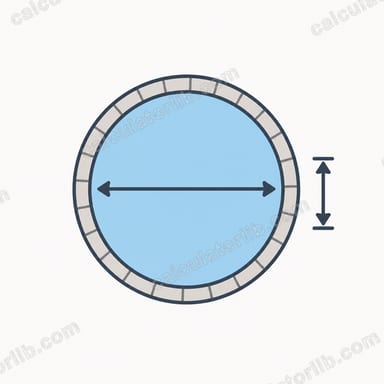
Choose your tub shape — round or square/rectangular. For a round tub, enter the inside diameter across the top in feet. For a square or rectangular tub, enter the length and width. Then enter the average water depth (not the cabinet height — measure from the floor of the seating area to the typical fill line). The calculator returns the approximate water volume.
The Formula Explained
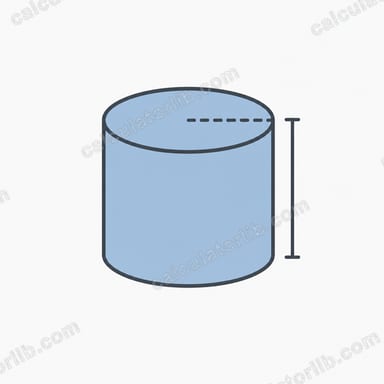
Volume in cubic feet is the surface area of the water times its depth. For a round tub the surface area is \(\pi \cdot r^2\) where \(r\) is half the diameter; for a rectangular tub it is \(\text{length} \times \text{width}\). Multiply cubic feet by 7.48 to convert to US gallons (one cubic foot holds 7.48 gallons):
Round: $$V = \pi \cdot r^2 \cdot d \cdot 7.48$$ Square: $$V = L \cdot W \cdot d \cdot 7.48$$

Worked Example
A round hot tub has a 7 ft diameter and an average water depth of 3 ft. The radius is 3.5 ft, so the surface area is \(\pi \cdot 3.5^2 \approx 38.48 \text{ ft}^2\). Multiplied by 3 ft of depth gives \(\approx 115.45 \text{ ft}^3\). Times 7.48 yields about 863.6 gallons. Most hot tubs hold less because seats and shells displace water — this gives a useful upper estimate.

Typical Hot Tub Capacities by Size and Seating
The figures below are typical ranges only and vary by manufacturer, seat design and fill level. Gallons are US gallons. If your manual gives a capacity, use that instead of this table.
| Type | Typical dimensions (ft) | Typical capacity (US gal) | Typical capacity (liters) |
|---|---|---|---|
| 2-person | about 4-5 × 5-6 | 150-250 | 570-950 |
| 4-person | about 6-7 × 6-7 | 250-350 | 950-1,325 |
| 6-person | about 7-7.5 × 7-7.5 | 300-450 | 1,135-1,700 |
| 8-person | about 8 × 8 | 400-600 | 1,515-2,270 |
| Plug-and-play (110-120 V) | about 5-7 × 5-7 | 200-400 | 760-1,515 |
| Swim spa | about 12-19 long × 7.5-8 wide | 1,500-3,000 | 5,700-11,360 |
Two tubs with the same seating count can differ noticeably in volume because of seat shape, footwell depth and foam or cabinet design.
Gallon, Liter and Cubic Foot Conversions
Key conversion factors
- 1 cubic foot = 7.48052 US gallons = 28.3168 liters
- 1 US gallon = 3.78541 liters = 0.13368 ft³
- 1 liter = 0.26417 US gallons
- 1 cubic meter = 264.172 US gallons
The calculator's formula uses the rounded factor 7.48 gallons per cubic foot, which is accurate enough for a hot tub estimate. Note that an imperial (UK) gallon is larger, about 4.546 liters, so check which gallon a manual uses.
Sample conversions
| US gallons | Liters | Cubic feet |
|---|---|---|
| 300 | 1,135.6 | 40.10 |
| 400 | 1,514.2 | 53.47 |
| 500 | 1,892.7 | 66.84 |
| 600 | 2,271.2 | 80.21 |
Practical Tips for Using Your Volume Estimate
- Prefer the manufacturer's stated capacity if you have it (manual, spec sheet or data plate). It accounts for the real interior shape.
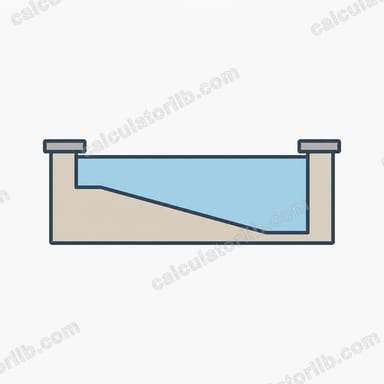
- Allow for displacement. A simple geometric formula treats the tub as an empty cylinder or box. Seats, steps and jets take up space, so the real water volume is often roughly 10-25% lower. Example: a round tub 7 ft across and 3.5 ft deep gives \(\pi \times 3.5^2 \times 3.5 \times 7.48 \approx 1{,}007\) gallons from the formula, but with 10-25% displacement the real figure is closer to 755-907 gallons.
- Verify by measurement. Read a water meter while filling, or time a hose fill: measure the flow with a bucket of known size, for example seconds per 5 gallons, and multiply by the fill time.
- Measure at the normal operating level. Use the depth to the usual fill line (typically near the skimmer or a few inches below the rim), not the full interior height.
- Dose chemicals by the label. Use the product's per-gallon instructions with your adjusted volume, and avoid overdosing if you are unsure. It is better to add a little, retest and adjust.
- Account for bathers. People displace water and raise the level, and splashing and evaporation lower it. Top up after use to the fill line, and recheck your chemical levels after adding a lot of fresh water.
This is general information, not professional advice. Follow your hot tub manufacturer's and chemical suppliers' instructions for safety and water care.
FAQ
Why is my actual fill less than this number? Built-in seats, footwells and the curved shell displace water, so real capacity is typically 10–25% lower than the box calculation.
What depth should I use? Use the average water depth at your normal fill line, not the total cabinet height.
Round vs square? Round tubs use diameter (\(\pi \cdot r^2\)); square/rectangular tubs use \(\text{length} \times \text{width}\). Pick the shape that matches your spa.