
What Is the Volume of a Sphere?
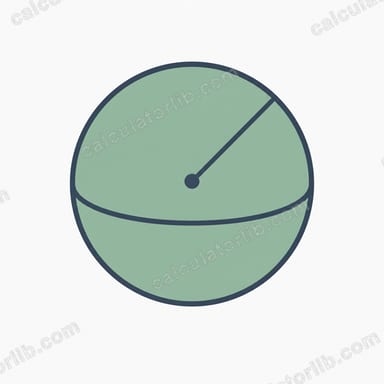
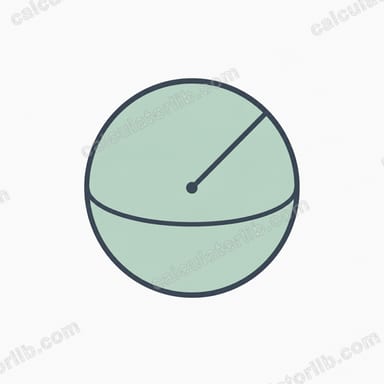
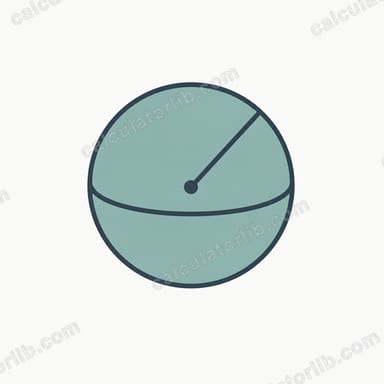
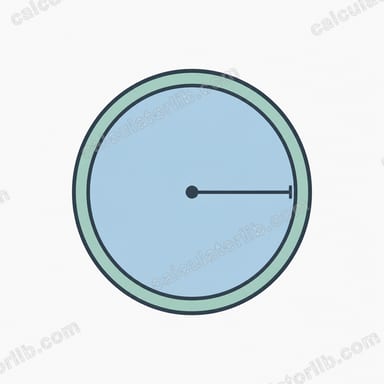
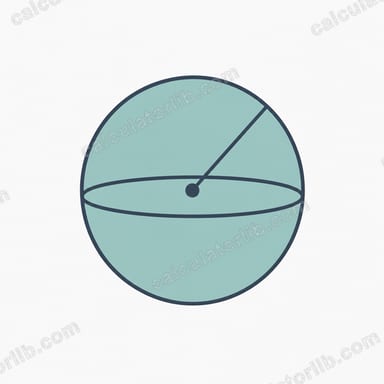
A sphere is a perfectly round three-dimensional object where every point on the surface is the same distance (the radius, \(r\)) from its center. The volume measures how much space the sphere occupies. This calculator computes that volume from a single input — the radius — and also reports the diameter and surface area for convenience.
The Formula
The volume of a sphere is given by:
$$V = \frac{4}{3} \pi \left(\text{Radius}\right)^{3}$$Here \(r\) is the radius and \(\pi\) (pi) \(\approx 3.14159\). Because the radius is cubed, volume grows very quickly as the sphere gets bigger — doubling the radius makes the volume eight times larger. The result is always in cubic units (the cube of whatever unit you used for the radius).
How to Use It
Enter the radius of your sphere in any unit (cm, m, inches, etc.) and the calculator instantly returns the volume in the matching cubic units, along with the diameter (\(2r\)) and surface area (\(4\pi r^{2}\)). If you only know the diameter, divide it by 2 first to get the radius.
Worked Example
Suppose a ball has a radius of 5 cm. Then:
$$V = \frac{4}{3} \times \pi \times 5^{3} = \frac{4}{3} \times \pi \times 125 = 166.667 \times \pi \approx 523.6 \text{ cm}^{3}.$$Its surface area is \(4 \times \pi \times 5^{2} = 100\pi \approx 314.16 \text{ cm}^{2}\), and its diameter is 10 cm.
FAQ
What if I have the diameter instead of the radius? Divide the diameter by 2 to get the radius, then enter that value.
What units does the answer use? Whatever unit you enter for the radius, cubed. A radius in meters gives cubic meters.
Why is \(\pi\) used? Pi appears in every formula involving circles and spheres because it relates a circle's circumference and area to its radius; integrating circular cross-sections of a sphere produces the \(\frac{4}{3}\pi r^{3}\) result.