
What this calculator does
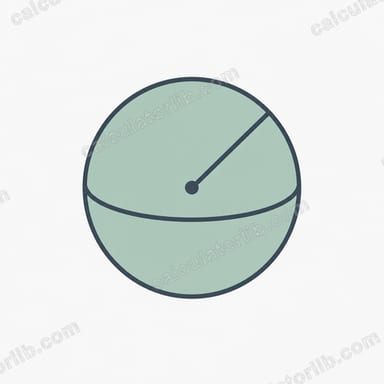
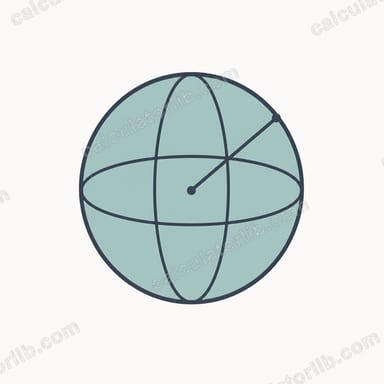
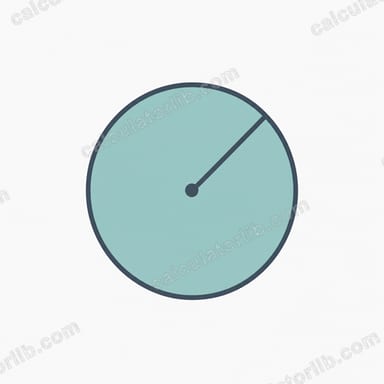
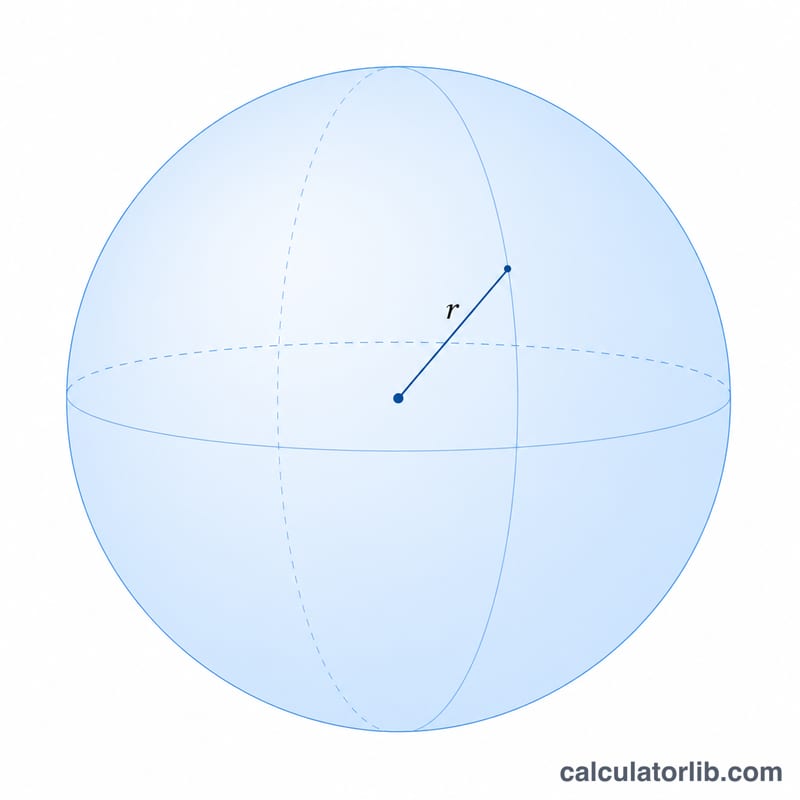
This tool computes the volume and surface area of a perfect sphere from a single input: its radius. A sphere is the set of all points in three-dimensional space that are the same distance (the radius) from a central point. The calculations are pure geometry and apply identically everywhere, so no country-specific rules are involved.
How to use it
Enter the radius in any length unit you like — meters, centimeters, inches, feet, and so on. Because no unit conversion is applied, the answers come back in matching units: the volume in that unit cubed (unit³) and the surface area in that unit squared (unit²). For example, if you enter the radius in centimeters, the volume is in cubic centimeters and the surface area in square centimeters.
The formulas explained
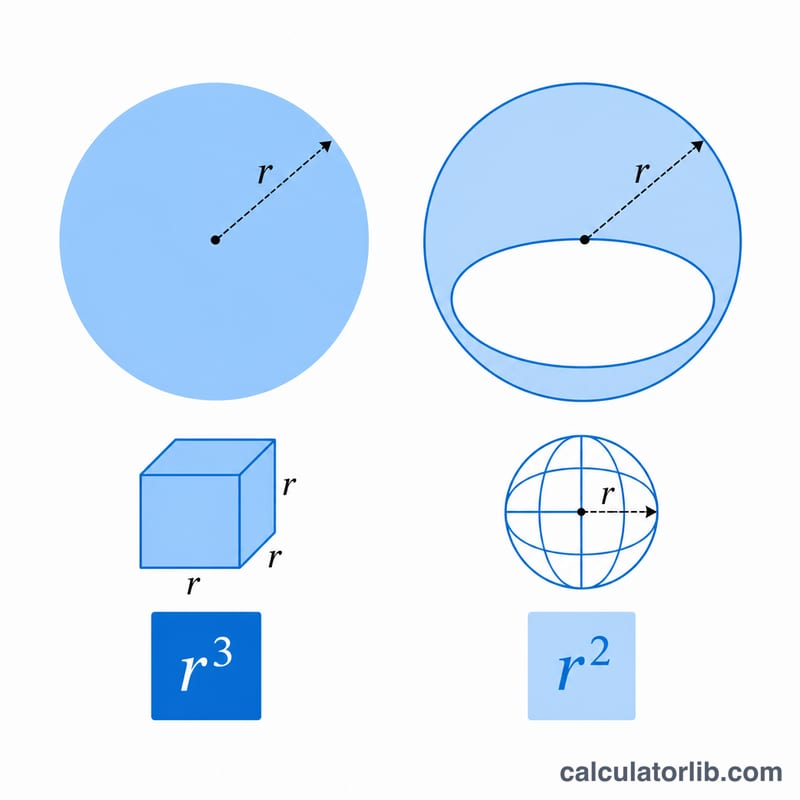
The volume of a sphere is $$V = \frac{4}{3}\times\pi\times r^{3}$$ and the surface area is $$S = 4\times\pi\times r^{2}$$ where \(r\) is the radius and \(\pi\) (pi) is approximately \(3.14159265\). Volume grows with the cube of the radius, so doubling the radius makes the volume eight times larger, while surface area grows with the square, becoming four times larger.
Worked example
Suppose the radius is 2. The volume is $$V = \frac{4}{3}\times\pi\times 2^{3} = \frac{32}{3}\times\pi \approx 33.51032164$$ cubic units. The surface area is $$S = 4\times\pi\times 2^{2} = 16\pi \approx 50.26548246$$ square units.
FAQ
What if my radius is zero? A radius of 0 is a single point, giving a volume and surface area of 0 — a valid degenerate case.
Can I enter a diameter instead? No — divide the diameter by 2 first, since the radius is half the diameter.
Why are the units cubed and squared? Volume is a three-dimensional measure (length \(\times\) length \(\times\) length) and surface area is two-dimensional (length \(\times\) length), so they inherit cubed and squared units respectively.