
What this calculator does
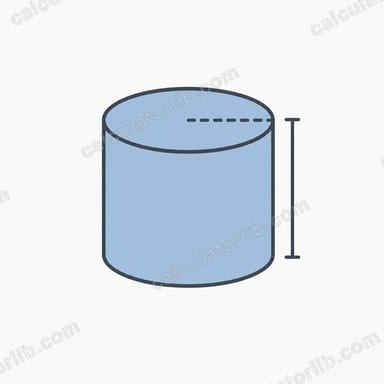
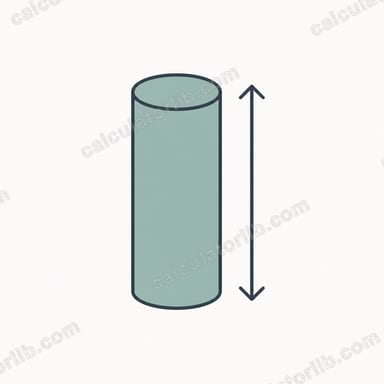
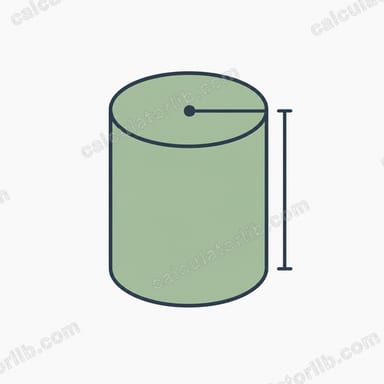
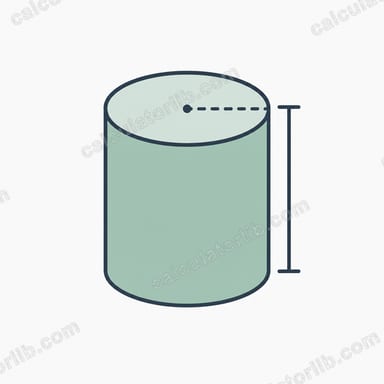
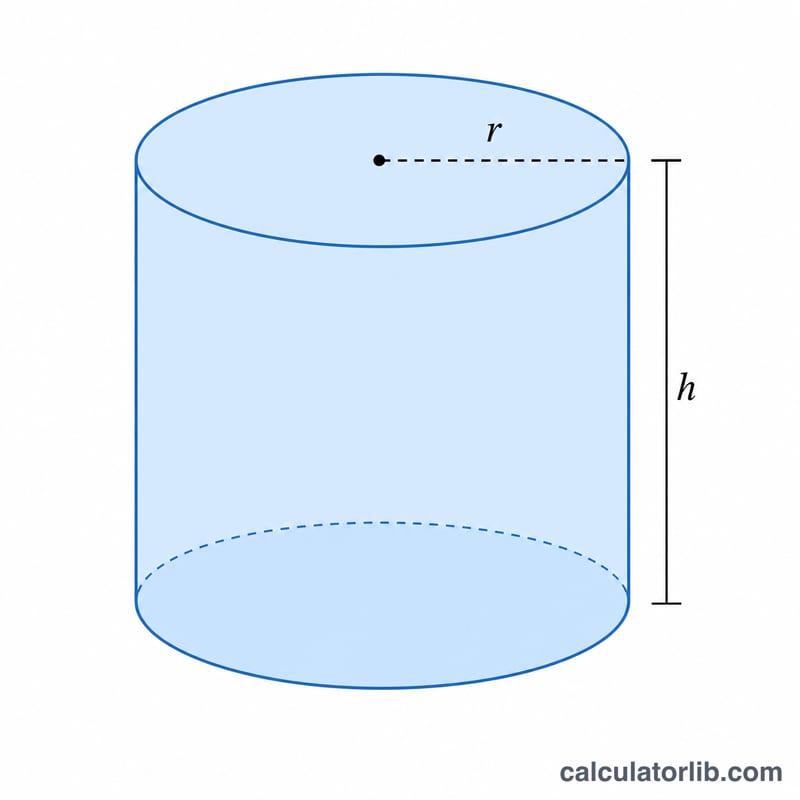
A right circular cylinder is a solid with two equal, parallel circular bases joined by a straight (perpendicular) curved wall — think of a soup can or a length of pipe. Given the base radius r and the height h, this tool instantly returns three quantities: the volume (how much it holds), the lateral surface area (just the curved side), and the total surface area (the side plus the two circular ends). This is pure geometry and applies identically anywhere in the world.
How to use it
Enter the radius and the height using the same length unit (for example both in meters, or both in centimeters). The calculator does not assume a particular unit — whatever unit you type in, the volume comes out in that unit cubed and the areas in that unit squared. Both values must be strictly positive; a radius or height of zero collapses the cylinder to a flat shape with no volume.
The formulas explained
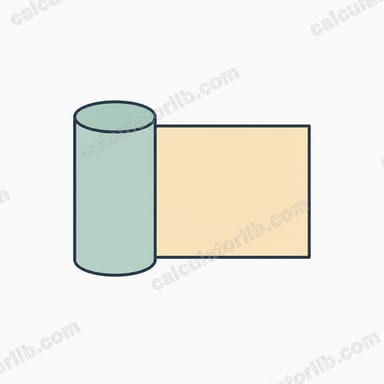
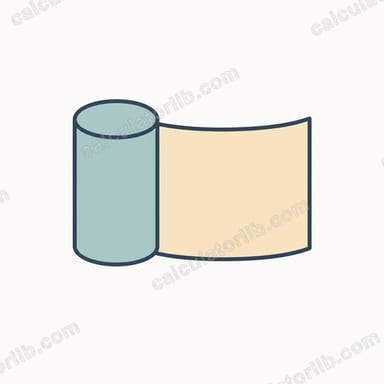
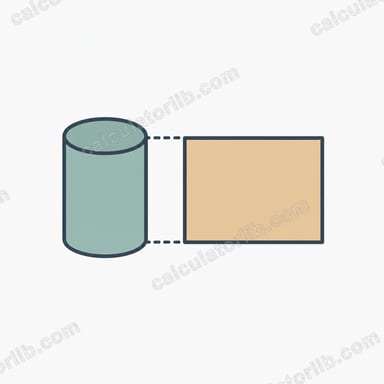
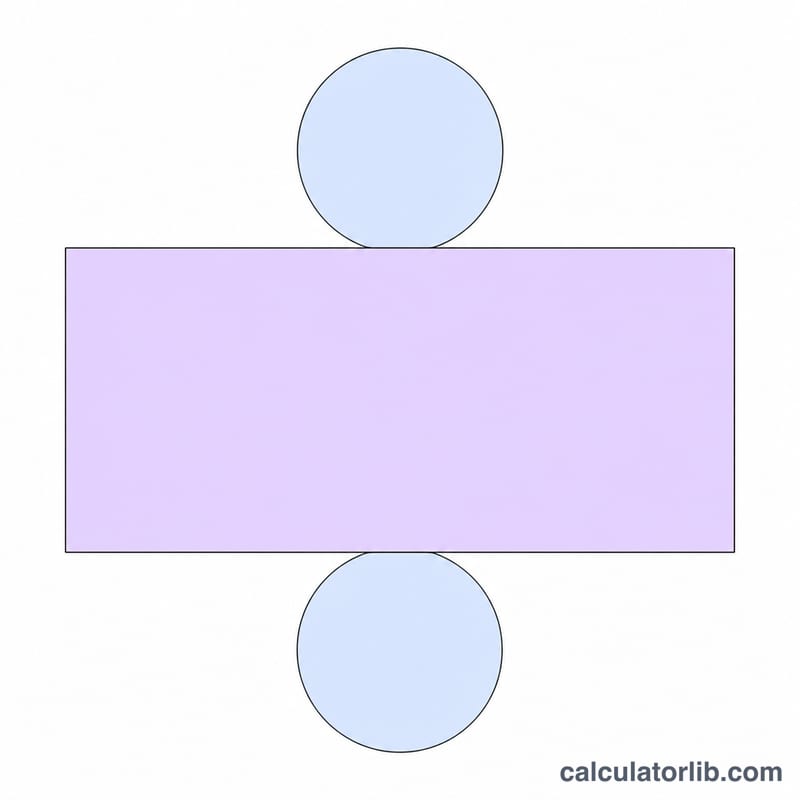
The volume is the base circle area (\(\pi r^{2}\)) multiplied by the height: $$V = \pi r^{2} h$$ The lateral area is the curved wall "unrolled" into a rectangle whose width is the base circumference (\(2\pi r\)) and whose height is \(h\), giving $$S_{\text{side}} = 2\pi r h$$ Adding the two circular caps (each \(\pi r^{2}\)) gives the total area $$S = 2\pi r h + 2\pi r^{2} = 2\pi r (h + r)$$
Worked example
For \(r = 3\) and \(h = 5\): $$V = \pi \cdot 9 \cdot 5 = 45\pi \approx 141.37 \text{ cubic units}$$ $$S_{\text{side}} = 2\pi \cdot 3 \cdot 5 = 30\pi \approx 94.25 \text{ square units}$$ $$S = 2\pi \cdot 3 \cdot (5 + 3) = 48\pi \approx 150.80 \text{ square units}$$
FAQ
What unit are the results in? Whatever unit you enter. Use the same unit for both inputs; volume is that unit cubed and areas are that unit squared.
What is the difference between lateral and total surface area? Lateral area is only the curved side wall. Total area adds the two flat circular ends — useful for an open pipe versus a closed can.
Does the cylinder have to be "right"? Yes — these formulas assume a right cylinder, where the side is perpendicular to the bases. Oblique (slanted) cylinders need different surface-area formulas.