
What Is the Surface Area of a Cylinder?
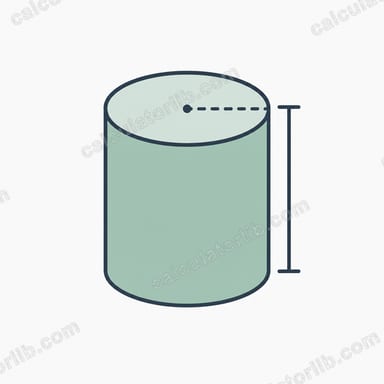
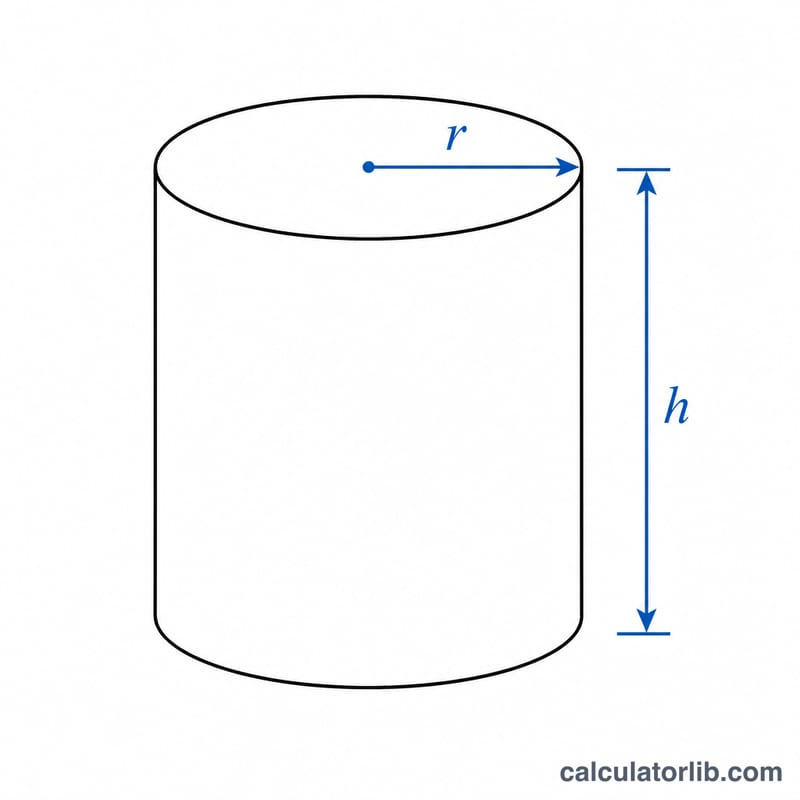
A cylinder is a 3D shape with two parallel circular bases joined by a curved side. Its total surface area is the combined area of both circles plus the curved wall. This calculator computes that area from just two measurements: the radius (\(r\)) of the base and the height (\(h\)) of the cylinder. The answer is in square units matching whatever units you enter (cm² for cm, in² for inches, etc.).
How to Use the Calculator
Enter the radius of the circular base and the height of the cylinder, then read the total surface area. The breakdown also shows the lateral (curved side) area and the combined top + bottom area, which is handy for material or paint estimates where you may not need every face.
The Formula Explained
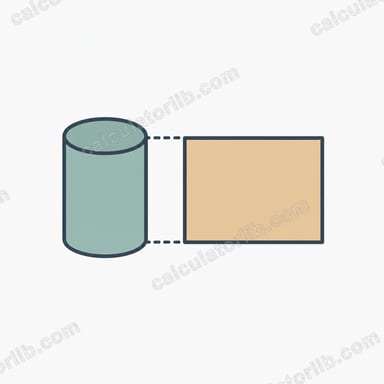
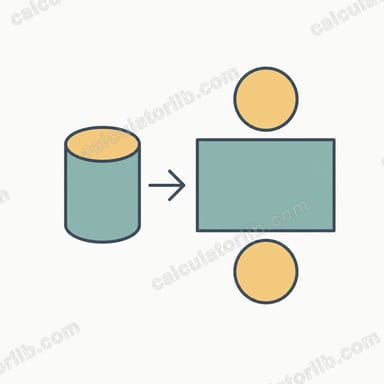
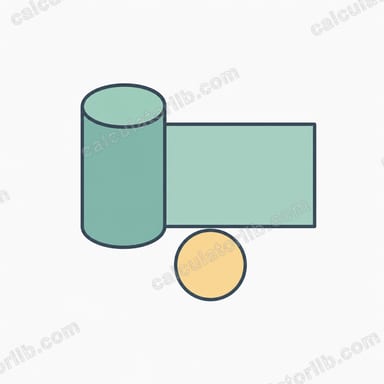
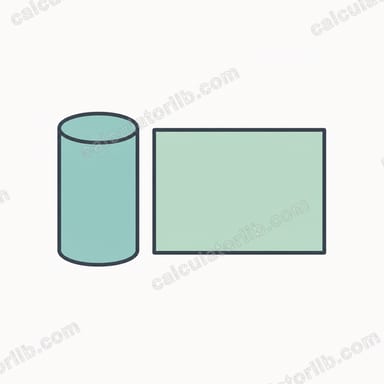
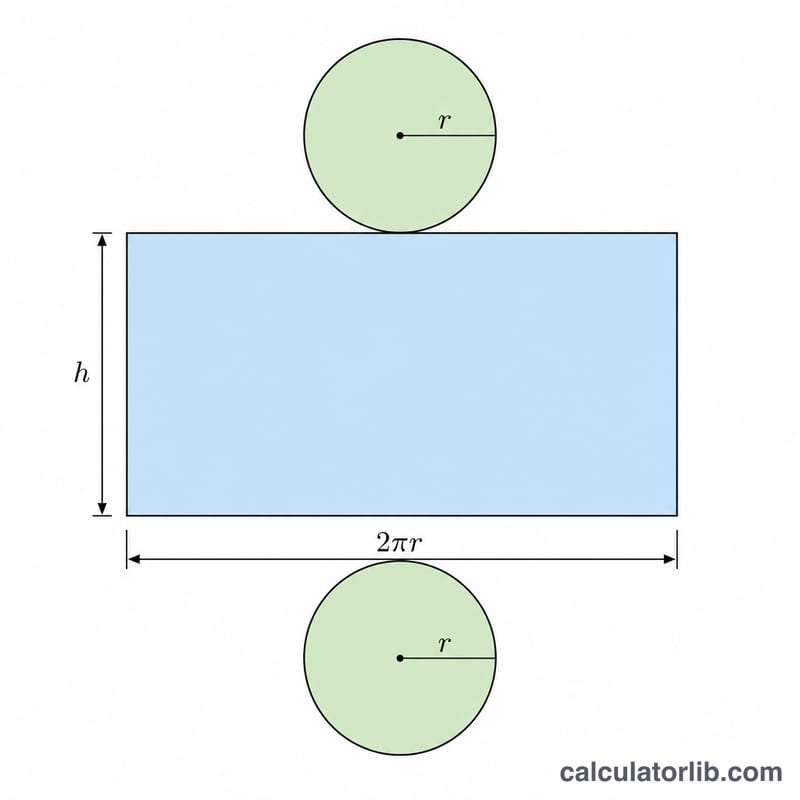
The formula is $$SA = 2\pi r^2 + 2\pi r h.$$ The first term, \(2\pi r^2\), is the area of the two circular ends (each circle is \(\pi r^2\)). The second term, \(2\pi r h\), is the lateral area — imagine unrolling the curved side into a rectangle whose width is the circumference (\(2\pi r\)) and whose height is \(h\).
Worked Example
Suppose \(r = 3\) and \(h = 5\). Top + bottom = \(2\pi(3^2) = 18\pi \approx 56.55\). Lateral = \(2\pi(3)(5) = 30\pi \approx 94.25\). Total $$= 48\pi \approx \mathbf{150.80}$$ square units.
FAQ
What if I only want the curved side? Use the lateral surface area row (\(2\pi r h\)), which excludes the two ends — useful for a label wrap or a pipe wall.
What units does it return? Square units of whatever length unit you input. Keep radius and height in the same unit.
Do I need the diameter or radius? The radius — half the diameter. If you measured the diameter, divide it by 2 first.