What the Rectangle Angle Calculator Does
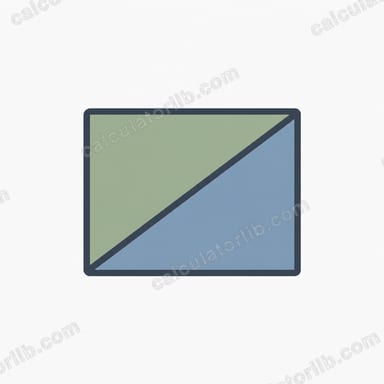
The Rectangle Angle Calculator works out the angle that a rectangle's diagonal makes with its longer side (the length). Although every interior corner of a rectangle is always 90°, the more useful "angle" in design and geometry is the diagonal angle — the angle formed between the diagonal line and the base. This calculator finds that angle from just two measurements, and along the way it also returns the diagonal length, perimeter and area.
The Inputs You Provide
- Length — the horizontal side of the rectangle (the base).
- Width — the vertical side of the rectangle (the height).
Use any consistent unit (cm, m, inches, feet) — the angle result is unitless, while the diagonal and perimeter share your input units and the area is in square units.
The Formula Explained
The diagonal angle is calculated with the inverse tangent (arctangent):
$$\theta = \arctan\!\left(\dfrac{\text{Width}}{\text{Length}}\right)$$Internally the tool uses atan2(width, length) and converts the result from radians to degrees, which gives a stable, accurate angle. It also computes:
- Diagonal = \(\sqrt{\text{Length}^2 + \text{Width}^2}\)
- Perimeter = \(2 \times (\text{Length} + \text{Width})\)
- Area = \(\text{Length} \times \text{Width}\)

Worked Example
Suppose you enter a Length of 4 and a Width of 3:
- Angle = \(\arctan(3 \div 4) = \arctan(0.75) \approx\) 36.87°
- Diagonal = \(\sqrt{4^2 + 3^2} = \sqrt{25} =\) 5
- Perimeter = \(2 \times (4 + 3) =\) 14
- Area = \(4 \times 3 =\) 12
So the diagonal of a 4×3 rectangle rises at roughly 36.87° from the base.
Diagonal Angle Across Common Rectangle Shapes
Every interior corner of a rectangle is exactly 90°, so the angle worth calculating is the one the diagonal makes with the length (base). That angle depends only on the ratio of width to length: \( \theta = \arctan\left(\frac{W}{L}\right) \). The diagonal length itself follows from the Pythagorean theorem, \( d = \sqrt{L^2 + W^2} \).
| Length (L) | Width (W) | Ratio (W/L) | Diagonal Angle θ (°) | Diagonal Length |
|---|---|---|---|---|
| 1 | 1 | 1.0000 | 45.00 | 1.414 |
| 4 | 3 | 0.7500 | 36.87 | 5 |
| 3 | 4 | 1.3333 | 53.13 | 5 |
| 16 | 9 | 0.5625 | 29.36 | 18.358 |
| 2 | 1 | 0.5000 | 26.57 | 2.236 |
| 10 | 1 | 0.1000 | 5.71 | 10.050 |
| 5 | 12 | 2.4000 | 67.38 | 13 |
Scale does not matter — only the ratio does. A 4 × 3 card, a 40 cm × 30 cm panel and a 400 m × 300 m field all share the ratio 0.75 and therefore the same 36.87° diagonal angle; only the diagonal length scales (5, 50 cm, 500 m). Rectangles are similar whenever W/L matches.
Notice also the mirror pairs: 4 × 3 gives 36.87° and 3 × 4 gives 53.13°, and 36.87° + 53.13° = 90°. Swapping length and width swaps the angle for its complement, because the two acute angles of the right triangle formed by the diagonal must add to 90°. The 1 × 1 square is the fixed point of that symmetry at exactly 45°, and long thin rectangles such as 10 × 1 push the angle toward 0°.
The values here are pure geometry and apply in any unit system and any country — millimetres, inches or metres all yield the same angle, provided both sides are measured in the same unit.
How to Calculate the Rectangle Diagonal Angle by Hand
The worked numbers below follow a rectangle with length \(L = 4\) and width \(W = 3\) (any unit) all the way through.
- Measure the length (base) and the width (height) in the same unit. Mixing units is the most common error — convert first if one side is in centimetres and the other in inches. Here: \(L = 4\), \(W = 3\).
- Divide the width by the length to get the ratio, which is \(\tan\theta\). $$\tan\theta = \frac{W}{L} = \frac{3}{4} = 0.75$$ Keep several decimals; rounding the ratio early distorts the angle.
- Apply the inverse tangent (labelled \(\tan^{-1}\),
atanorATANon most calculators and spreadsheets) to that ratio: $$\theta = \arctan(0.75) = 36.8699^\circ$$ which rounds to 36.87°. - Convert from radians if needed. Spreadsheets and most programming languages return radians: \(\arctan(0.75) = 0.643501\) rad. Multiply by \(180/\pi \approx 57.2958\): $$0.643501 \times 57.2958 = 36.87^\circ$$ On a handheld calculator, set the angle mode to DEG before pressing \(\tan^{-1}\). If the mode is left on RAD you will read 0.6435 instead of 36.87, and if it is on GRAD you will read 40.97 — the same geometry, three different numbers. A quick sanity check: a 1 × 1 square must return 45 in DEG mode.
- Get the complementary angle — the angle the same diagonal makes with the width — by subtracting from 90°: $$90^\circ - 36.87^\circ = 53.13^\circ$$ This is exactly the angle you would obtain by entering the rectangle as 3 × 4 instead.
- Cross-check with the diagonal. Compute the diagonal by Pythagoras and verify the angle a second way with the sine ratio: $$d = \sqrt{L^2 + W^2} = \sqrt{4^2 + 3^2} = \sqrt{16 + 9} = \sqrt{25} = 5$$ $$\sin\theta = \frac{W}{d} = \frac{3}{5} = 0.6 \quad\Rightarrow\quad \arcsin(0.6) = 36.87^\circ$$ The two independent routes agree, so the arithmetic and the calculator mode are both sound. As a third check, \(\cos\theta = L/d = 4/5 = 0.8\), and \(0.6^2 + 0.8^2 = 1\).
Edge cases. A length of zero makes the ratio undefined; in software use atan2(W, L), which handles \(L = 0\) by returning 90° instead of dividing by zero. Because \(\arctan\) is defined for every positive ratio, no rectangle — however elongated — will fail: as W/L grows the angle approaches 90°, and as it shrinks toward 0 the angle approaches 0°.
Key Terms and Definitions
| Rectangle | A quadrilateral with four right angles; opposite sides are equal and parallel. A square is the special case where length equals width. |
|---|---|
| Interior angle | The angle inside a corner of the shape. For a rectangle every interior angle is exactly 90°, and the four sum to 360°. This is why an angle calculator for a rectangle reports the diagonal angle rather than the corner angle. |
| Diagonal | The straight segment joining two opposite corners. A rectangle has two diagonals, equal in length and bisecting each other, with \( d = \sqrt{L^2 + W^2} \). |
| Diagonal angle θ | The acute angle between a diagonal and the length (base): \( \theta = \arctan(W/L) \). It depends only on the shape's proportions, not on its size. |
| Complementary angle | The angle that completes a right angle: \( 90^\circ - \theta \). It is the angle the same diagonal makes with the width. Two angles are complementary when they sum to 90°. |
| Aspect ratio | The proportion length : width, e.g. 16:9 or 4:3. Any two rectangles with the same aspect ratio are geometrically similar and share the same diagonal angle. |
| Arctangent (inverse tangent) | The function that recovers an angle from a tangent ratio, written \(\arctan x\) or \(\tan^{-1}x\). Its principal range is \(-90^\circ\) to \(+90^\circ\), which covers every rectangle since W/L is positive. |
| atan2(y, x) | A two-argument arctangent used in programming. It takes the numerator and denominator separately instead of their quotient, so it never divides by zero (a vertical case with \(x = 0\) simply returns 90°) and it keeps full precision for very large or very small ratios. It also returns the correct angle in all four quadrants, which the one-argument form cannot. |
| Radian vs degree | Two units for angle. A full turn is 360° or \(2\pi\) radians, so \(1\) radian \(= 180/\pi \approx 57.2958^\circ\) and \(1^\circ = \pi/180 \approx 0.0174533\) radians. Software trigonometric functions almost always work in radians; handheld calculators have a DEG/RAD mode switch. |
| Hypotenuse and legs | A diagonal cuts the rectangle into two congruent right triangles. The two perpendicular sides — the length and the width — are the legs; the diagonal opposite the right angle is the hypotenuse, and it is always the longest of the three sides. |
| Perimeter | The total distance around the rectangle: \( P = 2(L + W) \). For 4 × 3 that is 14 units. |
| Area | The surface enclosed: \( A = L \times W \), expressed in square units. For 4 × 3 that is 12 square units. |
Frequently Asked Questions
Aren't all rectangle angles 90°? Yes — the four corner (interior) angles of any rectangle are always right angles. This calculator gives you the diagonal angle instead, which is what matters for layout, bracing and design work.
What happens if length and width are equal? The shape becomes a square and the diagonal angle is exactly 45°, since \(\arctan(1) = 45°\).
Does the order of length and width matter? Yes for the angle value. The angle is measured from the length side, so swapping the two inputs gives the complementary angle (for 4 and 3 you get 36.87°, but 3 and 4 gives 53.13°). The diagonal, perimeter and area stay the same.