
What This Calculator Does
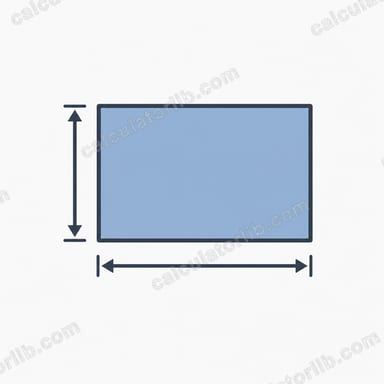
The Rectangle Perimeter Calculator finds the distance around the outside edge of a rectangle. You enter two measurements — the Length and the Width — and the tool instantly returns the perimeter using the standard geometry formula. It also displays the exact length and width values you entered alongside the result, so you can confirm your inputs at a glance.
How to Use It
- Length: Enter the longer side (or either side — the formula treats both equally) in any unit you like.
- Width: Enter the adjacent side in the same unit as the length.
Both values can be decimals (e.g. 12.5). Make sure both measurements use the same unit — if length is in metres, width must also be in metres — and the perimeter will come out in that same unit. If you leave a field blank, the calculator falls back to default values of 10 for length and 20 for width.
The Formula Explained
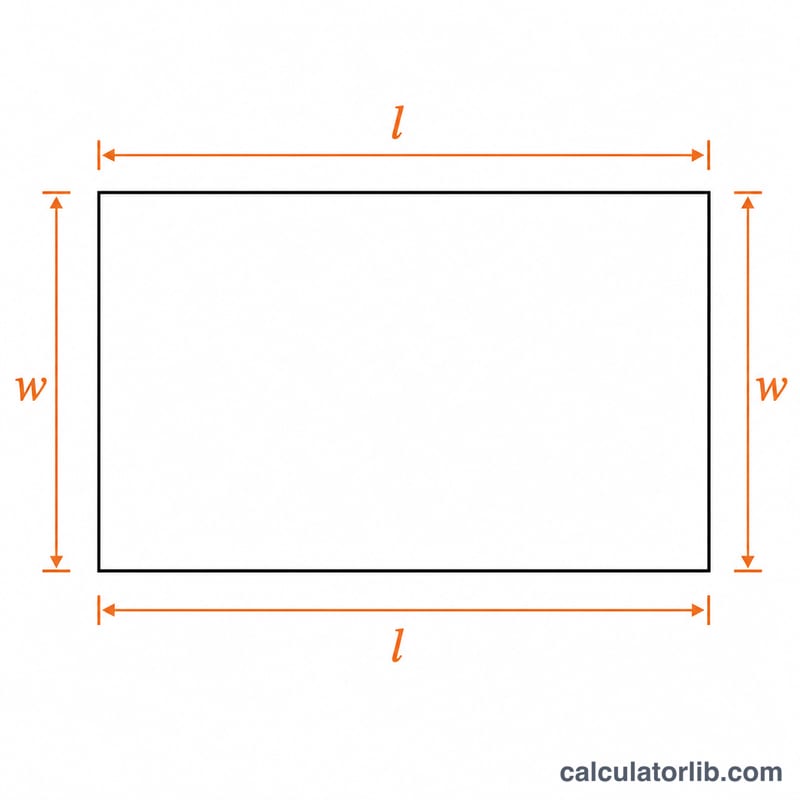
The perimeter of a rectangle is calculated as:
$$P = 2 \times (l + w)$$
A rectangle has two pairs of equal sides: two of length l and two of width w. Adding one length and one width gives you half the way around, so multiplying that sum by 2 gives the full perimeter. The calculator adds your length and width together, then doubles the total.
Worked Example
Suppose a garden bed is 8 metres long and 3 metres wide. Plug these into the formula:
- Add the sides: \(8 + 3 = 11\)
- Double the result: \(2 \times 11 = 22\)
The perimeter is 22 metres — the amount of edging or fencing you would need to surround the bed completely.
Frequently Asked Questions
What units does the result use? The perimeter is returned in whatever unit you used for length and width. The calculator does not convert units, so keep both inputs consistent.
What is the difference between perimeter and area? Perimeter measures the distance around the rectangle (\(P = 2(l + w)\)), while area measures the surface inside it (\(A = l \times w\)). Use perimeter for fencing or trim, and area for flooring or paint.
Does it matter which side I call length and which I call width? No. Because the formula simply adds the two sides and doubles them, swapping length and width gives the identical perimeter.