
What This Calculator Does
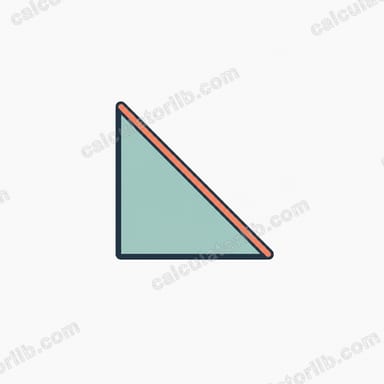
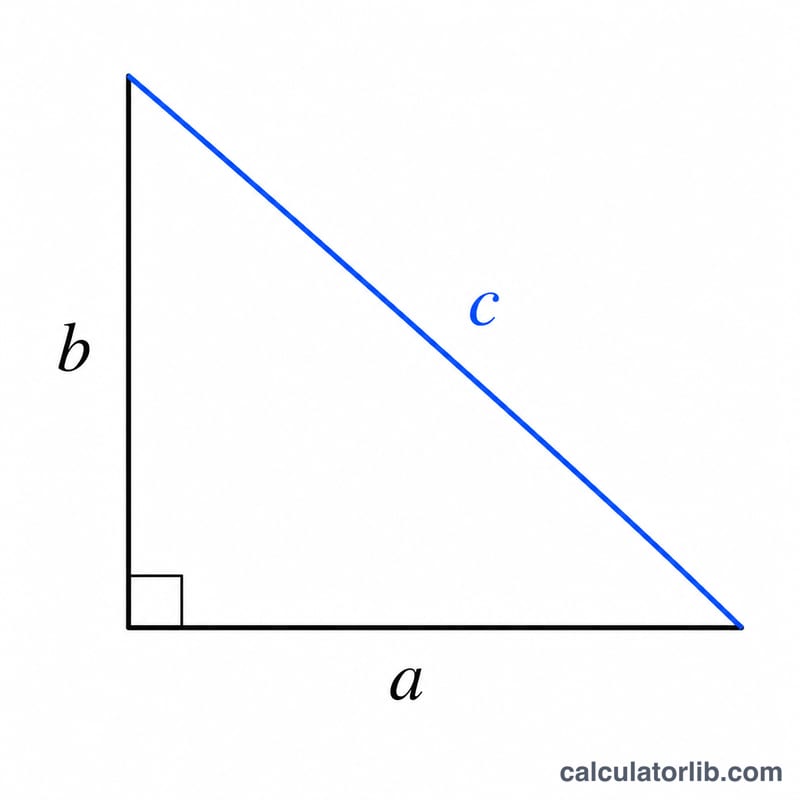
The Hypotenuse Perimeter Calculator works out the missing long side (the hypotenuse) of a right-angled triangle and then adds up all three sides to give you the full perimeter. You only need to enter the two shorter sides that meet at the right angle — Side A and Side B. From those two values the tool instantly calculates the hypotenuse, the perimeter, and a few helpful extras: the triangle's area and both non-right angles.
How to Use It
- Side A: Enter the length of the first leg (any unit — cm, m, inches — just stay consistent).
- Side B: Enter the length of the second leg, the one perpendicular to Side A.
Press calculate and the tool returns the hypotenuse, the total perimeter, the area, and the two acute angles in degrees.
The Formula Explained
The hypotenuse comes from the Pythagorean theorem, and the perimeter simply sums all three sides:
Perimeter = a + b + √(a² + b²)
Here √(a² + b²) is the hypotenuse. The calculator also computes:
- Area: (a × b) ÷ 2
- Angle A: atan2(a, b) converted to degrees
- Angle B: atan2(b, a) converted to degrees
Because it relies on the right-angle assumption, both inputs must be the legs — not the hypotenuse itself.
Worked Example
Suppose Side A = 3 and Side B = 4.
- Hypotenuse = √(3² + 4²) = √(9 + 16) = √25 = 5
- Perimeter = 3 + 4 + 5 = 12
- Area = (3 × 4) ÷ 2 = 6
- Angle A = atan2(3, 4) ≈ 36.87°
- Angle B = atan2(4, 3) ≈ 53.13°
So this classic 3-4-5 triangle has a perimeter of 12 and an area of 6.
Frequently Asked Questions
Do I enter the hypotenuse? No. You enter only the two legs (Side A and Side B). The calculator finds the hypotenuse for you.
What units should I use? Any unit works, but use the same one for both sides. The perimeter and hypotenuse come out in that same unit; the area in square units.
Why does it show angles too? The two acute angles always add to 90°. They're handy for checking the triangle's shape or for trigonometry homework — Angle A is opposite Side A, and Angle B is opposite Side B.