
What this calculator does
The Circle Perimeter Calculator finds the circumference (the distance around the edge) of a circle directly from its radius. You enter one number, choose a unit, and it returns the perimeter instantly — along with two useful extras: the diameter and the area. It works with any unit of length and uses the exact mathematical constant π (pi), so the result is as accurate as the radius you provide.
The inputs you provide
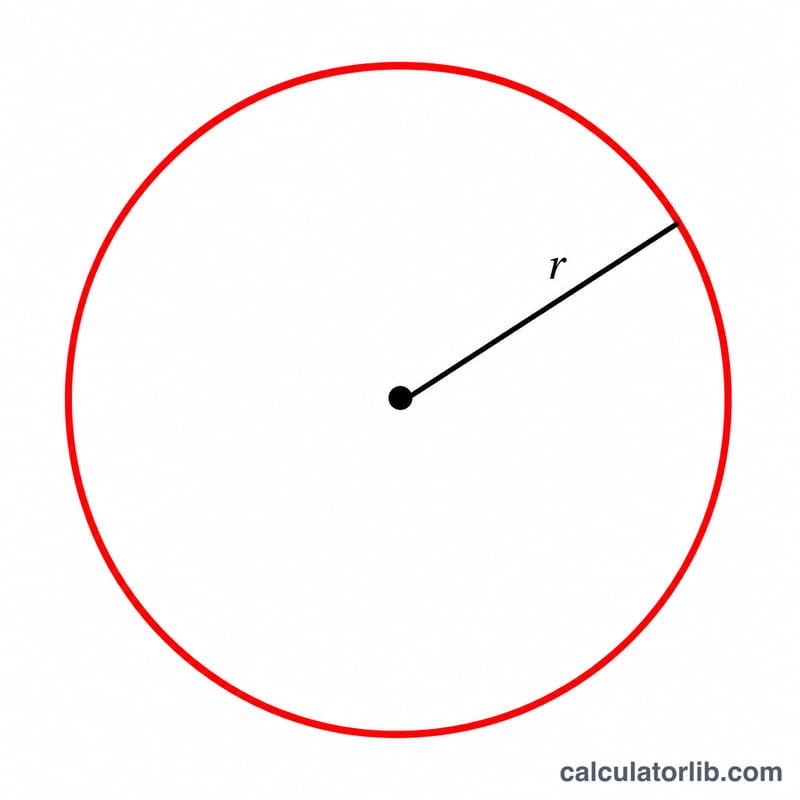
- Radius — the distance from the centre of the circle to its edge. This is the only measurement you need.
- Unit — pick from centimeters (cm), meters (m), inches (in), or feet (ft). The result is reported in the same unit you choose, so a radius in metres gives a perimeter in metres.
The formula explained
The perimeter of a circle is calculated with:
$$P = 2\pi r$$
Here r is the radius and \(\pi \approx 3.14159\). Because the diameter is twice the radius (\(d = 2r\)), this is the same as the familiar \(P = \pi d\). Behind the scenes the tool also computes:
- Diameter \(= 2 \times r\)
- Area \(= \pi \times r^2\)
So a single radius entry gives you three results at once.
Worked example
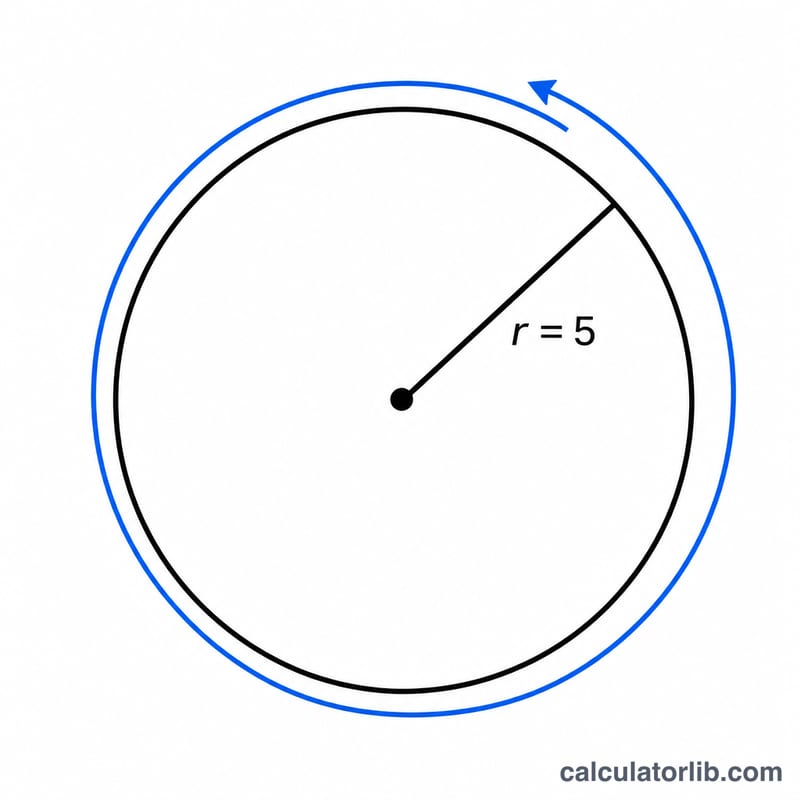
Suppose you enter a radius of 5 cm:
- Perimeter \(= 2 \times \pi \times 5 = 31.4159\) cm
- Diameter \(= 2 \times 5 = 10\) cm
- Area \(= \pi \times 5^2 = 78.5398\) cm²
So a circle with a 5 cm radius has a circumference of about 31.42 cm.
Frequently asked questions
What is the difference between perimeter and circumference? For a circle they are the same thing — "circumference" is simply the specific name for the perimeter of a circle.
I only know the diameter, not the radius. What do I do? Divide the diameter by 2 to get the radius, then enter that value. For example, a 10 cm diameter means a 5 cm radius.
Why is the answer never an exact whole number? Because π is an irrational number, the circumference of most circles is a non-terminating decimal. The calculator uses a high-precision value of π, so you can round the result to as many decimal places as your task requires.