What Is a Semi Circle Calculator?
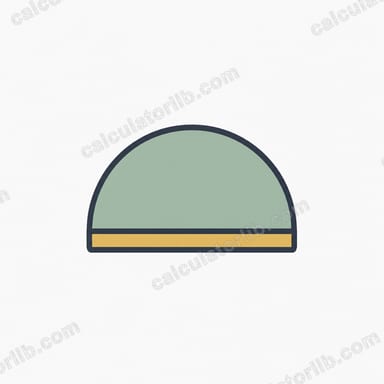
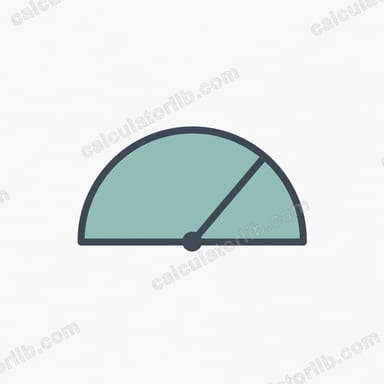
A semi circle is exactly half of a full circle, created when you cut a circle along its diameter. This Semi Circle Calculator lets you instantly find the key measurements of a semi-circle — its diameter, perimeter (circumference), and area — using just the radius. It's a handy tool for students, builders, designers, and anyone working with curved shapes like arches, windows, garden beds, or fabric patterns. The formulas used are universal and apply anywhere in the world.
How to Use the Calculator
Using the tool takes just a few seconds:
- Enter the radius of the semi-circle (the distance from the center of the flat edge to the curved edge).
- Read off the calculated diameter, perimeter, and area.
- Use the interactive diagram to visualize how each dimension relates to the shape.
Make sure all your measurements use the same unit (centimeters, inches, meters, etc.) so the results stay consistent.
The Formulas Explained
A semi-circle is half a circle, so its formulas are based on the standard circle equations:
- Diameter: \(d = 2 \times r\)
- Area: \(A = (\pi \times r^{2}) \div 2\)
- Perimeter: \(P = (\pi \times r) + 2r\) — this is half the circle's circumference plus the straight diameter edge.
Note that the perimeter includes both the curved arc and the flat diameter line, which is a common point people forget.

Worked Example
Suppose you have a semi-circle with a radius of 5 cm:
- Diameter $$= 2 \times 5 = \textbf{10 cm}$$
- Area $$= (\pi \times 5^{2}) \div 2 = (3.1416 \times 25) \div 2 \approx \textbf{39.27 cm}^{2}$$
- Perimeter $$= (\pi \times 5) + (2 \times 5) = 15.71 + 10 \approx \textbf{25.71 cm}$$
Constants Used: The Value of Pi
The only constant in the semi-circle formulas is pi (π), the ratio of any circle's circumference to its diameter. Its value is approximately 3.14159265. It is often rounded to 3.1416 or 3.14 for quick work. Pi is irrational, so its decimal expansion never ends or repeats, and any rounded value gives a slightly approximate result.
Pi is dimensionless. It is a pure number with no unit, so it does not change the unit of the quantity it multiplies. A radius in centimetres gives an arc length in centimetres, and a radius in inches gives an arc length in inches.
The factor 1/2 for half a circle
A semi-circle is exactly half of a circle, so the circle's area formula is multiplied by 1/2:
$$A = \frac{1}{2}\,\pi r^{2}$$
The curved edge (the arc) is also half of the full circumference \(2\pi r\), which gives \(C = \pi r\). The diameter is the straight edge, \(d = 2r\). If you need the full perimeter of the closed half-disc, add the straight edge to the arc: \(P = \pi r + 2r = (\pi + 2)\,r\).
Units
- Diameter, arc length and perimeter are linear measures, expressed in units such as cm, m or in.
- Area is a square measure, expressed in units such as cm², m² or in², because the radius is squared.
Example: for a radius of 5 units, the area is \(A = \frac{1}{2} \times 3.14159265 \times 5^{2} = \frac{78.5398}{2} \approx\) 39.27 square units. The arc length is \(\pi \times 5 \approx 15.71\) units, and the diameter is \(2 \times 5 = 10\) units.
Frequently Asked Questions
Is the perimeter of a semi-circle just half a circle's circumference? No. You must add the diameter (the straight edge) to the curved arc. Forgetting this gives a value that's too small.
What's the difference between the arc and the perimeter? The arc is only the curved part \((\pi \times r)\). The perimeter is the full boundary, including the straight diameter.
Can I find the radius from the area? Yes — rearrange the area formula: \(r = \sqrt{2A \div \pi}\).