
What the Rectangle Diagonal Calculator Does
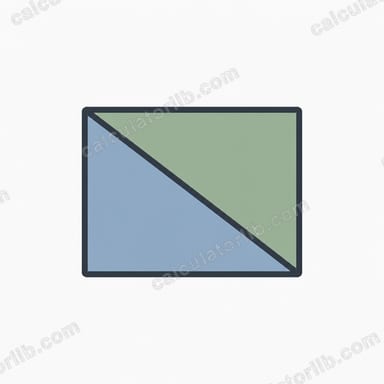
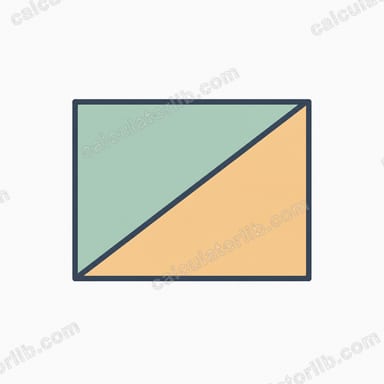
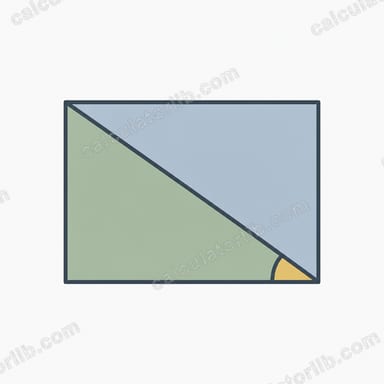
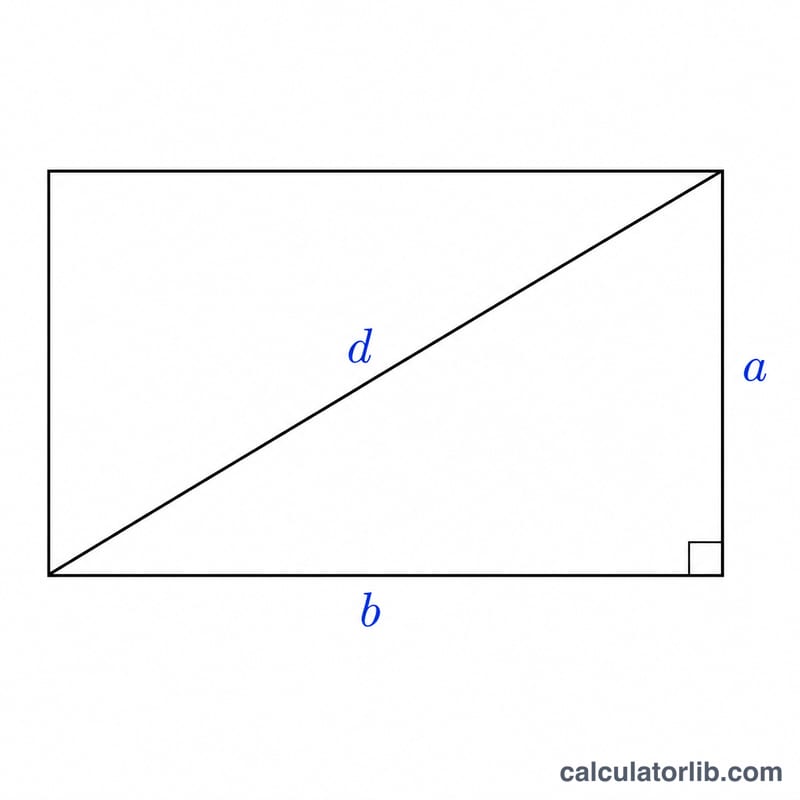
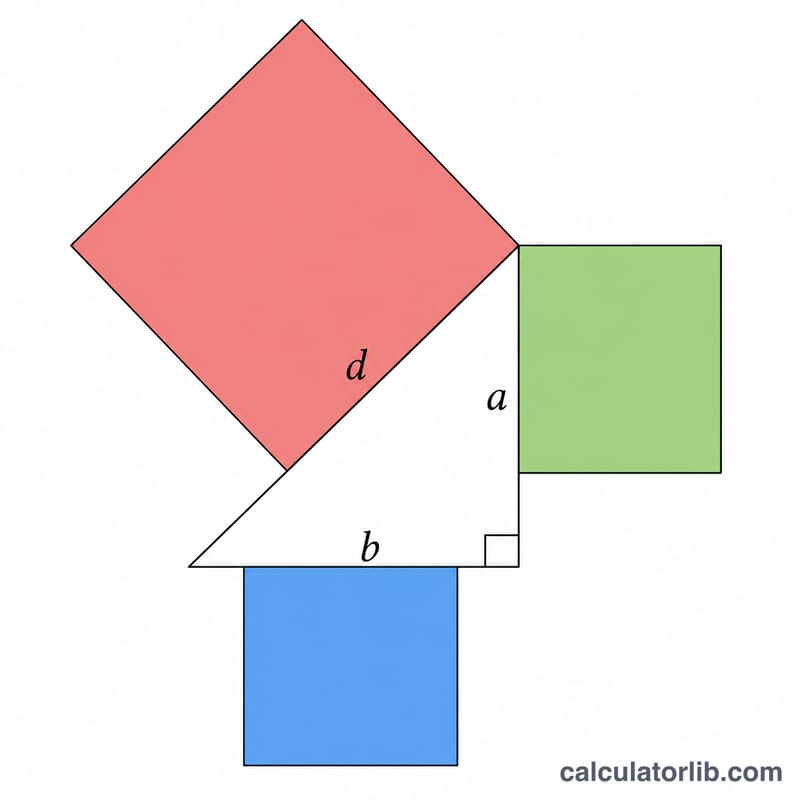
This calculator finds the straight-line distance across a rectangle—from one corner to the opposite corner—using just two measurements: the length and the width. Because a rectangle's diagonal splits it into two right triangles, the diagonal is simply the hypotenuse, which we can solve with the Pythagorean theorem. The tool works with any consistent unit (cm, inches, metres, feet), and as a bonus it also reports the rectangle's area and perimeter from the same two numbers.
How to Use It
- Length: enter the longer (or any) side of the rectangle.
- Width: enter the adjacent side.
Press calculate and you instantly get the diagonal, plus the area and perimeter. Keep both inputs in the same unit so the results make sense—if length is in inches, width must be in inches too.
The Formula Explained
The diagonal is computed as:
$$d = \sqrt{\text{Length}^{2} + \text{Width}^{2}}$$Here l is the length and w is the width. Each side is squared, the squares are added, and the square root of that sum is the diagonal. The calculator also derives:
- \(\text{Area} = l \times w\)
- \(\text{Perimeter} = 2 \times (l + w)\)
Worked Example
Suppose you have a rectangle with a length of 8 and a width of 6.
- Diagonal: $$\sqrt{8^{2} + 6^{2}} = \sqrt{64 + 36} = \sqrt{100} = \mathbf{10}$$
- Area: \(8 \times 6 = \mathbf{48}\)
- Perimeter: \(2 \times (8 + 6) = \mathbf{28}\)
This is the classic 6-8-10 right triangle, so the diagonal comes out to a clean 10 units. Most real-world rectangles produce a decimal diagonal, which the calculator handles automatically.
Frequently Asked Questions
Does it matter which side I call length and which I call width?
No. Because both values are squared and added together, swapping them gives the identical diagonal, area, and perimeter.
What units does the calculator use?
It is unit-agnostic. Whatever unit you enter (inches, cm, feet, metres), the diagonal comes back in that same unit and the area in that unit squared.
Why is the diagonal useful in DIY and construction?
Checking the diagonal is the fastest way to confirm a frame, deck, or wall is truly square. If the measured corner-to-corner distance matches the calculated diagonal, your corners are exact right angles.