What This Calculator Does
The Calories Burned Weightlifting Calculator estimates how much energy you expend during a strength-training session. It uses the widely accepted MET (Metabolic Equivalent of Task) method, which links the intensity of an activity to your body weight and the time you spend exercising. Weightlifting MET values typically range from about 3.5 for light effort to 6.0 for vigorous powerlifting.
How To Use It
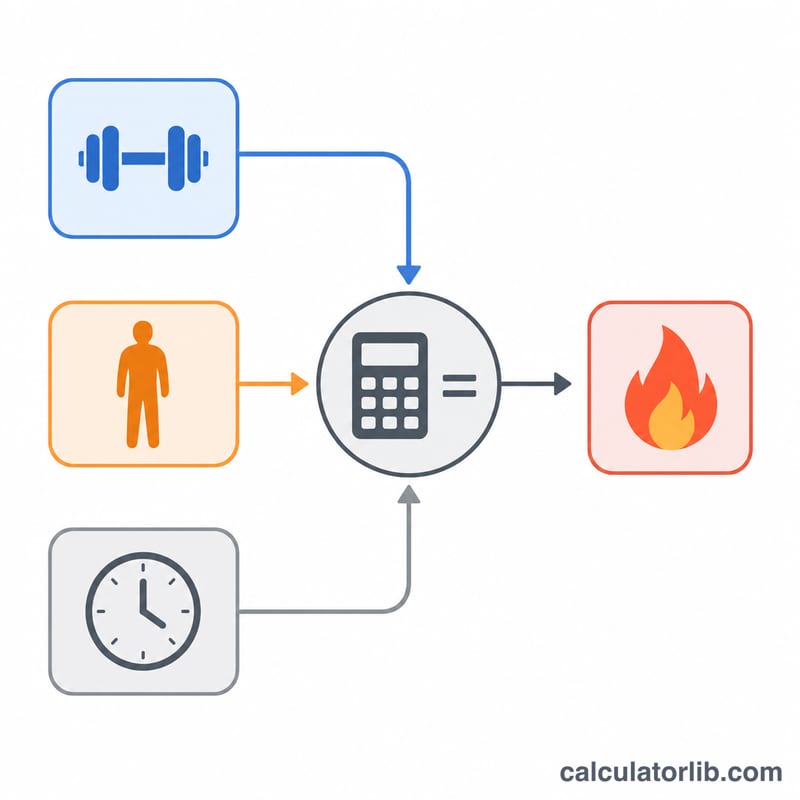
Enter your body weight in kilograms, the duration of your workout in minutes, and pick an intensity level. The calculator returns the total calories burned plus a per-minute breakdown so you can compare sessions. Use "Light effort" for slow, controlled accessory work, "Moderate" for typical mixed gym sessions, and "Vigorous" for heavy compound lifting or circuit-style training.
The Formula Explained
The core equation is $$\text{kcal} = \frac{\text{MET} \times 3.5 \times \text{weight (kg)}}{200} \times \text{minutes}$$. The constant 3.5 represents resting oxygen uptake in millilitres per kilogram per minute, and dividing by 200 converts oxygen consumption into kilocalories. Multiplying by the MET value scales that baseline up to your chosen activity intensity, and multiplying by minutes gives the total for the whole session.
Worked Example
Suppose you weigh 80 kg and lift for 60 minutes at a moderate intensity (MET 5.0). Calories per minute = $$\frac{5.0 \times 3.5 \times 80}{200} = 7 \text{ kcal/min}.$$ Over 60 minutes that is $$7 \times 60 = \textbf{420 kcal}.$$
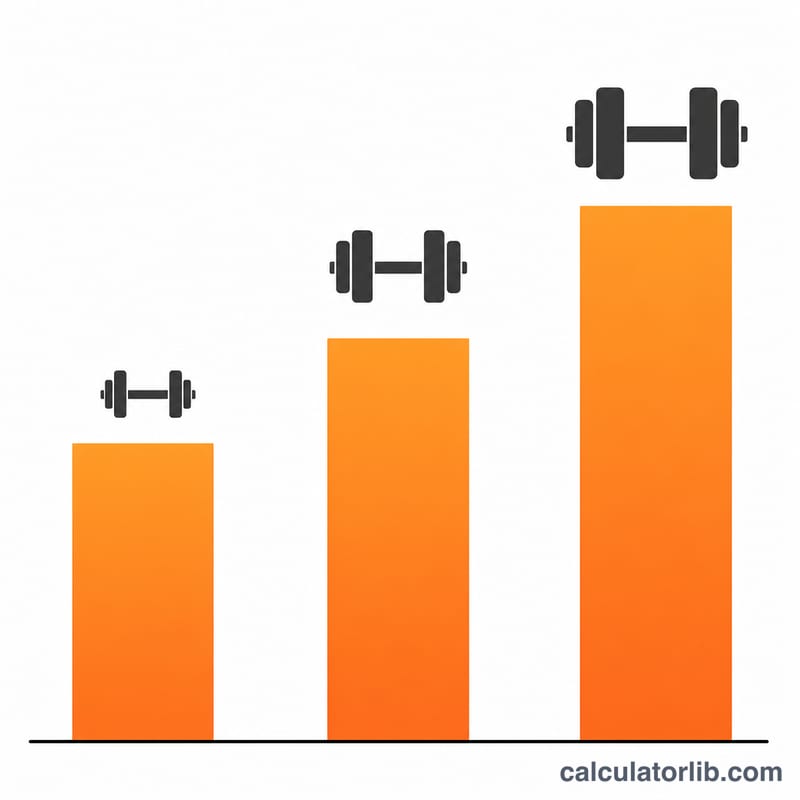
Weightlifting MET Values by Intensity
A MET (metabolic equivalent of task) expresses exercise energy cost as a multiple of resting energy use. The values below are based on the Compendium of Physical Activities, a widely used research reference. The 5.0 option is an intermediate setting between the light and vigorous entries, so use it for effort that sits between the two descriptions.
| Intensity | Approx. MET | What the effort looks like |
|---|---|---|
| Light effort | 3.5 | Free weights or machines with light to moderate loads, multiple exercises, generous rest between sets. |
| Moderate effort | 5.0 | Steady session with moderately heavy loads and shorter rests. Calculator setting between light and vigorous. |
| Vigorous effort (powerlifting, bodybuilding) | 6.0 | Heavy loads or high volume, sets taken close to fatigue, with a sustained working pace. |
| Circuit training, minimal rest | 8.0 | Moving quickly from one exercise to the next with little rest, so the heart rate stays elevated. Not one of this calculator's three options; for a rough estimate, multiply the MET by 3.5, then by your weight in kg, then divide by 200 and multiply by minutes. |
Calories Burned by Body Weight and Intensity
Each figure uses \(\text{kcal} = \frac{ \text{MET} \times 3.5 \times \text{kg}}{200} \times \text{minutes}\) for a 60-minute session. For example, at 80 kg and 5.0 MET: \(\frac{5.0 \times 3.5 \times 80}{200} \times 60 = 7 \times 60 = \) 420 kcal.
| Body weight | 3.5 MET (light) | 5.0 MET (moderate) | 6.0 MET (vigorous) |
|---|---|---|---|
| 60 kg | 220.5 kcal | 315 kcal | 378 kcal |
| 80 kg | 294 kcal | 420 kcal | 504 kcal |
| 100 kg | 367.5 kcal | 525 kcal | 630 kcal |
These values are estimates. Real energy expenditure varies between individuals and between sessions. Because the formula is linear, a 30-minute session burns half of the figures shown.
Interpreting Your Result
- Gross, not net. The result estimates total (gross) energy expenditure during the session. It includes the resting metabolism you would have used anyway over the same time (1 MET is about 3.5 mL of oxygen per kg per minute). The extra energy attributable to lifting alone is smaller.
- MET values are population averages. They come from measurements on groups of people. Your own energy cost can differ with body composition, fitness, training experience, exercise selection and load.
- Rest intervals lower the effective intensity. A MET value describes an average over an activity. Long rests between sets mean much of the session is spent at low energy cost, so the light setting often fits sessions with generous rest, even when individual sets are hard.
- Post-exercise oxygen consumption is not included. Energy use can remain slightly elevated after training, and this formula does not account for it.
- Use it as a rough guide. The figure is useful for comparing sessions or settings with each other, not as a precise measurement. Heart-rate monitors and wearables also give only estimates.
FAQ
Is this exact? No estimate is exact — actual burn depends on muscle mass, rest intervals, and effort. MET formulas give a solid, science-based approximation.
Why does intensity matter so much? The MET value scales the entire result linearly, so heavy, fast-paced lifting can burn nearly twice the calories of light, leisurely sets of the same duration.
Should I count rest periods? Enter the total time you were actively training. Long idle breaks lower your average MET, so for very rest-heavy sessions consider the lighter intensity option.