
What This Calculator Does
This Treadmill Calories Burned Calculator estimates the energy you expend while running on a treadmill, based on your body weight, running speed, the treadmill incline (grade), and how long you run. It uses the American College of Sports Medicine (ACSM) running metabolic equation, a widely used standard in exercise physiology. The result is universal and not tied to any country.
How to Use It
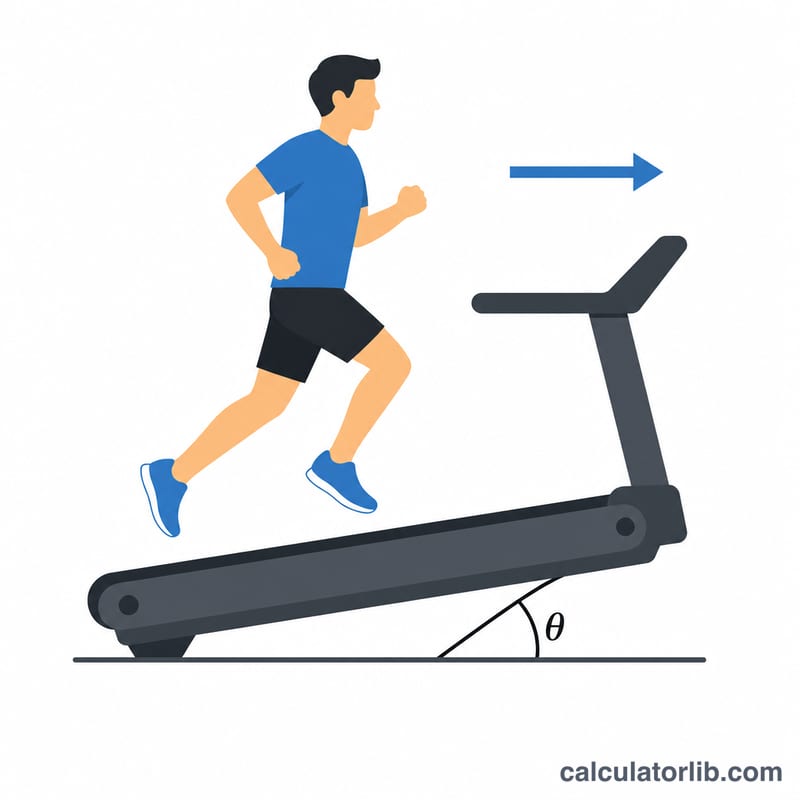
Enter your body weight in kilograms, your treadmill speed in km/h, the incline percentage shown on the console, and your run duration in minutes. The calculator converts speed into metres per minute, computes your oxygen uptake (VO₂), and then converts that into calories burned for the full session.
The Formula Explained
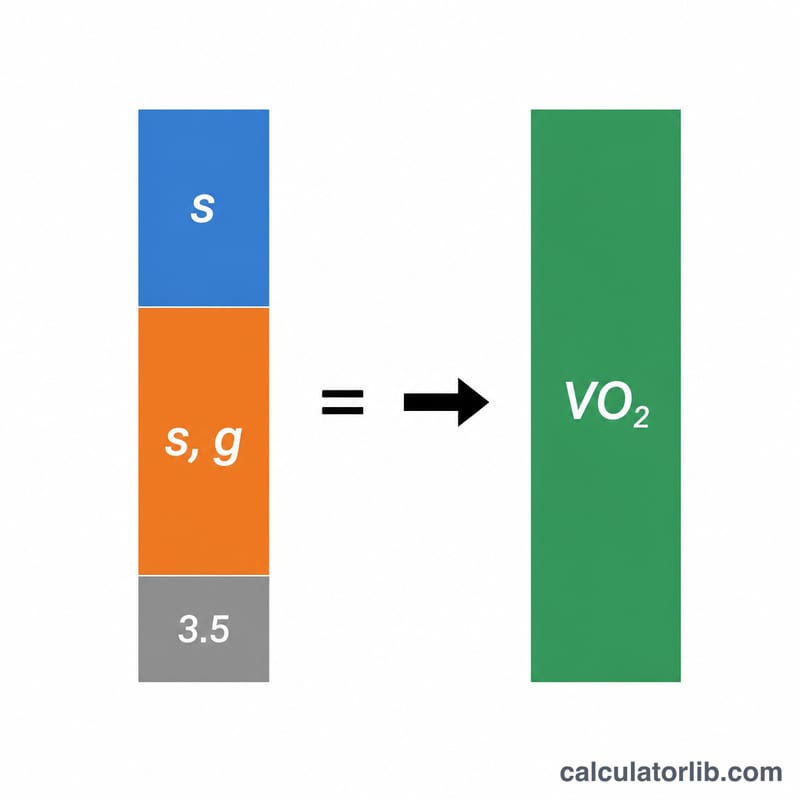
The ACSM running equation is $$\dot{V}O_2 = (0.2 \times s) + (0.9 \times s \times g) + 3.5$$ where \(s\) is speed in metres per minute and \(g\) is the incline as a decimal fraction (e.g. 5% = 0.05). The 3.5 represents resting oxygen uptake. Calories per minute are then $$\text{kcal} = \frac{\dot{V}O_2 \times \text{weight(kg)} \times 5}{1000}$$ because each litre of oxygen consumed burns roughly 5 kcal. Multiply by minutes for the session total.
Worked Example
A 70 kg runner at 8 km/h with 0% incline for 30 minutes: 8 km/h = 133.33 m/min. $$\dot{V}O_2 = (0.2 \times 133.33) + 0 + 3.5 = 30.17 \text{ mL/kg/min}$$ $$\text{kcal/min} = \frac{30.17 \times 70 \times 5}{1000} = 10.56$$ Over 30 minutes \(\approx 317\) kcal.
FAQ
Does incline really matter? Yes — adding incline increases the work done against gravity, so calories burned rise noticeably even at the same speed.
Why kilograms and km/h? The underlying equation is metric. Heavier runners burn more calories at the same pace because more mass must be moved.
Is this exact? It is a validated estimate. Real expenditure varies with fitness, running economy and individual metabolism, so treat the number as a close approximation.