
What Is the Fat-Burning Heart Rate Zone?
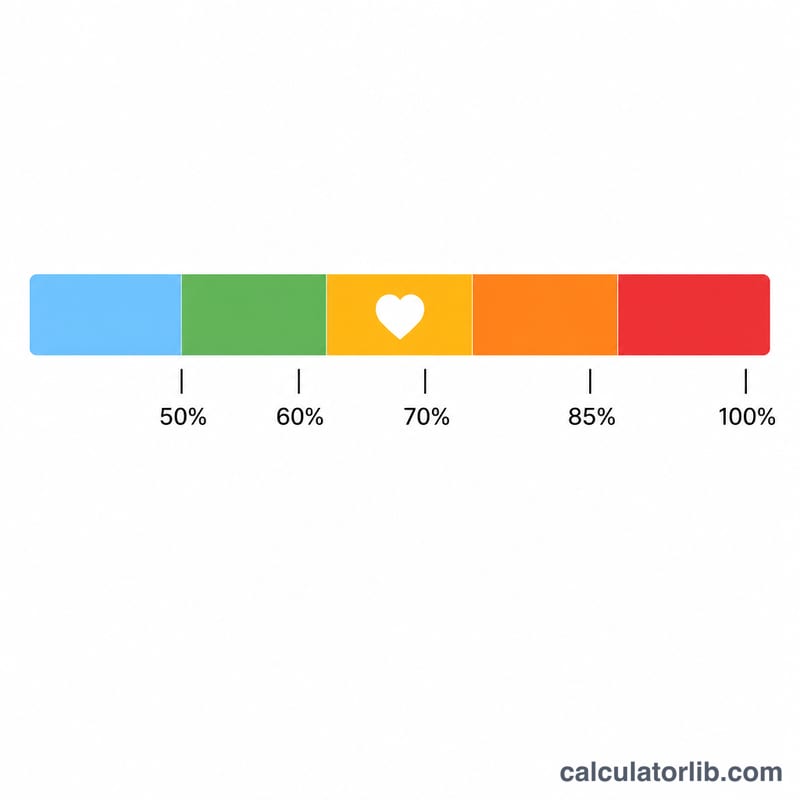
The fat-burning heart rate zone is the exercise intensity at which your body relies most heavily on stored fat for fuel. It is commonly defined as 60% to 70% of your age-predicted maximum heart rate. Training in this lower-intensity range lets you sustain effort longer, making it popular for steady-state cardio, weight management, and building an aerobic base.
How to Use This Calculator
Enter your age in years and the calculator instantly returns your estimated maximum heart rate and the lower and upper bounds of your fat-burning zone in beats per minute (bpm). Aim to keep your heart rate within this range during steady cardio sessions such as brisk walking, light jogging, or cycling. A wearable heart rate monitor makes it easy to stay in zone.
The Formula Explained
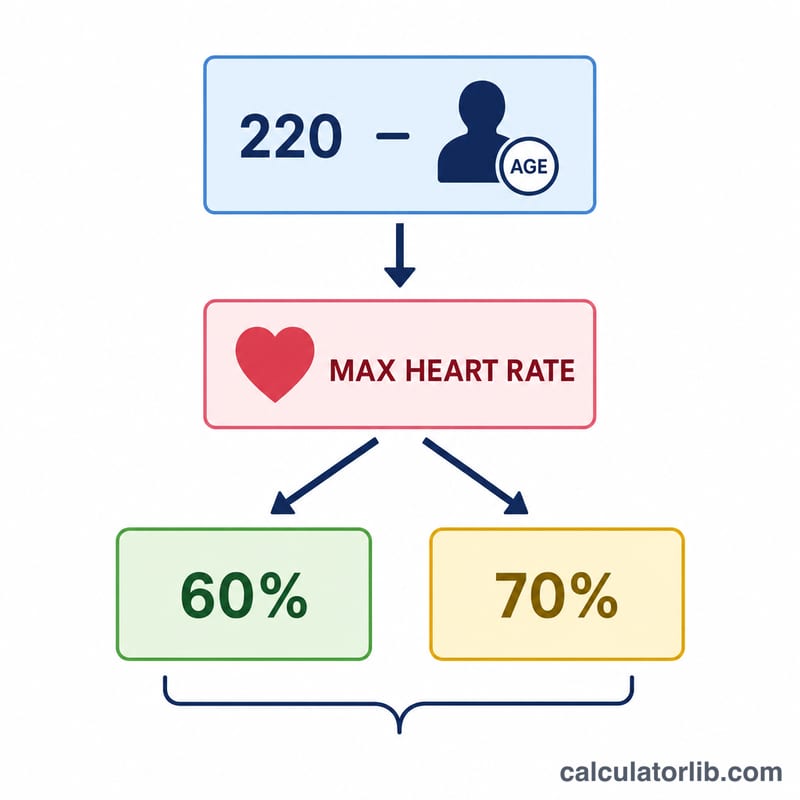
First, estimate your maximum heart rate using the classic formula \(\text{MaxHR} = 220 - \text{age}\). Then take 60% and 70% of that value:
$$\text{Lower} = 0.60 \times (220 - \text{age})$$$$\text{Upper} = 0.70 \times (220 - \text{age})$$This 220-minus-age method is a simple, widely used estimate. Individual maximum heart rates vary, so treat the result as a guideline rather than a precise medical figure.
Worked Example
For a 40-year-old: \(\text{MaxHR} = 220 - 40 = 180\) bpm. The lower bound is
$$0.60 \times 180 = 108 \text{ bpm}$$and the upper bound is
$$0.70 \times 180 = 126 \text{ bpm}$$So the fat-burning zone is roughly 108–126 bpm.
FAQ
Does lower intensity really burn more fat? At lower intensities a higher percentage of calories comes from fat, but higher-intensity exercise burns more total calories. Both have value depending on your goals.
Is the 220-age formula accurate? It is a convenient estimate with a typical error of about ±10–12 bpm. For precise zones, a clinical exercise test is more reliable.
How often should I train in this zone? Many fitness guidelines recommend 150 minutes of moderate-intensity cardio per week, much of which can fall in this zone.