
What is the Daily Calorie Intake by Goal Calculator?
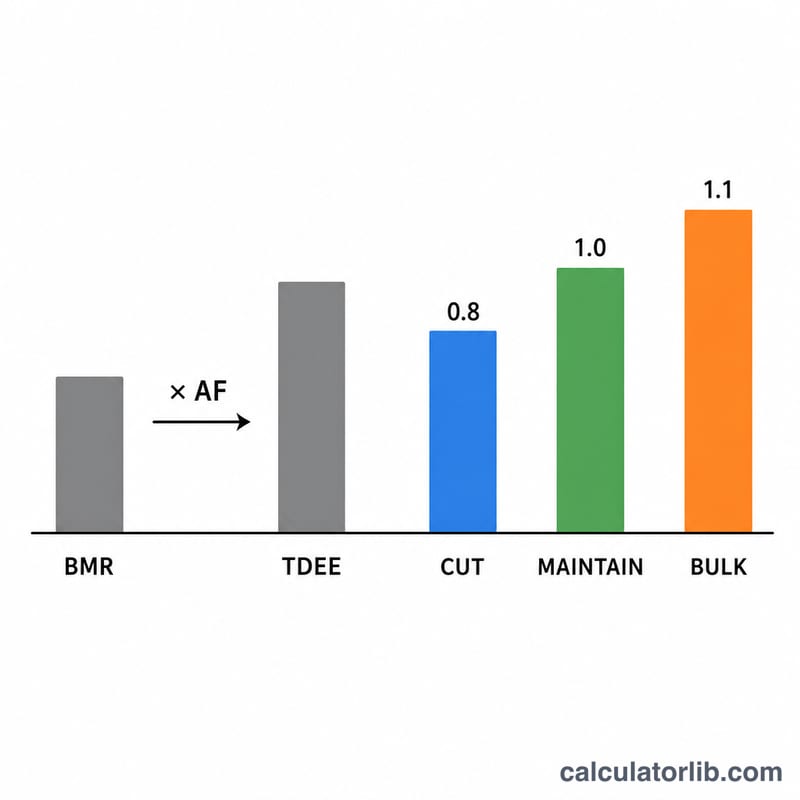
This tool estimates how many calories you should eat each day based on your fitness goal — cutting (fat loss), maintaining, or bulking (muscle gain). It first calculates your Basal Metabolic Rate (BMR), scales it by your activity level to get Total Daily Energy Expenditure (TDEE), then applies a calorie adjustment for each goal.
How to use it
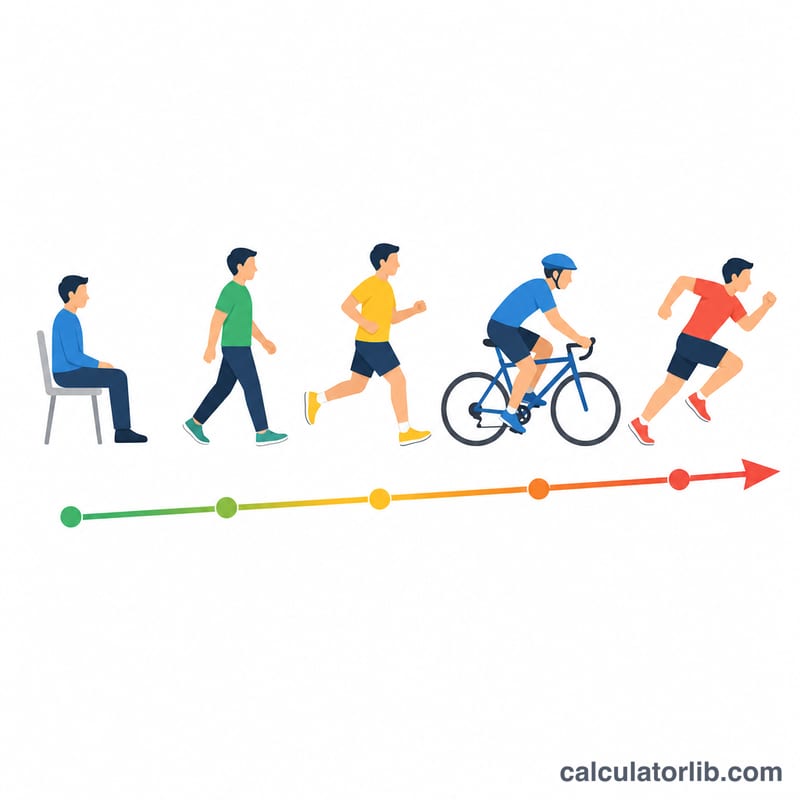
Enter your gender, weight in kilograms, height in centimetres, and age in years, then choose the activity level that best matches your weekly exercise. The result shows your maintenance calories along with cut and bulk targets.
The formula explained
BMR is estimated with the Mifflin-St Jeor equation: $$\text{BMR} = 10 \times \text{weight(kg)} + 6.25 \times \text{height(cm)} - 5 \times \text{age} - 161$$. TDEE = BMR × activity factor. From TDEE we derive: $$\text{Cut} = \text{TDEE} \times 0.80 \text{ (a 20\% deficit)}, \quad \text{Maintain} = \text{TDEE}, \quad \text{Bulk} = \text{TDEE} \times 1.10 \text{ (a 10\% surplus)}$$
Worked example
A 30-year-old, 75 kg, 178 cm individual who is moderately active (factor 1.55): $$\text{BMR} = 10 \times 75 + 6.25 \times 178 - 5 \times 30 - 161 = 750 + 1112.5 - 150 - 161 = 1551.5$$ $$\text{TDEE} = 1551.5 \times 1.55 \approx 2404.8$$ Cut \(\approx 1923.9\), Bulk \(\approx 2645.3\) calories/day.
FAQ
How fast will I lose weight on the cut number? A 20% deficit typically yields roughly 0.4–0.7 kg of fat loss per week, depending on your size.
Should I recalculate as my weight changes? Yes — recalculate every few kilograms of change so your targets stay accurate.
Why use Mifflin-St Jeor? It is widely regarded as one of the most accurate predictive BMR equations for the general population.