What This Calculator Does
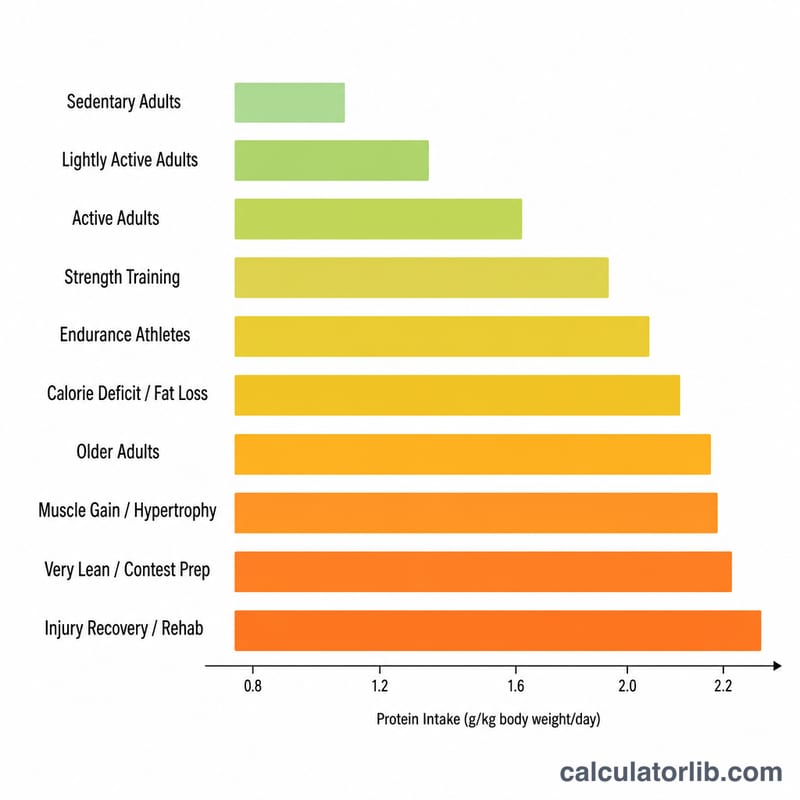
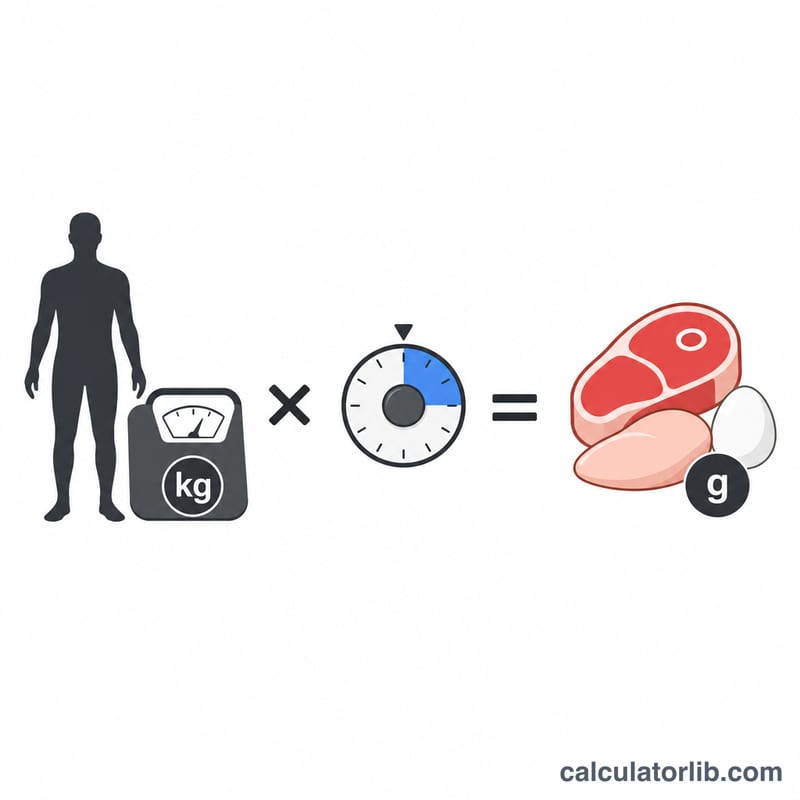
The Daily Protein Intake by Body Weight Calculator estimates how many grams of protein you should eat each day based on your body weight and your training or health goal. It multiplies your weight in kilograms by an evidence-based factor ranging from 0.8 g/kg (the basic RDA for sedentary adults) up to 2.2 g/kg (used by athletes during fat loss or cutting phases).
How to Use It
Enter your body weight in kilograms, then choose the goal that best matches your lifestyle. The calculator returns your total daily protein target, suggests a per-meal amount assuming four meals a day, and shows how many calories that protein provides (protein supplies about 4 kcal per gram).
The Formula Explained
The core equation is simple: $$\text{Protein (g)} = \text{Weight (kg)} \times \text{Factor}$$. Sedentary adults need roughly \(0.8\ \text{g/kg}\) to prevent deficiency, while resistance-training individuals benefit from \(1.6\text{–}2.2\ \text{g/kg}\) to support muscle growth and recovery. Higher intakes are especially useful when dieting, as protein preserves lean mass and increases satiety.
Worked Example
A 75 kg person aiming for general muscle building (1.6 g/kg) needs $$75 \times 1.6 = \mathbf{120\ \text{g}}$$ of protein per day. Split across four meals that is \(30\ \text{g}\) per meal, providing \(120 \times 4 = 480\ \text{kcal}\) from protein.
Protein Factors by Goal (g/kg)
The table below lists commonly cited protein factors in grams per kilogram of body weight per day. They come from the Recommended Dietary Allowance (RDA, 0.8 g/kg for healthy adults, set by the US/Canada Dietary Reference Intakes) and from sports nutrition position stands. They are general ranges, not individual prescriptions. The daily figure is for a 70 kg reference person, calculated as \(70 \times \text{factor}\).
| Goal | Factor (g/kg/day) | Daily protein for 70 kg (g) |
|---|---|---|
| Sedentary adult (RDA) | 0.8 | 56 |
| Older adults or generally active people | 1.0–1.2 | 70–84 |
| Endurance training | 1.2–1.6 | 84–112 |
| General muscle building | 1.6 | 112 |
| Fat loss / cutting with resistance training | 1.8–2.2 | 126–154 |
The calculator's goal selector offers 0.8, 1.2, 1.6, 1.8, 2.0 and 2.2 g/kg. Pick the value closest to your situation.
Protein Needs Across Body Weights and Goals
Total grams per day = body weight (kg) × factor (g/kg).
| Body weight | 0.8 g/kg | 1.2 g/kg | 1.6 g/kg | 2.2 g/kg |
|---|---|---|---|---|
| 55 kg | 44 g | 66 g | 88 g | 121 g |
| 70 kg | 56 g | 84 g | 112 g | 154 g |
| 85 kg | 68 g | 102 g | 136 g | 187 g |
| 100 kg | 80 g | 120 g | 160 g | 220 g |
Per-meal split and protein calories (selected rows)
Per meal assumes 4 equal meals; protein calories use 4 kcal per gram.
| Weight × factor | Daily grams | Per meal (÷ 4) | Protein kcal (× 4) |
|---|---|---|---|
| 55 kg × 0.8 | 44 g | 11 g | 176 kcal |
| 70 kg × 1.2 | 84 g | 21 g | 336 kcal |
| 70 kg × 1.6 | 112 g | 28 g | 448 kcal |
| 85 kg × 1.6 | 136 g | 34 g | 544 kcal |
| 100 kg × 2.2 | 220 g | 55 g | 880 kcal |
Interpreting Your Result
Your result is an estimate based only on body weight and a chosen factor. It does not account for body composition, age, training volume, total calorie intake or protein quality. Compare it against these reference points:
- 0.8 g/kg/day: the RDA in the US/Canada Dietary Reference Intakes, the amount meant to meet the needs of nearly all healthy, sedentary adults.
- 1.2–2.0 g/kg/day: the range commonly cited in sports nutrition position statements for people who train regularly. Higher values within it are typically used for strength training or when cutting calories.
- 10–35% of calories: the Acceptable Macronutrient Distribution Range (AMDR) for adult protein intake.
Protein share of energy. Protein calories = grams × 4 kcal/g. Divide by your total daily calories to get the share:
$$\text{Protein share} = \frac{ \text{grams} \times 4}{\text{total kcal}} \times 100$$
Example: 112 g of protein gives \(112 \times 4 = 448\) kcal. On a 2,500 kcal diet this is \(448 \div 2500 = 0.179\), or about 17.9%, inside the 10–35% AMDR.
Per-meal split. Dividing the daily total evenly is only an illustration. A figure of about 0.25–0.4 g/kg per meal is often cited for stimulating muscle protein synthesis. For a 70 kg person that is \(70 \times 0.25 = 17.5\) g to \(70 \times 0.4 = 28\) g per meal. Total daily intake matters more than perfect timing.
This is general educational information, not medical advice. Kidney disease, liver conditions, pregnancy, older age, or other health situations can change protein requirements, sometimes substantially. Check with a physician or registered dietitian before making major changes.
FAQ
Should I use my current or goal weight? For most people, current body weight works well. Very overweight individuals may prefer lean body mass or a target weight to avoid overestimating.
Is more protein always better? No. Beyond about \(2.2\ \text{g/kg}\) there is little additional muscle benefit for most people, and extra calories can hinder fat loss.
How do I convert pounds to kilograms? Divide your weight in pounds by 2.205. For example, \(165\ \text{lb} \div 2.205 \approx 74.8\ \text{kg}\).